
Breeds · breed profile
The Welsh Mountain Pony
Welsh Mountain Pony · Welsh Section A
The Welsh Mountain Pony is the small Welsh pony registered in Section A of the Welsh Stud Book. Its history connects upland breeding in Wales with the riding, driving and show ponies now bred in many countries. Section A requires a recorded pedigree and a defined type: being small and born in Wales does not by itself make a pony a Welsh Mountain.
- Category
- Pony
- Country of origin
- United Kingdom
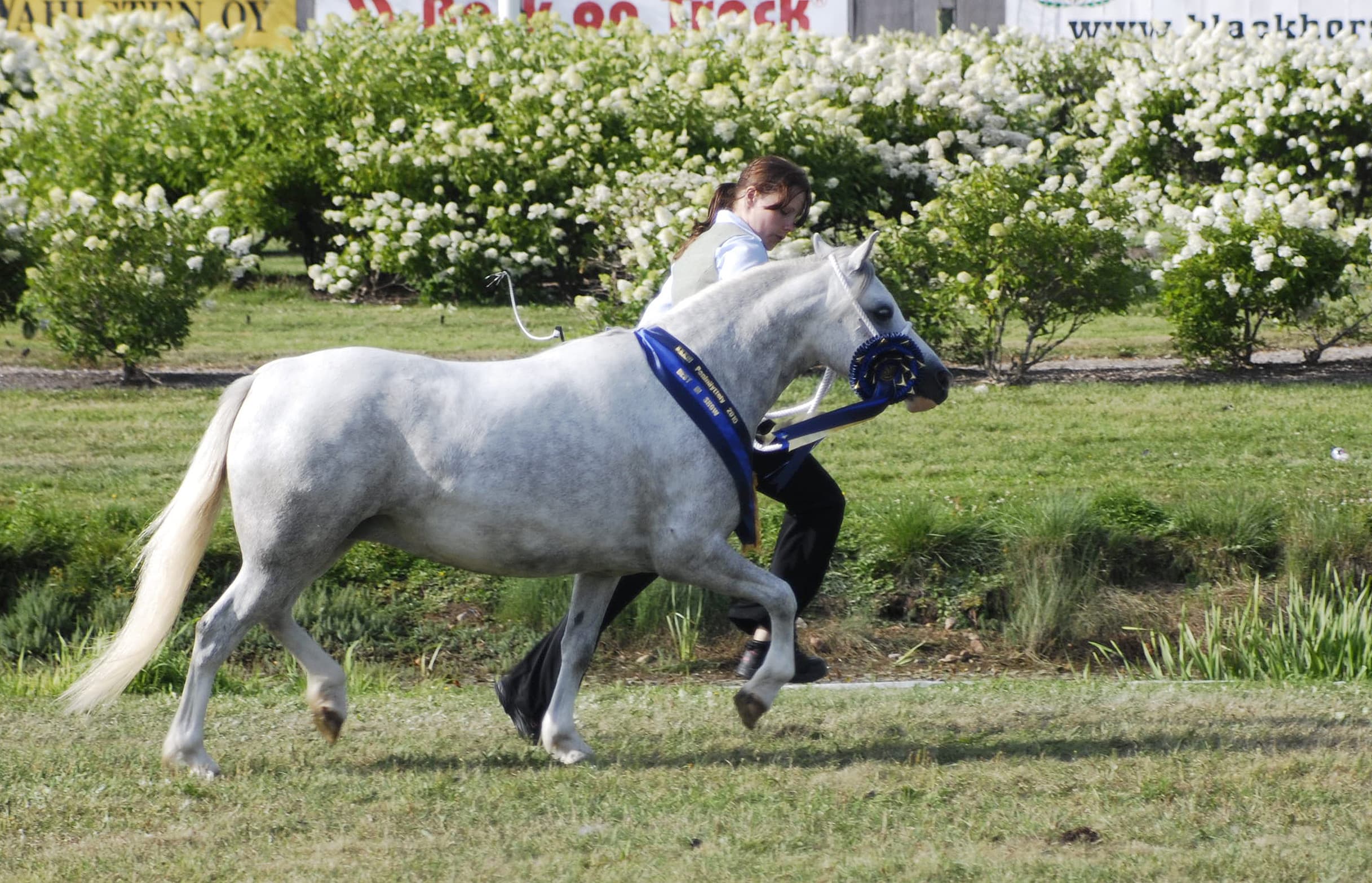
Moondelight Marilyn, a three-year-old grey Welsh Mountain mare, shown at Vermo, Finland, on 1 August 2010.

The Welsh Mountain Pony: From Welsh uplands to the Welsh Stud Book
The Welsh Mountain Pony: a pony shaped by upland breeding
The Welsh Mountain comes from the mountainous areas of Wales, where breeders maintain herds that spend much of the year on open grazing. Breeding for a sound, mobile pony able to thrive in these conditions helped shape its type. Mountain refers to this homeland; it does not mean that every modern Section A pony lives in a semi-feral herd.
The Welsh Mountain Pony: 1901–1902: recording families and organising breeding
The Welsh Pony and Cob Society, or WPCS, was founded in 1901 and published the first volume of its studbook in 1902. The register connected ponies and cobs to their parents and provided a framework for breeding. The Mountain Pony occupied Section A. Descriptions and height limits subsequently changed, so the earliest sections should not be read as exact equivalents of those used today.
The Welsh Mountain Pony: Historic crosses and breeding within the registered population
The WPCS records the introduction of Arabian and Thoroughbred bloodlines in the nineteenth century, before the studbook was established. These crosses contributed to changes in type. Today, a Section A foal must have two parents already registered in Section A. Upland herds and show studs share a broader history while retaining different management practices and families.
Sources for this section: WPCS · history [3] · WPCS · Section A [2]
The Welsh Mountain Pony: Section A type and its upper height limit
The Welsh Mountain Pony: a small head and a well-carried neck
The WPCS breed description sets out the features breeders seek: a small, clean-cut head tapering towards the muzzle, bold eyes and small pointed ears. The neck should be long and well carried; a mature stallion may develop more crest. The overall impression should retain pony character, presence and spirit.
The Welsh Mountain Pony: Strength through the body and free movement
The back and loins should be muscular and well coupled, with a deep chest and well-sprung ribs. The description calls for long sloping shoulders, strong forearms, short cannon bones (the long bones above the fetlocks) and round feet with dense horn. Limbs should work straight, with the hocks flexing beneath the body. Movement is expected to be quick, free and energetic.
The Welsh Mountain Pony: 121.9 cm is a section limit, not an average
Under WPCS rules, Section A must not exceed 121.9 cm at the withers, or 12 hands. This is the section’s upper limit rather than an average height. A registered Section A pony that grows beyond it must transfer to Section B through the veterinary measurement procedure. Conversely, a small Section B pony cannot become Section A simply because of its height. In the United States, the WPCSA publishes a different Section A maximum of 127 cm (12.2 hands). This national rule does not replace the British 12-hand limit described here.
Sources for this section: WPCS · Section A [2] · WPCS · purebred rules [4] · WPCSA · uses and US height [1]
The Welsh Mountain Pony: Accepted colours and progressive greying
The Welsh Mountain Pony: a range of colours with a specific exclusion
The breed description accepts all colours except piebald and skewbald. WPCS registration terminology includes bay, chestnut, black, grey, roan and several diluted colours. White markings on the face and legs do not by themselves make a pony piebald or skewbald. The list describes registration possibilities; it does not measure their frequency within Section A.
The Welsh Mountain Pony: a grey pony may have been born dark
Progressive greying associated with STX17 gradually adds white hairs to the birth coat. A Welsh A born bay or chestnut can therefore look almost white as an adult. The grey test looks for the variants responsible for this change and helps breeders understand their inheritance. An adult photograph may no longer reveal the underlying base colour.
Sources for this section: WPCS · Section A [2] · UC Davis · grey [11]
The Welsh Mountain Pony: From earlier work to riding and driving
The Welsh Mountain Pony: Small ponies in the Welsh rural economy
Before motor vehicles, Welsh ponies carried people and goods and worked on farms; some also worked in mines. Their jobs depended on their size and strength. Military work or heavy draught described for the larger cobs should therefore not be assigned indiscriminately to the small Mountain Pony.
The Welsh Mountain Pony: Learning to ride, leisure and showing
Young riders use Welsh As in riding schools, on outings and in classes suited to their size. British showing includes lead-rein classes, where a handler accompanies the child, and first-ridden classes for independent riding. In-hand shows assess type, conformation and movement. They continue selection for breed characteristics, with a different purpose from showjumping or dressage.
The Welsh Mountain Pony: Driving provides another way to work with the pony
Welsh Mountains are also used in harness. One or more ponies pull a carriage for pleasure or in the relevant competitions, providing an activity that does not require riding them. In France, the Welsh assessment programme brings show and performance results together with evaluations of conformation, movement and temperament.
Sources for this section: WPCS · history [3] · WPCS · Section A [2] · AFPCW · breeding programme [8] · WPCSA · uses and US height [1]
The Welsh Mountain Pony: Section A, the other Welsh sections and Part-Breds
The Welsh Mountain Pony: A, B, C and D combine height, type and ancestry
The WPCS distinguishes the Mountain Pony in Section A, up to 121.9 cm, from the riding-type Welsh Pony in Section B, up to 137.2 cm. Section C is the more substantial Welsh Pony of Cob Type, also up to 137.2 cm; Section D is the Welsh Cob, exceeding 137.2 cm. These sections combine conformation and pedigree. They are not four height classes into which any pony can be placed.
The Welsh Mountain Pony: a Section A foal needs two Section A parents
The studbook records each animal’s identity and parentage. Both parents must already be registered in Section A for their foal to enter A. The WPCS mating table provides other combinations: A × B produces B, while A × D produces a cob-type foal registered in C. Recorded ancestry therefore matters as well as resemblance to the breed description.
The Welsh Mountain Pony: Welsh Part-Bred has separate crossbreeding rules
The Welsh Part-Bred studbook is separate and has no height limit. The WPCS rules consulted place animals with at least 75% registered, verifiable Welsh ancestry in its main section, subject to further pedigree requirements. A supplementary section accommodates animals reaching 25% under its criteria. A separate register for 12.5–25% provides competition recognition only, through an overstamp on a passport issued elsewhere. None of these crossbred categories confers Section A registration.
The Welsh Mountain Pony: the WPCS and national organisations
The WPCS maintains the British studbook of origin and recognises associations overseas. In France, the Association française du poney et cob Welsh, or AFPCW, leads the breeding programme, while IFCE handles SIRE procedures. Conformation, movement and performance labels provide information about breeding animals. They serve a different purpose from recording ancestry and from the British stallion licensing process.
The calculator’s Welsh Pony group does not specify a section
The Welsh Pony and Cob Society has four sections: A for the Welsh Mountain Pony, B for the Welsh Pony, C for the Welsh Pony of Cob Type and D for the Welsh Cob. The 2022 coat study uses Welsh Pony without detailing the horses’ sections. It would therefore be unjustified to assign every animal automatically to Section A or Section B. This profile covers only the Welsh Mountain Pony; the calculator’s data retain the scope of the published study group.
Sources for this section: WPCS · purebred rules [4] · WPCS · Part-Bred rules [5] · WPCS · overseas network [7] · AFPCW · breeding programme [8] · WPCSA · uses and US height [1] · Welsh Pony and Cob Society [12] · Avila et al. (2022) [13]
The Welsh Mountain Pony: International breeding and defined British figures
The Welsh Mountain Pony: From Welsh herds to overseas studs
Welsh Mountains are bred in the United Kingdom and in countries with Welsh organisations, including France, the Netherlands, Germany, North America, Australia and New Zealand. The WPCS network covers several sections and Part-Breds. The number of affiliated organisations cannot be used to count Section A ponies.
The Welsh Mountain Pony: an estimated 5,259 breeding females in 2025
The DEFRA dataset released on 17 July 2026 estimates 5,259 Welsh Mountain Section A breeding females in the United Kingdom for 2025. Its method counts females that produced at least one foal in the preceding ten years and were still alive at the end of the period, unless recorded as deceased. This is neither the number of mares foaling in 2025 alone nor the entire Section A population: males, youngstock and females that have never bred are excluded. It is not a worldwide total.
Sources for this section: WPCS · overseas network [7] · DEFRA · 2025 data [9]
The Welsh Mountain Pony: Family diversity and the purposes of DNA tests
The Welsh Mountain Pony: the study published by Winton and colleagues in 2013
The researchers compared registered Welsh As and Ds, Connemaras, Highlands and free-living Carneddau ponies. For Section A, 48 ponies were examined at 17 microsatellite markers, short DNA sequences that vary between animals. Mitochondrial DNA, inherited through the mother, was studied in 47 Section As; the genome-wide single-base-marker analysis used 12. The registered animals represented different bloodlines, with siblings avoided during sampling.
The Welsh Mountain Pony: Related to the Carneddau, while remaining distinct groups
The analyses placed Carneddau ponies close to Section As but still distinguished the two groups. Some maternal lineages and genetic profiles in the Carneddau reflect their own population history. Living nearby and looking similar are therefore insufficient reasons to merge every mountain pony into Section A. These samples describe the genetic structure investigated in 2013; they do not measure current disease frequencies throughout the breed.
The Welsh Mountain Pony: DNA parentage testing supports reliable pedigrees
A laboratory compares markers from the foal with those of its declared parents to check that they are compatible. Since 2016, the WPCS has required a mare’s DNA profile when registering her first purebred foal. Stallions born from 2025 onwards require verification against both parents before licensing; older males fall under the published transitional provisions. Late registrations and certain reproductive techniques have additional requirements. Parentage and colour tests answer different questions: who the parents are, and which colour variant an animal may pass on.
Sources for this section: Winton et al., 2013 [10] · WPCS · DNA and licensing [6] · UC Davis · grey [11]
Sources and updates
Profile updated on .
The Welsh Pony and Cob Society (WPCS) documents explain British rules for the Welsh Mountain. In France, registration procedures involve the French breed association, AFPCW, and IFCE. Breeding statistics and research findings identify the countries, years and groups of ponies they cover.
- WPCSA — Section A Welsh Pony
Riding and driving uses; the US maximum of 12.2 hands differs from the British WPCS limit of 12 hands. Prehistoric ancestry narratives are not used.
- WPCS — Welsh Mountain Pony, Section A
Current description: type, 121.9 cm limit, colours and ridden uses.
- WPCS — History
Foundation in 1901, first studbook in 1902, changing sections and earlier uses. Prehistoric ancestry narratives are not used.
- WPCS — Welsh Pure Bred Rules of Registration
Document linked by the WPCS on the review date: sections and mating table, pages 9–10. No unsupported edition date is assigned.
- WPCS — Welsh Part-Bred Rules of Registration
Main and supplementary sections, competition register and ancestry percentages, pages 8–12.
- WPCS — DNA and Stallion Licencing
Mare profiles since 2016, parentage checks, special cases and changes for males born from 2025.
- WPCS — Overseas Associations
National organisations and the distinct role of the parent society.
- AFPCW — Programme de sélection
French assessment of conformation, movement, temperament, showing and performance.
- DEFRA — UK FAnGR breed inventory, 2025 data released on 17 July 2026
5,259 estimated UK breeding females: CSV row for Welsh Mountain Pony (Section A), fempop, 2025. The notice explains the ten-year method.
- Winton et al. (2013) — Genetic diversity and phylogenetic analysis of native mountain ponies of Britain and Ireland reveals a novel rare population
Ecology and Evolution, 3, 934–947, DOI 10.1002/ece3.507; author proof held by Aberystwyth. Methods and Table 1: 48, 47 or 12 Section As depending on analysis.
- UC Davis VGL — Gray Copy Number
STX17-related progressive greying and the purpose of colour testing; no frequency extrapolated to Section A.
- Welsh Pony and Cob Society
Names, registry scope and membership requirements.
- Avila et al. — Genes, 2022
Avila and colleagues (2022): coat variants, sample sizes before and after removing close relatives, and limitations of the laboratory sample.