
Breeds · breed profile
Vercors de Barraquand horse
The Vercors de Barraquand horse, a mountain horse shaped by the Barraquand family
The Vercors de Barraquand is a compact bay horse with an abundant mane and tail. Its history is linked to seasonal movements between the Vercors and the Crau plain. To conserve this small population, breeders develop leisure uses and track relationships between families. Breeding rules also require a test for PSSM1, a condition that can impair muscle function.
- Category
- Horse
- Country of origin
- France
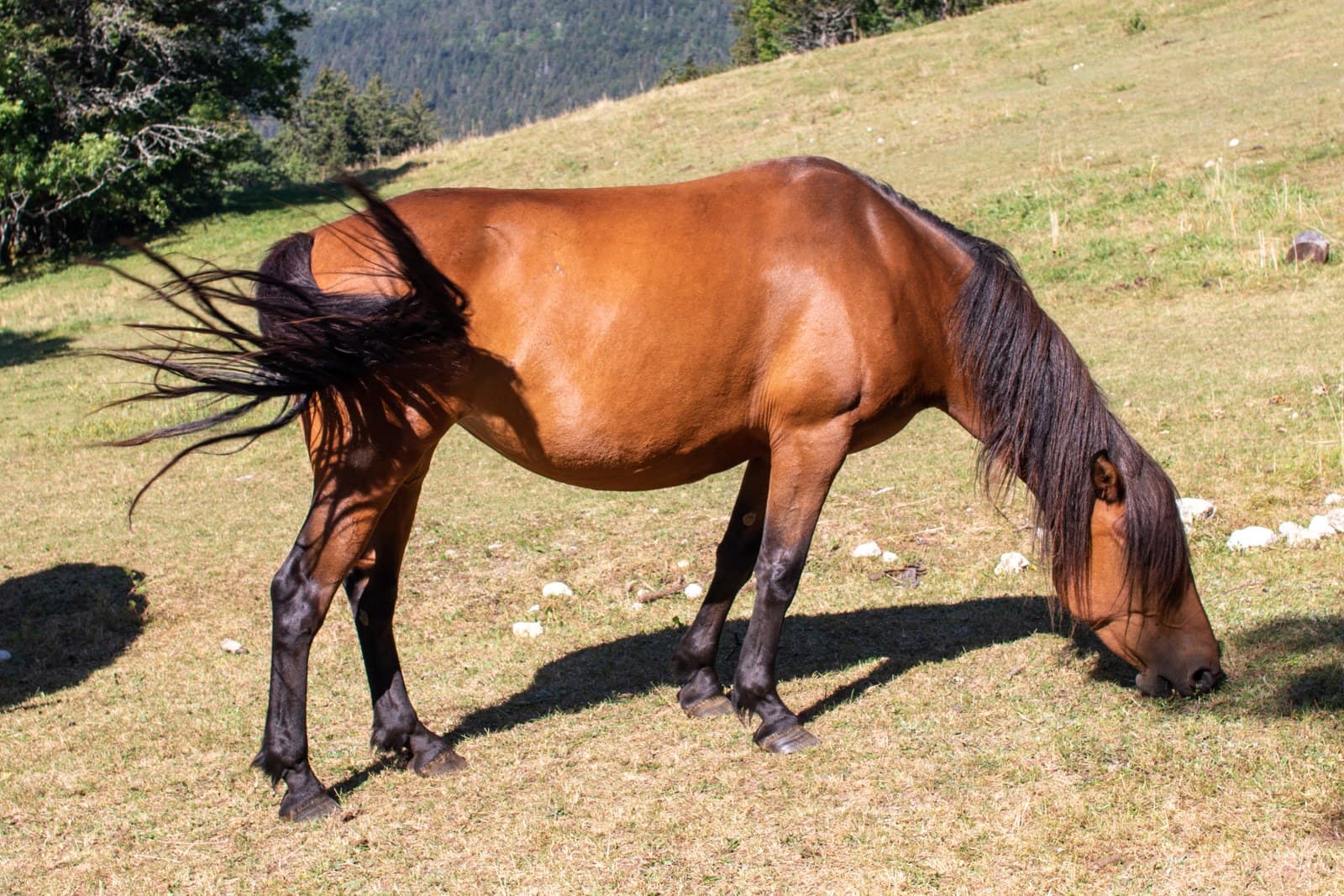
A Vercors de Barraquand horse grazing in mountain pasture.

The Vercors de Barraquand horse: the Barraquand herd and seasonal migration
The Vercors de Barraquand horse: Between the Vercors and the Crau
From the late nineteenth century, the Barraquand family developed a herd that spent winters on the Crau plain and summers in the Vercors. Seasonal migration between these complementary environments began in 1908. The horses worked in agriculture and transport. After the decline of animal traction, conservation and rebuilding of the population eventually led to recognition of the breed in 2017.
Sources for this section: ANCVB [1]
The Vercors de Barraquand horse: a compact horse for outdoor work
The Vercors de Barraquand horse: the build described by the Vercors standard
Association nationale du cheval du Vercors de Barraquand (ANCVB) describes the desired traits of the Vercors de Barraquand horse in its breeding programme. This document guides the choice of breeding animals. The programme gives a height of 1.45–1.55 m and a weight of 450–550 kg. A broad forehead, muscular neck, short strong back and loin, and sturdy limbs form the selected type. Feet are small with black horn. The mane and tail are abundant and may be wavy. Movement should remain energetic and supple, with conformation assessed for its practical function.
Sources for this section: ANCVB [1]
The Vercors de Barraquand horse: Bay coats with little white
The Vercors de Barraquand horse: Visible features and colour-test results
The Vercors de Barraquand horse breed standard accepts different shades of bay and strongly restricts white markings, especially on the legs. Hooves should be black. Extension and Agouti test results are required for certain breeding and registration procedures. These analyses identify coat variants that may not be apparent from appearance alone; they provide information beyond simply recording the colour visible on the horse.
Sources for this section: ANCVB [1]
The Vercors de Barraquand horse: Trail riding, driving and land management
The Vercors de Barraquand horse: Uses that support a regional breed
The Vercors horse is promoted for trail riding, driving and work suited to its build. Outdoor breeding is also connected with pastoral land use. The programme links conservation with assessment of practical handling: stallion candidates must complete an appropriate young working-equid performance test, known as PEJET, from age three. Practical aptitude therefore accompanies the assessment of type.
Sources for this section: ANCVB [1]
The Vercors de Barraquand horse: Studbook entry and breeding approval
The Vercors de Barraquand horse: a commission assesses eligible horses
The studbook is the register that records the identity and ancestry of animals admitted to the breed. The Association nationale du cheval du Vercors de Barraquand, or ANCVB, organises stallion approval and mare confirmation. The 2023 rules provide registration by descent and controlled initial-entry procedures. Castillonnais stallions may also be approved for one breeding season, with possible renewal. Assessment covers conformation, aptitude and the documentary and genetic conditions applying to the particular procedure.
Sources for this section: ANCVB [1]
The Vercors de Barraquand horse: Renewing a small population
The Vercors de Barraquand horse: 35 births reported for 2023
The October 2023 programme reports 35 births for 2023, following 24 in 2022. This annual record should not be confused with a census of all living horses. Breeding is concentrated in Auvergne-Rhône-Alpes and Provence-Alpes-Côte d’Azur. Maintaining several breeding families and uses that encourage the retention of young horses are important parts of conservation.
Sources for this section: ANCVB [1]
The Vercors de Barraquand horse: PSSM1 in Vercors breeding selection
The Vercors de Barraquand horse: PSSM1 testing and breeding approval
The PSSM1 test detects a GYS1 variant that can disrupt energy storage in muscle. One copy can contribute to muscle disease, with variable expression between horses. The rules require a result for future breeding animals and exclude stallion candidates carrying two copies. A test exemption is possible when both parents are documented as clear, subject to certification by the commission.
The Vercors de Barraquand horse: PSSM1 results for 136 horses tested by March 2023
The Vercors de Barraquand horse breeding programme records 136 horses tested by March 2023: 69 without the variant, 59 with one copy and 8 with two copies. These figures describe the group studied within the breeding initiative. They are not a probability to assign to every Vercors horse. A negative PSSM1 result also does not exclude other causes of muscle pain.
Sources for this section: ANCVB [1] · UC Davis VGL [2]
Sources and review date
Profile reviewed on .
The documents below were used to prepare this profile of the Vercors de Barraquand horse. They explain which animals can enter the studbook and how breeding animals are selected.
- ANCVB — Studbook rules and breeding programme, October 2023
October 2023 programme: history, 35 births in 2023, PSSM1 rules and results for 136 horses tested by March 2023.
- UC Davis VGL — PSSM1 testing
The GYS1 variant, dominant inheritance and result interpretation; this source is not used to infer a current breed frequency.