
Breeds · breed profile
The French Trotter
Trotteur Français · TF
The French Trotter is bred to race at speed while maintaining a trot, either pulling a sulky, a light two-wheeled vehicle, or carrying a jockey. Its history is tied to Normandy's races and selection through performance. Some horses later move into leisure riding or sport after appropriate retraining.
- Category
- Horse
- Country of origin
- France
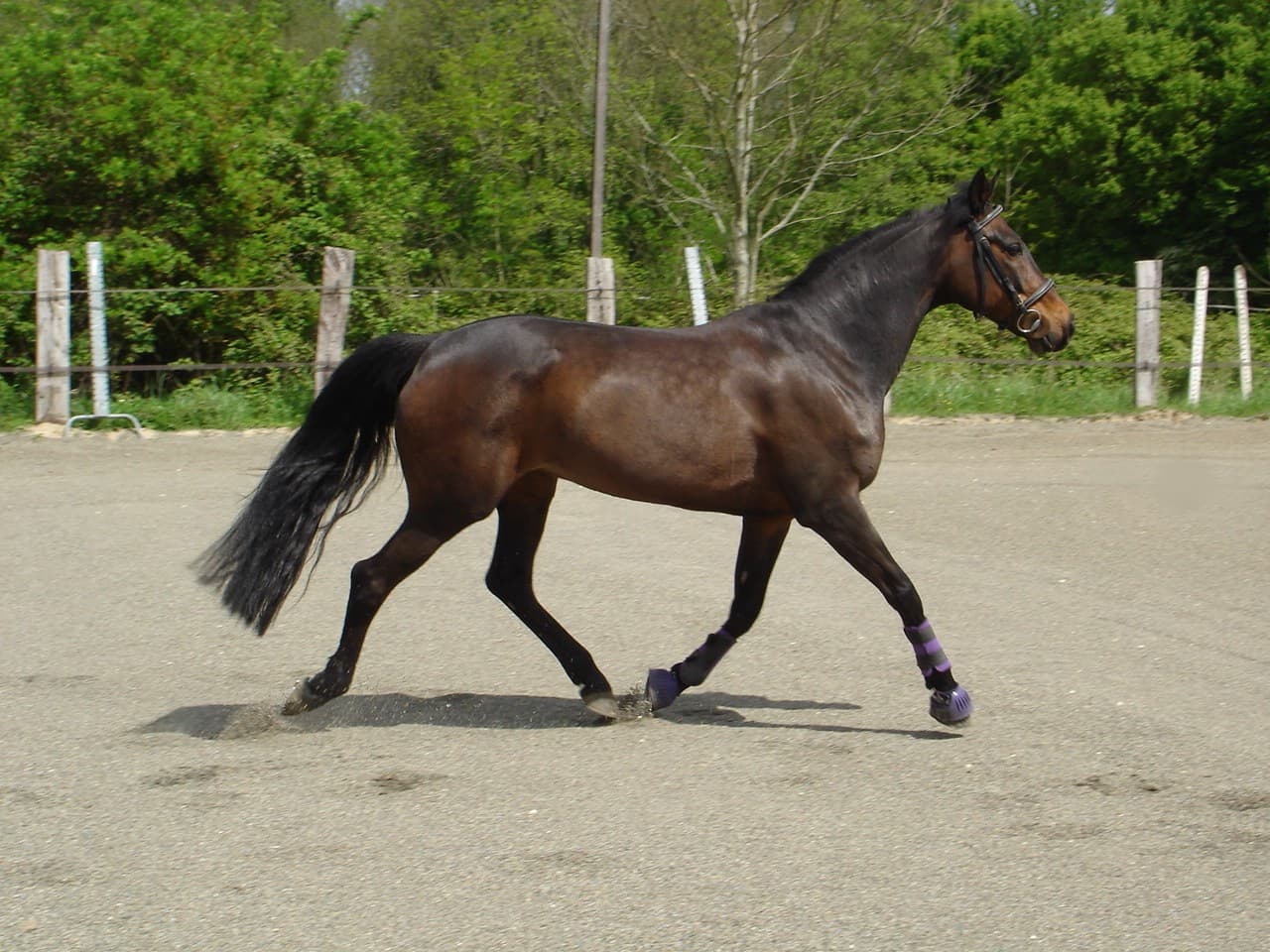
A French Trotter mare trotting in an arena.

The French Trotter: From Norman horses to trotting races
The French Trotter: Crosses selected for trotting speed
Breeders used Norman horses, introducing Thoroughbreds, British trotters and later other trotting lines, including American stock. Performance at the trot increasingly guided breeding choices. These historical contributions do not mean that any cross is permitted in today's studbook.
The French Trotter: Cherbourg and the organisation of racing
Races held at Cherbourg in 1836, promoted by Éphrem Houël and the municipality, are a landmark in this history. They allowed horses to be compared at the same gait. The society founded at Caen in 1864 was the predecessor of today's French Trotter breeding organisation.
The French Trotter: Using a racing career to inform breeding
Qualifying trials and races provide repeated information about speed, consistency of gait and career length. Today's programme seeks better performance and longevity while retaining genetic diversity. A horse's own results and the qualities it may pass to offspring are related but distinct measures.
Sources for this section: SETF [1]
French Trotter conformation
The French Trotter: a build suited to sustained effort
Société d’encouragement à l’élevage du Trotteur Français (SETF) describes the desired traits of the French Trotter in its breeding programme. This document guides the choice of breeding animals. SETF describes a long, muscular neck, prominent withers, well-developed back and loins, and a long, powerful croup. The chest is deep and the limbs strong. Differences between horses used in ridden and harness racing also reflect the different demands of those activities.
The French Trotter: a descriptive range rather than an entry threshold
The French Trotter breeding programme describes a usual height of 1.60–1.70 m at the withers, with some taller horses. This is not an exclusion threshold for registration. Function at the trot remains central, and selection gives considerable weight to performance and the requirements for breeding animals.
Sources for this section: SETF [1]
French Trotter coat colours
The French Trotter: Chestnut, bay and darker shades
The French Trotter breeding programme mainly describes chestnut, bay and dark bay or brown coats, sometimes with white markings on the head and legs. Grey is described as very rare. This account does not provide colour percentages measured in a recent population sample.
The French Trotter: Colour contributes to identification
Visible features are recorded when the foal is identified and microchipped. They help match the animal to its documents. They do not replace DNA parentage checks or assessment of its eligibility for the TF studbook.
Sources for this section: SETF [1]
The French Trotter: Trotting races and life after racing
The French Trotter: Two forms of trotting race
In harness racing, a driver controls the horse from a sulky. In ridden trotting races, a jockey sits on the horse. Both require the prescribed gait to be maintained. Before entering races, a horse must pass a qualifying trial, a timed test governed by the discipline's rules.
The French Trotter: a new activity involves new learning
SETF supports retraining associations, including Passerelle. Moving from racing to leisure riding involves learning different responses to the aids, balance and exercises. Preparation, physical condition and the rider's experience guide the choice of activity and workload.
Sources for this section: SETF [1] · SETF, 2026 [3]
French Trotter registration and breeding
The French Trotter: SETF maintains the original studbook
The Société d'encouragement à l'élevage du Trotteur Français, or SETF, runs the programme and delegates procedures to IFCE. Registration by descent requires an approved sire and a registered, confirmed dam eligible to breed and not suspended for that year. At least one parent must itself have two parents registered in the TF studbook at birth.
The French Trotter: Identifying the foal and checking ancestry
Birth notification, identification alongside the biological dam before weaning, and microchipping are required procedures. Parentage verification compares the foal's DNA with that of its recorded parents. Registration requires compatible results; trotting speed cannot establish parentage.
The French Trotter: Reproductive techniques have specific rules
The 2026 regulations allow, among other methods, insemination with fresh semen used immediately. Transport, chilling, freezing and embryo transfer are subject to specific restrictions and exemptions. The articles relevant to a proposed mating therefore need to be checked, as sport-horse studbook practices cannot simply be transferred to the TF.
Sources for this section: SETF [1]
French Trotter breeding and dated figures
The French Trotter: Normandy within a wider breeding network
Normandy remains an important centre, alongside breeders in other French regions. Horses also race and breed abroad. The programme distinguishes French activity from horses born and raised overseas, so the geographical scope matters when reading its figures.
The French Trotter: 9,057 registered foals for 2022
The table compiled as of 1 June 2023 records 9,057 foals for 2022, excluding TF horses born and raised abroad. It also lists 12,742 mares covered by TF stallions that year. These activity measures are neither a count of horses alive in 2026 nor a worldwide population total.
Sources for this section: SETF [1]
The French Trotter: DMRT3 and research into trotting performance
The French Trotter: Comparing DNA with racing careers
Anne Ricard's 2015 study examined a DNA marker closely linked to DMRT3, a gene involved in gait coordination. It retained 630 French Trotters born between 1996 and 2008. Samples came from an osteochondrosis study that recruited horses through veterinary centres and clinics in 2008–2010.
The French Trotter: Age and sample selection affect the findings
In this study, horses with two different versions of the marker did slightly less well in qualification, but had higher earnings per race as adults than horses with two copies of the other version. Qualified and successful horses were overrepresented in the sample. The findings help explain selection across ages and racing conditions; this marker alone cannot predict a foal’s career.
Sources for this section: Ricard, 2015 [2]
Sources and review date
Profile reviewed on .
The SETF programme published in January 2026 includes the 2026 breeding regulations and historical tables compiled as of 1 June 2023. The DMRT3 paper is an original study published in 2015.
- TF selection programme and 2026 breeding regulations
Origins, conformation, registration, reproduction and French 2022 statistics compiled as of 1 June 2023.
- Does heterozygosity at the DMRT3 gene make French trotters better racers?
Original study: 630 genotyped horses, recruitment in 2008–2010 and associations between marker, age and performance.
- Renewed support for retraining associations, 18 March 2026
SETF support for trotters' second careers.