
Breeds · breed profile
The Thoroughbred
Thoroughbred · English Thoroughbred
The Thoroughbred developed in England through selection for gallop racing. Bred in many countries today, it is recorded in studbooks that share international rules. Its name identifies this particular breed, rather than simply any purebred horse. After racing, some Thoroughbreds go on to other riding careers.
- Category
- Horse
- Country or region of origin
- United Kingdom
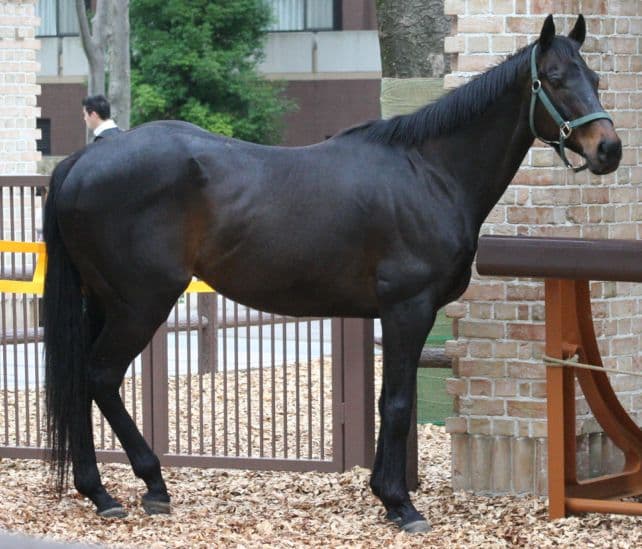
Winning Ticket, a Japanese Thoroughbred, at Tokyo Racecourse on 22 April 2007.

The Thoroughbred: the development of a racehorse breed in England
The Thoroughbred: Selecting through racing performance
During the seventeenth and eighteenth centuries, English breeders crossed local mares with stallions imported from the Middle East and North Africa. Racing compared speed and stamina over distance and helped determine which horses would breed. The breed developed gradually from these horses and their descendants. “English” refers to its historical homeland, even when a Thoroughbred is born in France, Japan or Australia today.
The Thoroughbred: Sire lines and mare families
The Byerley Turk, Darley Arabian and Godolphin Arabian occupy a major place in pedigrees. Their male lines continue through Herod, Eclipse and Matchem respectively. A male line follows a father, his father and so on through the generations. It is only one route through a pedigree: other foundation stallions and mare families also contributed to the breed's genetic heritage.
The Thoroughbred: From collecting pedigrees to the General Stud Book
James Weatherby compiled pedigrees and published an introduction to the General Stud Book in 1791, before the first volume in 1793. The studbook allowed ancestry to be followed across generations and supported the definition of the breed. Weatherbys still maintains the General Stud Book for Great Britain and Ireland. The register includes ancestors that have died: it traces families rather than directly counting living horses.
The Thoroughbred: Expansion into other breeding countries
Exports of breeding stock and the growth of racing spread Thoroughbreds to continental Europe, the Americas, Oceania, Africa and Asia. The French studbook opened in 1834. International travel for racing and breeding subsequently became an important part of the industry. This movement explains the need for compatible national studbooks able to exchange verified identities and pedigrees.
Sources for this section: France Galop · programme [2] · Weatherbys · General Stud Book [1]
The Thoroughbred: a build shaped by racing
The Thoroughbred: a sporting objective rather than one fixed type
The French Thoroughbred breeding programme seeks sound, well-conformed horses that perform well in gallop races. It explains that the breed has no single conformation standard: build varies with the intended speciality. A sprinter is selected for shorter races, while a stayer sustains effort over longer distances. Soundness of the locomotor system and career longevity also inform breeding choices.
The Thoroughbred: the build and movement breeders seek
The Thoroughbred breeding programme describes a rangy horse, a refined, generally straight-profiled head, a long neck and prominent withers. The chest is deep and the hindquarters muscular. Well-aligned limbs, sound joints and functional feet support effective, repeatable movement. Racing results assess that conformation under physical effort; an in-hand show does not replace this performance selection.
The Thoroughbred: Descriptive heights in the French programme
The Thoroughbred breeding programme published in 2025 gives a usual reference of 1.60–1.65 m and a wider range of 1.52–1.72 m at the withers. These describe horses encountered, rather than a measured mean from a sample supplied in the document. Registration conditions do not turn these figures into height limits. Parentage and reproductive rules determine eligibility for the studbook.
Sources for this section: France Galop · programme [2]
Thoroughbred coat colours
The Thoroughbred: Colours without a prescribed selection target
The French Thoroughbred breeding programme mainly describes bay, brown, chestnut, black and grey, without selecting for a particular colour. White markings also help describe and identify individual horses. This account does not give percentages for each colour. Coat and markings are recorded in the foal's identification details and checked against parentage where a case requires it.
The Thoroughbred: a coat that may lighten with age
A grey Thoroughbred can be born dark and develop increasing numbers of white hairs. Greying associated with STX17 changes visible colour throughout life. It differs from white markings and variants that produce white at birth. A laboratory may test a coat variant to address an identification or inheritance question; that is a different purpose from verifying the parents.
Sources for this section: France Galop · programme [2] · UC Davis · grey [11]
The Thoroughbred: Racing, retraining and crossbreeding
The Thoroughbred: Flat and jump racing
Flat racing compares horses over different distances and surfaces. Jump racing includes hurdles and steeplechases, involving different kinds of obstacles. Breeders choose parents using their careers, ancestry and the performance of their offspring. Results therefore need to be read within a particular speciality and level of competition.
The Thoroughbred: Preparing for a new riding career
After racing, some Thoroughbreds move into dressage, showjumping, eventing, polo or leisure riding. In Britain, Retraining of Racehorses provides training and competition opportunities to support that transition. Retraining develops new skills: working at the pace requested, balancing through figures and approaching different obstacles. Preparation takes account of the horse's previous experience and the intended activity.
The Thoroughbred: an influence in other populations
Thoroughbreds are also used in crosses for riding and sport. In France, Thoroughbred mares produce offspring for studbooks including Anglo-Arabian and Selle Français, subject to those studbooks' rules. A crossbred offspring may therefore belong to another breed or category. Having one Thoroughbred parent is insufficient for registration in the Thoroughbred studbook.
Sources for this section: France Galop · programme [2] · RoR · retraining [6]
The Thoroughbred: National studbooks with shared requirements
The Thoroughbred: ISBC and the registering authorities
The International Stud Book Committee, or ISBC, sets the requirements for approving Thoroughbred studbooks and monitors their application. National authorities register horses born in their territory and exchange certificates for international movements. Weatherbys serves Great Britain and Ireland; France Galop is the French breeding organisation, with IFCE's SIRE identification procedures. ISBC coordinates this network of approved studbooks.
The Thoroughbred: Identifying a foal and verifying its parents
The birth file links a foal to a covering and to parents registered under the studbook's rules. Markings, a microchip and a DNA profile contribute to identification. For parentage verification, a laboratory compares the foal's markers with those of the declared mare and stallion. This can identify incompatible parentage before the pedigree is entered in the register.
The Thoroughbred: Breeding through natural service
ISBC requirements specify conception by natural service and gestation by the mare in which conception occurred. Artificial insemination, embryo transfer and cloning are excluded from Thoroughbred registration. Two Thoroughbred parents are therefore insufficient if the reproductive method fails these conditions. Covering certificates and birth declarations also document compliance with the rules.
Sources for this section: Weatherbys · General Stud Book [1] · ISBC · organisation [3] · ISBC · 2024 requirements [4] · France Galop · programme [2]
The Thoroughbred: Distribution and annual breeding output
The Thoroughbred: Breeding populations connected by movement
Thoroughbreds are bred in the major racing regions: Europe, the Americas, Australasia, Japan and other Asian countries, as well as South Africa. Movement of mares and stallions connects these populations. ISBC publishes statistics collected from approved studbooks, allowing annual output to be compared rather than adding every age of horse in their archives.
The Thoroughbred: 79,625 registered foals for 2025
The ISBC world series consulted on 7 November 2026 lists 79,625 registered Thoroughbred foals for 2025, compared with 82,466 for 2024. These are annual foal crops reported by approved studbooks, according to the series available on the consultation date. They represent neither the world's living population nor the number in training. Late reports or corrections can alter registry series.
Sources for this section: ISBC · organisation [3] · ISBC · global foal crops [5]
The Thoroughbred: What DNA studies can explain
The Thoroughbred: Following relationships across the genome
In 2020, McGivney and colleagues analysed 10,118 Thoroughbreds, including 305 stallions, from major breeding regions. DNA markers revealed increasing inbreeding; detailed annual analysis concerned horses born between 1996 and 2017, with earlier years less well represented. Long stretches where both DNA copies are identical reveal shared ancestors. Samples included submissions for commercial testing, with some farms more represented than others: the findings support diversity monitoring rather than providing an individual health diagnosis.
The Thoroughbred: MSTN and race distance
In 2010, Hill and colleagues studied an initial group of 148 Thoroughbreds using samples collected in Ireland and New Zealand between 1998 and 2009. Among 79 elite winners with the required data, a marker in MSTN, the myostatin gene, was associated with the distance of their best race. Myostatin contributes to muscle development. Testing informs a relative predisposition towards distance; the study did not show that genotype alone identifies a future winner. Training, other genes and physical condition also contribute to performance.
The Thoroughbred: Two documented recessive conditions
Equine familial isolated hypoparathyroidism, or EFIH, disrupts calcium regulation and causes fatal muscle contractions and seizures in affected foals. A RAPGEF5 variant has been identified. Fragile foal syndrome, or FFS, associated with a PLOD1 variant, affects connective tissues and may cause extremely fragile skin and excessively mobile joints. Tests look for these variants to identify unaffected breeding carriers and avoid mating two carriers of the same condition.
The Thoroughbred: an American sample and its limits
An Elcombe and colleagues study, published online in 2022 and in a journal volume in 2023, tested 1,789 US Thoroughbreds born between 1988 and 2019. It identified 28 EFIH-variant carriers and 25 FFS-variant carriers. Samples had been archived during parentage testing, so foals dying before registration are poorly represented or absent. These counts describe the tested horses rather than today's worldwide disease frequency or losses at birth.
The Thoroughbred: Match the analysis to the question
Parentage verification checks the declared parents; EFIH or FFS testing looks for a disease-associated variant; MSTN analysis examines a sporting predisposition. The purposes are different. International identification requirements do not make all of these health or performance tests compulsory. For breeding, mare and stallion results are considered together with the applicable rules and family history.
Sources for this section: McGivney et al., 2020 [7] · Hill et al., 2010 [8] · Elcombe et al., 2022/2023 [9] · Rivas et al., 2020 [10] · ISBC · 2024 requirements [4]
Sources and update
Profile updated on .
Weatherbys, ISBC and France Galop documents explain studbook organisation and selection. The scientific publications distinguish genetic relationships, associations with race distance and disease-associated variants.
- Weatherbys — About us and our history
Pedigree recording since 1791 and management of the General Stud Book in Great Britain and Ireland today.
- France Galop — Thoroughbred breeding programme, published by IFCE in 2025
History, the first 1793 volume, French studbook of 1834, conformation, descriptive heights, uses and French rules; older internal statistics retain their dates.
- International Stud Book Committee — Introduction
Coordination and approval of national Thoroughbred studbooks.
- ISBC — Requirements and Guidelines, October 2024
Studbook approval, natural service, identification and DNA parentage validation.
- ISBC — Resources: Thoroughbred horse statistics
World series consulted on 7 November 2026: 79,625 registered foals for 2025 and 82,466 for 2024, rather than living population totals.
- Retraining of Racehorses — Training and competitions
Training and disciplines for Thoroughbreds after racing.
- McGivney et al. (2020) — Genomic inbreeding trends, influential sire lines and selection
Scientific Reports, 10, 466. 10,118 Thoroughbreds, including 305 stallions; detailed annual analysis of 1996–2017 birth cohorts.
- Hill et al. (2010) — A Sequence Polymorphism in MSTN Predicts Sprinting Ability and Racing Stamina
PLOS ONE, 5, e8645. Initial group of 148; distance association in 79 elite winners. Methods and the 2010 correction are available on the page.
- Elcombe et al. — RAPGEF5 and PLOD1 variants in US Thoroughbreds (1988–2019)
Equine Veterinary Journal, 55, 666–671; online in 2022, journal volume 2023. 1,789 horses tested, 28 EFIH and 25 FFS carriers.
- Rivas et al. (2020) — RAPGEF5 and equine familial isolated hypoparathyroidism
PLOS Genetics, 16, e1009028. Variant identification, clinical cases and functional investigation.
- UC Davis VGL — Gray copy number
Progressive greying, STX17 and the distinction from white present at birth.