
Breeds · breed profile
Tennessee Walking Horse
The Tennessee Walking Horse is known for its four-beat running walk
The Tennessee Walking Horse developed in central Tennessee. Its best-known gait is the running walk, a four-beat movement faster than an ordinary walk, with the hind feet stepping beyond the tracks of the forefeet. A rhythmic head movement accompanies the stride. This gait contributed to the breed’s reputation as a comfortable mount for travel and trail riding.
- Category
- Horse
- Country of origin
- United States
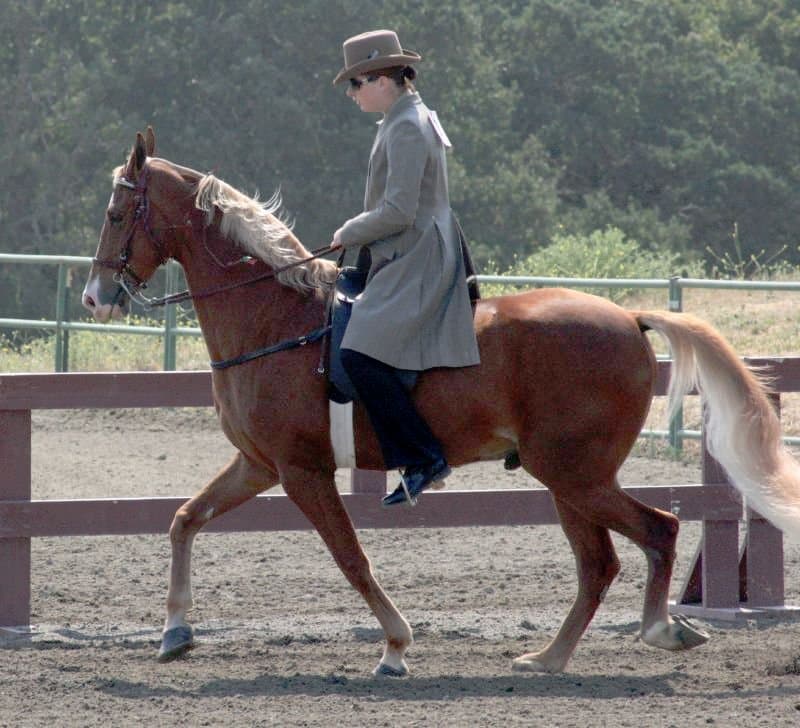
A Tennessee Walking Horse photographed outdoors.

Tennessee Walking Horses developed from practical saddle-horse breeding
The breed formed in central Tennessee from several backgrounds, including Standardbred, Morgan, Thoroughbred and American Saddlebred ancestry. Breeders wanted useful horses that could carry riders comfortably. Selection retained distinctive gaits, including the running walk. The breed association founded in 1935 subsequently organised registration. This history explains why Tennessee Walking Horses share ancestry with other American breeds while maintaining a separate registry. Shared foundation influences do not make their present-day registration rules or populations identical.
Sources for this section: TWHBEA [1] · Walking Horse Owners Association [2]
The Tennessee Walking Horse’s running walk differs from a trot
During the running walk, all four feet land separately in a regular sequence. The hind feet pass the tracks left by the forefeet, and the head moves with the rhythm. The feet therefore do not land in pairs as they do at the trot. TWHBEA describes a usual height range of 14.3 to 17 hands, approximately 1.50 to 1.73 m at the withers. This describes the breed’s range, rather than promising identical size, stride length or comfort in every individual.
Sources for this section: TWHBEA [1] · Walking Horse Owners Association [2]
Tennessee Walking Horses have many coat colours
The population includes base colours as well as several dilutions and white patterns. The breed name therefore does not predict one particular appearance. Similar-looking colours can result from different mechanisms: diluted pigment is not the same process as the progressive appearance of white hairs with age. Coat tests look for the variants involved and help distinguish those mechanisms. Visual description, ancestry and individual DNA results provide complementary information about a horse’s colour and what it may transmit to a foal.
Sources for this section: TWHBEA [1] · Avila et al. (2022) [5] · Walking Horse Owners Association [2]
Tennessee Walking Horses are used for pleasure riding and gaited events
Trail and pleasure riding are important uses for Tennessee Walking Horses. Breed events also provide opportunities to observe their characteristic gaits. The running walk is a naturally occurring ability selected within the population; preparation develops rhythm, balance and responsiveness to the rider. When choosing a horse, watching it work in circumstances similar to its intended activity remains useful. A breed reputation for a comfortable ride does not replace observing the individual animal’s training and behaviour.
Sources for this section: TWHBEA [1] · Walking Horse Owners Association [2]
TWHBEA maintains the Tennessee Walking Horse registry
The Tennessee Walking Horse Breeders’ and Exhibitors’ Association records horses and their pedigrees. Its rules include identification procedures, declared parentage and DNA checks. The studbook allows recognised ancestry and descendants to be traced. A horse showing a gait similar to a running walk does not automatically qualify for registration. Its observed movement and its standing in the registry are different pieces of information. Registration records establish the recognised ancestry rather than relying on movement or appearance alone.
Sources for this section: TWHBEA [3]
The 2022 sample does not represent every Tennessee Walking Horse
Avila and colleagues had data from 340 Tennessee Walking Horses and retained 181 after removing close relatives. This reduces repeated representation of the same immediate families. However, the horses had been submitted for coat testing, not selected at random from the entire breed. The reported proportions therefore describe that group. They are not a census of living horses or annual TWHBEA registrations, and they should not be assumed to apply equally to every breeding line.
Sources for this section: Avila et al. (2022) [5] · TWHBEA [3]
DNA can help identify a registered horse without automatically assigning a breed
TWHBEA explains that a DNA profile can be compared with its database to seek a previously registered horse’s identity when its information is on file. That service cannot establish an unknown horse’s complete ancestry from appearance or a coat test alone. Colour tests answer a narrower question: which variants does the horse carry and potentially transmit? Calculator frequencies help when individual information is missing, but they do not replace parentage verification or registration documents.
Sources for this section: TWHBEA [4] · Avila et al. (2022) [5]
Sources and review date
Profile reviewed on .
Breed organisations document history, registration rules and uses. The 2022 study examined horses submitted for coat-colour testing; its results describe that sample, rather than a census of the breed.
- TWHBEA — The breed
Conformation, height and movement considered during assessments.
- Walking Horse Owners Association — The breed
Uses of the horses and activities offered by breed organisations.
- TWHBEA — Corporate rules
Registration requirements, studbook categories and verification of ancestry.
- TWHBEA — Adopted horses
What a DNA profile can and cannot establish when looking for a horse already in the registry.
- Avila et al. — Genes, 2022
Avila and colleagues (2022): coat variants, sample sizes before and after removing close relatives, and limitations of the laboratory sample.