
Breeds · breed profile
The Shire
Shire Horse · formerly English Cart Horse
The Shire is an English draught horse shaped by farming and the transport of heavy loads. Its height, powerful limbs and feathering recall that work. The Shire Horse Society (SHS) maintains the studbook of origin and supports international breeding in which preserving families matters alongside conformation and movement.
- Category
- Horse
- Country of origin
- United Kingdom
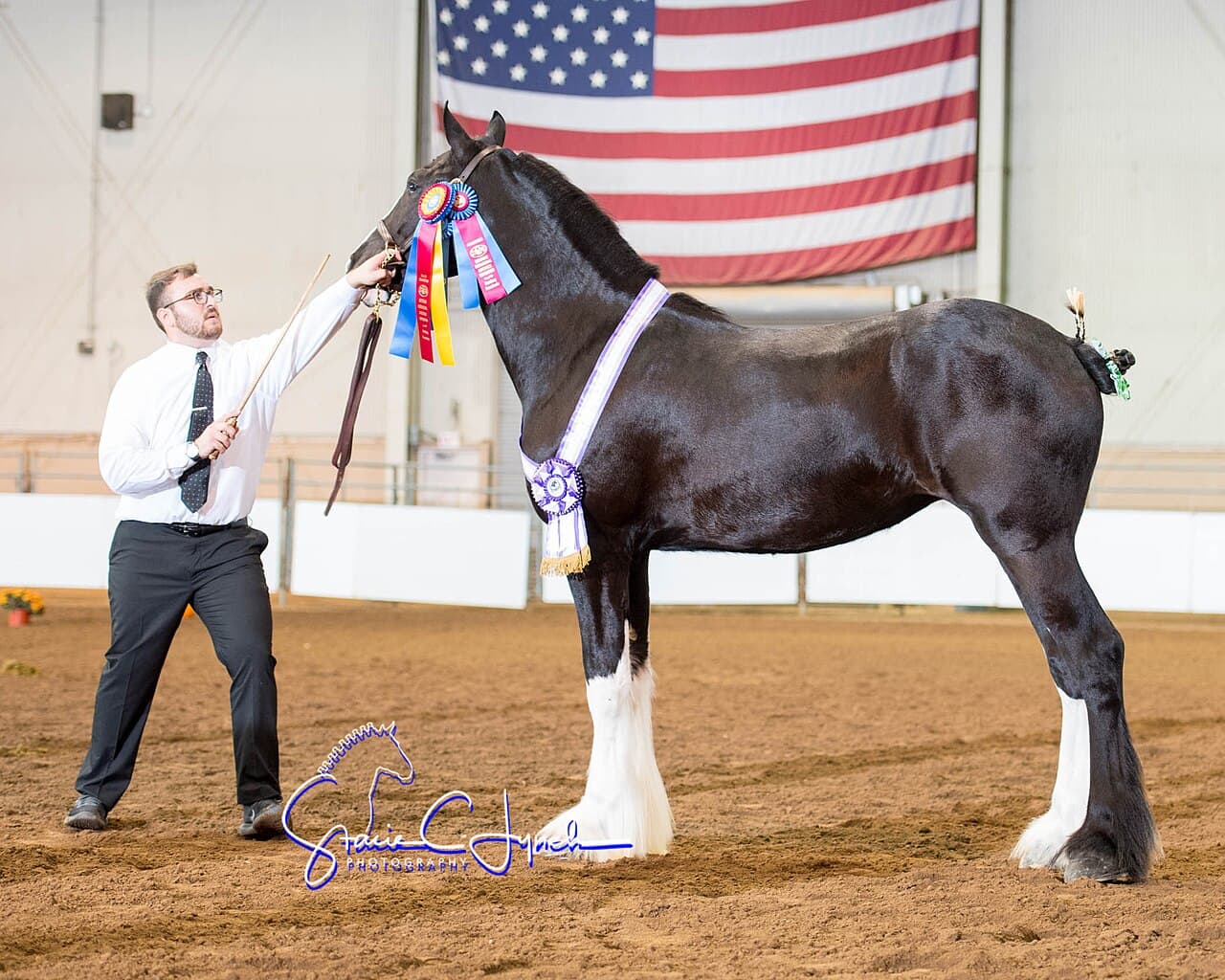
Illusion Farms Rustic Liberty, a Shire mare awarded at the 2017 Keystone International Livestock Exposition, shown by Emile Castonguay.

The Shire on English farms and in towns
The Shire: Agricultural and urban haulage shaped the horse
The Shire developed in England to pull substantial loads. Farming, canal towing and wagon transport required a powerful horse able to push into a collar and move a load at the walk. Growing towns and trade gave these horses important work far beyond farms.
The Shire: From the English Cart Horse Society to SHS
The English Cart Horse Society was founded in 1878 to improve horses through pedigrees and shows. It became the Shire Horse Society in 1884. Shire refers to a county; the name gradually distinguished a breed organised within a studbook from the wider group of horses pulling vehicles.
The Shire: Engines reduced demand for draught horses
During the twentieth century, lorries replaced wagons and tractors increasingly worked the fields. The loss of work reduced breeding. Breeders and users preserved families and developed showing, leisure driving and riding, while some horses continued to work in more specialised settings.
Sources for this section: SHS · horse history [1] · SHS · society history [2]
The Shire’s draught conformation in its breed standard
The Shire: Power combined with depth of body
The SHS standard reproduced by the South Eastern Shire Horse Association describes a long, relatively lean head, a slightly convex profile and a fairly long, arched neck. The deep, sloping shoulder accommodates the collar, with a broad chest, strong back and well-developed ribs. A long, muscular hindquarter contributes to the horse’s pushing power.
The Shire: Large feet and fine feathering
The Shire breed standard seeks strong joints, well-positioned limbs and large feet. Feathering is the long hair around the lower legs, ideally straight, fine and silky. In movement, the horse should travel straight and use its knees and hocks powerfully. Abundant hair alone is therefore not the measure of good conformation.
The Shire: Height guidelines differ by sex
The SHS standard reproduced by SESHA seeks mature stallions from 17 hands, approximately 1.73 m, mares from 16 hands, approximately 1.63 m, and geldings from 16.2 hands, approximately 1.68 m. The notation 16.2 means sixteen hands and two inches, rather than a decimal measurement of 16.2 hands. These are standard guidelines, not a measured population average.
Sources for this section: SESHA · SHS standard [3]
Coat colours and markings in the Shire standard
The Shire: Black, brown, bay and grey, with conditions by sex
The SHS standard reproduced by SESHA lists black, brown, bay and grey for stallions. Roan is also listed for mares and geldings. Colour descriptions must therefore specify the group to which they apply. A grey horse can be born dark and lighten with age, a process distinct from white markings present at birth.
The Shire: White stockings do not establish breed identity
White face and leg markings are familiar in the Shire, but the standard discourages large white body patches in stallions. A stocking or white feathering describes appearance rather than proving ancestry. Entry into an SHS register depends on parents and registration conditions, rather than resemblance to a show horse’s colour.
Sources for this section: SESHA · SHS standard [3]
From haulage to the Shire’s present-day activities
The Shire: Pulling loads in the countryside and towns
Shires worked at the plough, on canals and in urban transport. Railways even created work delivering goods between stations and their destinations. Brewers used teams for deliveries, and some still keep horses for local deliveries or public presentations.
The Shire: Driving, demonstrations and riding
Current activities include driving, conformation shows, agricultural demonstrations and recreational riding. These involve carrying or pulling loads under different conditions from industrial transport. Breed conservation therefore relies on breeders, events and users who maintain practical outlets for draught horses.
Sources for this section: SHS · horse history [1]
The Shire: SHS registration and stallion approval
The Shire: the studbook connects horses with their parents
Pedigree recording distinguishes several categories. Under SHS rules consulted on 8 November 2026, a filly by a registered, approved Shire stallion and out of a full-studbook or Grade B mare can enter the full studbook. Notification of a colt and his later approval as a stallion are separate stages.
The Shire: Grading registers follow controlled ancestry
Grade A conditionally admits fillies by an approved Shire stallion out of an unregistered mare; Grade B admits those out of a Grade A or registered Clydesdale mare. Grade C covers colts born from 2024 by a registered Shire stallion out of a Grade B mare, with its own approval rules. The Part Bred register for certain crosses with another breed is separate from the full studbook.
The Shire: Registration alone does not authorise studbook breeding
SHS requires stallion approval and a service book for the relevant breeding season. Approved stallions undergo a second inspection at five years old. Using an unapproved male does not give offspring the same registration options; the rules then provide for the Non-Breeding register. Arrangements operated by overseas organisations must be consulted separately.
The Shire: DNA checks parentage, with register-specific exceptions
For relevant registrations, a veterinarian describes the horse and collects hairs with roots. The laboratory compares the foal’s DNA markers with those of the declared parents. SHS requires samples from foals being registered, except the Non-Breeding and ID Only categories; parental requirements differ for Grade A, among other cases. This identity check does not test for disease.
Sources for this section: SHS · registration [4]
International distribution and Shire conservation
The Shire: the United Kingdom maintains the studbook of origin
SHS documents historical exports to the Americas, Australia and several European countries. Overseas organisations also maintain Shire registers. Their records can include horses already registered elsewhere, so adding studbook totals without matching identities does not count distinct living horses worldwide.
RBST lists the Shire as At Risk in 2026/27
The Rare Breeds Survival Trust’s 2026/27 Watchlist places the Shire in its British At Risk category. This conservation assessment considers breeding population size and genetic diversity. It concerns breed monitoring in the United Kingdom, rather than providing a worldwide headcount or an estimate of horses affected by a disease.
Sources for this section: SHS · society history [2] · RBST · 2026/27 [6]
Kinship, lymphoedema and targeted testing in Shires
The Shire: SPARKS helps breeders choose less-related parents
The voluntary SPARKS programme uses SHS pedigrees to compare horses’ kinship and predict inbreeding in a proposed foal. A stallion less closely related to the population can help retain underrepresented families. Tables are updated annually to guide pairings; SHS explains that their filtered data are not a suitable research sample for describing the whole population.
The Shire: Chronic progressive lymphoedema requires clinical monitoring
Chronic progressive lymphoedema, described in Shires among other breeds, affects drainage of lymph, the fluid circulating through tissues. Progressive lower-leg swelling leads to skin folds and nodules, sometimes with secondary infections. Feathering can conceal early lesions. UC Davis describes a suspected genetic component without an identified exact cause or validated DNA test that rules out the condition, making examination of the skin and legs essential.
The Shire: the PSSM1 test investigates one form of muscle disease
The PSSM1 test detects the GYS1 variant associated with abnormal storage of glycogen, an energy reserve in muscle. It can help investigate muscle signs with a veterinarian. A negative result does not exclude every other cause of pain or exercise intolerance. The laboratory page provides neither a representative Shire frequency nor a universal testing requirement for Shire registries.
Sources for this section: SHS · SPARKS [5] · UC Davis · lymphoedema [7] · UC Davis · PSSM1 [8]
Sources and review date
Profile reviewed on .
Current Shire Horse Society pages document history, registration and SPARKS. The regional association SESHA reproduces the SHS standard; the RBST 2026/27 Watchlist gives the British conservation category, while veterinary references explain the scope of health information.
- Shire Horse Society — The Shire Horse
Farming, canals, urban haulage, mechanisation and current uses; undated page consulted on 8 November 2026.
- Shire Horse Society — The Shire Horse Society
Foundation in 1878, renaming in 1884 and exports; registry history distinguished from a living census.
- South Eastern Shire Horse Association — The Shire Horse
Reproduction of the Shire Horse Society standard: proportions, limbs, heights by sex and colours. No version date; consulted on 8 November 2026. Registration rules come from SHS.
- Shire Horse Society — Registration and Passports
Public rules consulted on 8 November 2026: full studbook, Grades A, B and C, Part Bred, approval and DNA. Grade C applies to colts born from 2024; no general revision year is invented.
- Shire Horse Society — SPARKS Breeding Programme
Voluntary pedigree-based advice, annual tables and limits of filtered data; separate from a disease DNA test.
- Rare Breeds Survival Trust — Watchlist 2026/27
Shire in the United Kingdom’s At Risk category, checked in the colour document; no worldwide status extrapolated.
- UC Davis Center for Equine Health — Chronic Progressive Lymphedema, 5 July 2019
Condition documented in Shires, signs, management and genetic knowledge; no breed prevalence or validated DNA analysis inferred.
- UC Davis VGL — Polysaccharide Storage Myopathy Type 1
GYS1 variant and scope of testing for this muscle condition; no representative Shire frequency or registry obligation inferred from availability.