
Breeds · breed profile
The Shetland pony
Shetland pony
The Shetland is a small pony from the islands of the same name, north of mainland Scotland. Its compact, powerful body and thick winter coat reflect a history of work on small island farms and, later, in coal mines. Today, breeders preserve the breed’s type while producing ponies for children to ride and for carriage driving.
- Category
- Pony
- Country of origin
- United Kingdom
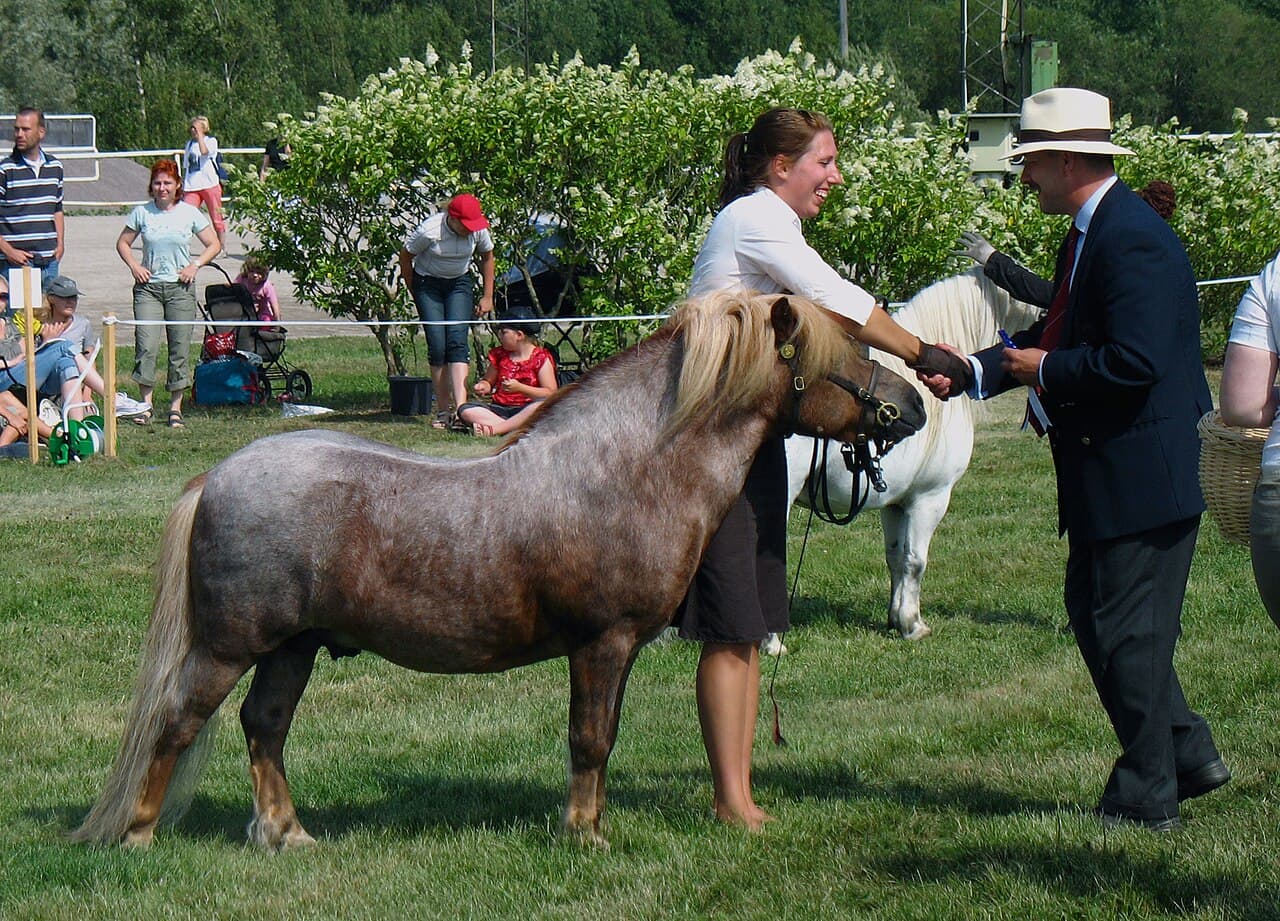
A Shetland pony shown in hand.

The island origins and history of the Shetland pony
The Shetland pony: a pony from Scotland’s northern islands
The breed takes its name from the Shetland archipelago. Ponies worked alongside families on small farms, known as crofts, in a landscape exposed to wind and wet winters. Their tasks included carrying peat for fuel and seaweed to fertilise the fields. This farming and breeding environment helps explain the importance of a compact build and hardiness in the breed.
The Shetland pony: From island farms to coal mines
During the nineteenth century, British collieries sought small ponies able to haul coal tubs through low underground passages. Demand encouraged exports and specialised studs. The Marquis of Londonderry established a stud on Bressay and Noss in the 1870s to supply his collieries in County Durham. Its influence belongs to this period of selective breeding; it was not the origin of all ponies in the islands.
The Shetland pony: Recording pedigrees from 1890
The Shetland Pony Stud-Book Society was founded in 1890, during a period of substantial exports. Its first studbook appeared in 1891, recording breeding animals and their family relationships. Official recognition as the studbook of origin in 1992 formalised its international role: recognised daughter studbooks abroad follow the entry principles established by the British society.
Sources for this section: SPS-BS · history [1] · Shetland · heritage [2] · SPS-BS · studbook [4]
The Shetland pony: the Shetland’s conformation and height standard
The Shetland pony: a small head and a substantial body
The British society’s standard describes a proportionate head, broad forehead, small ears and broad muzzle. The neck joins a sloping shoulder; the body has a deep chest, rounded ribs, muscular loins and broad quarters. Mane and tail should be abundant. In winter, a dense undercoat and longer outer hairs provide protection suited to the island climate.
The Shetland pony: Strong limbs and free movement
The Shetland breed standard calls for strong forearms, short cannons, muscular thighs and well-shaped hocks. Feet should be hard, round and regular. Movement should be free and straight, with the joints used actively. Vitality and stamina are also breeding aims, reflecting the pony’s former work carrying loads and pulling vehicles.
The Shetland pony: 107 cm is a maximum, not an average
The current Shetland breed standard of the studbook of origin sets a maximum height at the withers of 42 inches, given by the society as 107 cm. This is a standard limit rather than the breed’s average height. Ponies are measured with a measuring stick on level ground. Size divisions used in showing should be distinguished from this overall limit.
Sources for this section: SPS-BS · standard [3]
The Shetland pony: Shetland coat colours and studbook rules
The Shetland pony: a broad range of colours
The Shetland breed standard accepts equine colours except leopard-type spotted coats. This exclusion does not apply to pinto patterns, which the society registers. Its registration colour list distinguishes black, bay, chestnut, grey and several dilutions and mixtures of white and coloured hairs. Greying develops with age, whereas the white areas of a pinto coat arise through a different mechanism.
The Shetland pony: the studbook’s notice about Silver pedigrees
In a notice consulted on 6 November 2026, the British society reports pedigree irregularities in Silver ponies and carriers of the variant. It advises against using them to breed registered purebred Shetlands while investigations continue. The notice concerns ancestry records and registration; it does not measure the frequency of Silver in the breed.
Sources for this section: SPS-BS · standard [3] · SPS-BS · registration [5] · SPS-BS · notices [6]
The Shetland pony: From working pony to riding and driving
The Shetland pony: Carrying peat and hauling coal tubs
On the islands, Shetlands helped cultivate the land and move loads between fields and farms. In collieries, their height allowed them to pass through low tunnels while hauling tubs. These tasks explain the demand for strength and stamina in a small body. They also belong to historical working conditions very different from modern leisure activities.
The Shetland pony: Children’s riding and carriage driving
Shetlands are now used in riding centres for children’s lessons, as well as for leisure and competitive driving. Driving also enables adults to work with these small ponies without riding them. In-hand classes assess conformation and movement, while ridden and driving classes demonstrate trained work and serve a different purpose.
Sources for this section: SPS-BS · history [1] · Shetland · heritage [2] · IFCE · French programme [7]
The Shetland pony: Shetland breeding and the studbook
The Shetland pony: the studbook of origin and recognised daughter studbooks
The studbook records each pony’s identity and family. The British society holds the studbook of origin; recognised organisations keep daughter studbooks in other countries. For registration, a foal must have parents registered in recognised Shetland studbooks and a pedigree tracing back to the studbook of origin. A small pony casually described as a “Shetland type” does not necessarily have that recorded ancestry.
The Shetland pony: Identifying foals and checking their parents
In the British system, the breeder applies to register a foal within twelve months of birth. A pony presented later requires full DNA verification of both parents. Sires have required a DNA profile since 2022, and first-foaling mares since 2024. The laboratory compares DNA markers from the youngster and the declared parents to check whether the recorded parentage is compatible.
The Shetland pony: a voluntary veterinary examination
The Shetland Pony Stud-Book Society recommends veterinary examination of males before breeding, but the examination remains voluntary in its studbook. Specific parentage requirements apply to males born from 2017 onwards presented for this examination. Eligibility for affiliated shows is a separate matter. This British procedure does not replace the breeding approval requirements of another country.
Sources for this section: SPS-BS · studbook [4] · SPS-BS · registration [5] · SPS-BS · notices [6]
The Shetland pony: Shetland distribution and documented breeding figures
The Shetland pony: Island breeding and an international network
Shetlands continue to be bred on their home islands and elsewhere in the United Kingdom, as well as in countries with recognised studbooks. France has its own breeding programme. The country of origin shown in the directory therefore describes the breed’s history, rather than all the places where registered ponies are born today.
The Shetland pony: 893 registered births in France for 2025
The French programme published in March 2026 includes IFCE figures extracted in February 2026: 893 registered Shetland births for 2025 in France, and 1,531 Shetland mares covered that year. The first figure describes registered production, the second breeding activity. Neither counts all living ponies in France or the worldwide population; late registrations can change a birth series.
Sources for this section: SPS-BS · studbook [4] · IFCE · French programme [7]
The Shetland pony: Skeletal atavism and its DNA test
The Shetland pony: an inherited disorder of limb development
Skeletal atavism is an inherited disorder described in Shetland ponies and Miniature Horses. Abnormal development of bones in the forearm and lower hind limb leads to limb deformities and impaired movement early in life. Research identified two losses of DNA sequence, called Del1 and Del2, in the region containing SHOX, a gene involved in skeletal development.
The Shetland pony: What the 2016 study compared
Rafati and colleagues first compared DNA markers in 72 animals: 14 affected, 22 carriers and 36 controls. That approach did not locate the relevant region; sequencing six cases then revealed the deletions. Researchers thus compare landmarks in the DNA, then read its sequence in greater detail to find missing sections. In a separate group of 94 Shetlands selected from a Swedish sample bank, born between 1968 and 2000, 11 were carriers. This historical group does not measure the proportion of carriers in current breeding populations worldwide.
The Shetland pony: Finding carriers to plan matings
The test looks for Del1 and Del2. A pony carrying one of these deletions can transmit it without having the disease. Two disease-associated copies, either of the same deletion or one of each, put the foal at risk of skeletal atavism. Mating two carriers gives a 25% chance of an affected foal at each conception. Testing breeding animals helps avoid that combination; it serves a different purpose from DNA parentage verification.
Sources for this section: Rafati et al. · 2016 [8] · UC Davis · test [9]
Sources and updates
Profile updated on .
The studbook of origin documents the standard and British registration procedures. The French programme supplies breeding figures for France. The original research and laboratory guidance explain skeletal atavism and the purpose of testing.
- Shetland Pony Stud-Book Society — Breed history
Island work, the mining trade, Londonderry’s stud and the society’s foundation.
- Shetland.org — Shetland ponies
Croft work, exports and the studs on Noss and Bressay.
- Shetland Pony Stud-Book Society — Breed standard
Conformation, seasonal coat, colours and the 107 cm height maximum.
- Shetland Pony Stud-Book Society — The studbook
Foundation, international recognition in 1992 and ancestry requirements.
- Shetland Pony Stud-Book Society — Registrations
DNA profiles, late registration, colour terms and voluntary veterinary examination.
- Shetland Pony Stud-Book Society — Breeder notices
Dates of DNA profile requirements and the ongoing Silver pedigree notice, consulted on 6 November 2026.
- French Shetland studbook — Breeding programme (PDF, March 2026)
Uses and registered births and mares covered; IFCE extraction dated February 2026.
- Rafati et al. (2016) — SHOX-region deletions and skeletal atavism
G3, 6, 2213–2223. Discovery methods and a historical sample of 94 Swedish Shetlands.
- UC Davis Veterinary Genetics Laboratory — Skeletal atavism
Tested variants, recessive inheritance and interpretation of results.