
Breeds · breed profile
Shagya Arabian
The Shagya Arabian, bred for riding and endurance
The Shagya Arabian was developed from Arabian ancestry at Central European studs, notably Bábolna in Hungary. Breeders sought a larger horse with stronger bone while retaining Arabian characteristics. The Shagya is bred for riding and endurance. Its studbook, which records horses and their parents, is separate from the purebred Arabian studbook.
- Category
- Horse
- Country of origin
- Central Europe
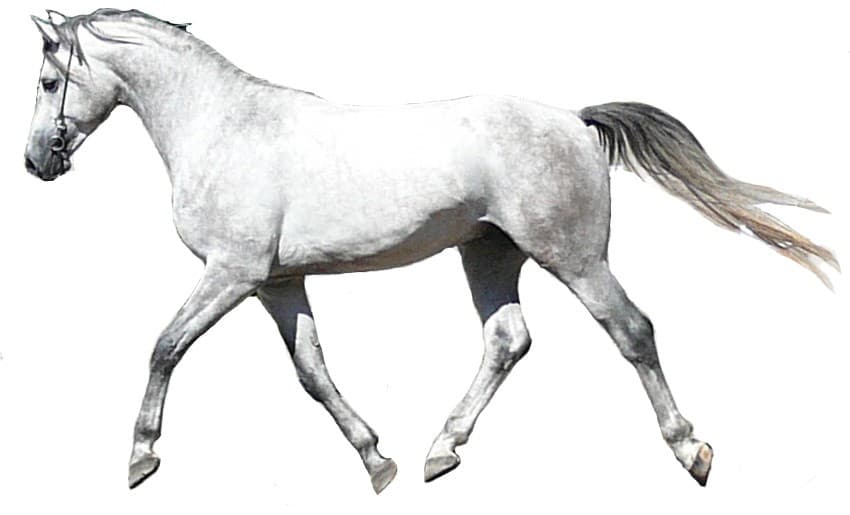
A representative Shagya Arabian stallion photographed in motion.
Véronique Mestre Gibaud (Association française du Cheval Arabe-Shagya) · CC BY-SA 3.0

The Shagya Arabian: Bábolna and the Central European studs
Bábolna Stud, founded in 1789, played a major role alongside other studs in the former Austro-Hungarian region. The Arabian stallion Shagya, born in 1830 and imported in 1836, gave the breed its name. International cooperation became formally established through the International Shagya-Araber Gesellschaft, or ISG, founded in 1978.
Sources for this section: AFCAS [1]
The Shagya Arabian: a substantial frame with regular movement
Association française du cheval arabe Shagya et du Demi-sang Shagya (AFCAS) describes the desired traits of the Shagya Arabian in its breeding programme. This document guides the choice of breeding animals. The Shagya Arabian breed standard favours an expressive head, a fairly long neck, defined withers and a long croup. The chest should be developed and the cannon bones (the long bones above the fetlocks), between knee and fetlock, short and strong. Cannon circumference must be at least 18 cm. The assessment describes 1.50–1.53 m as small, 1.54–1.57 m as medium and 1.58 m upwards as large; breeding categories have their own thresholds. The walk should cover ground with a clear, regular rhythm.
Sources for this section: AFCAS [1]
The Shagya Arabian: Grey and the basic coat colours
The Shagya studbook accepts grey and basic colours, including bay, chestnut and black. Grey is progressive whitening of the hair, so a future grey horse may be dark at birth. Shagya colour rules should not automatically be applied to the separate Partbred Shagya registry.
Sources for this section: AFCAS [1]
The Shagya Arabian: Endurance, trail riding and driving
Endurance has an important place in the French programme, which follows the results of French-bred horses. Trail riding, leisure riding and driving are further uses. Regular movement and a cooperative response support these activities. Presentations and practical assessments help evaluate those qualities in individual horses rather than relying solely on the breed's reputation.
Sources for this section: AFCAS [1]
The Shagya Arabian: Keeping track of Shagya ancestry
The Association française du cheval arabe Shagya et du Demi-sang Shagya (AFCAS) oversees the French studbooks under ISG principles. Breeding divisions consider both assessment results and ancestors in the fourth generation. The Partbred Shagya registry, established in 2018, tracks eligible crosses while keeping them distinct from the Shagya studbook.
Sources for this section: AFCAS [1]
The Shagya Arabian: a small French breeding population
The 2025 Écus yearbook records 16 mares covered in France in 2024 for anticipated Shagya production, using provisional data dated 21 October 2025. This is declared breeding activity for one year, not all registered mares or living horses. Exchanges between breeders help maintain different families within a small national population.
Sources for this section: IFCE — Écus 2025 [2]
The Shagya Arabian: DNA profiles help document families
A parentage DNA profile consists of markers used to check a proposed relationship. The studbook provides for stallion genotyping and, since 2014, genotyping of mares before their first foal. These records support the pedigrees used to follow Shagya lines. They do not measure endurance ability or screen for every inherited condition.
Sources for this section: AFCAS [1]
Sources and review date
Profile reviewed on .
The documents below were used to prepare this profile of the Shagya Arabian. They explain which animals can enter the studbook and how breeding animals are selected.
- Shagya et Demi-sang Shagya — Programme de sélection 2024
Studbook document covering selection, registration, breeding assessments and dated figures where available.
- IFCE — Annuaire Écus 2025
IFCE-SIRE statistics: French breeding activity in 2024, provisional at 21 October 2025, p. 11.