
Breeds · breed profile
Rocky Mountain Horse
The Rocky Mountain Horse is a Kentucky breed with an even four-beat gait
The Rocky Mountain Horse developed in eastern Kentucky, in the Appalachian region. Despite its name, the organised breed did not originate in the Rocky Mountains. It is valued for a natural four-beat gait and for recreational riding. A chocolate coat with a pale mane and tail is widely associated with the breed, but Rocky Mountain Horses are not all that colour.
- Category
- Horse
- Country of origin
- United States
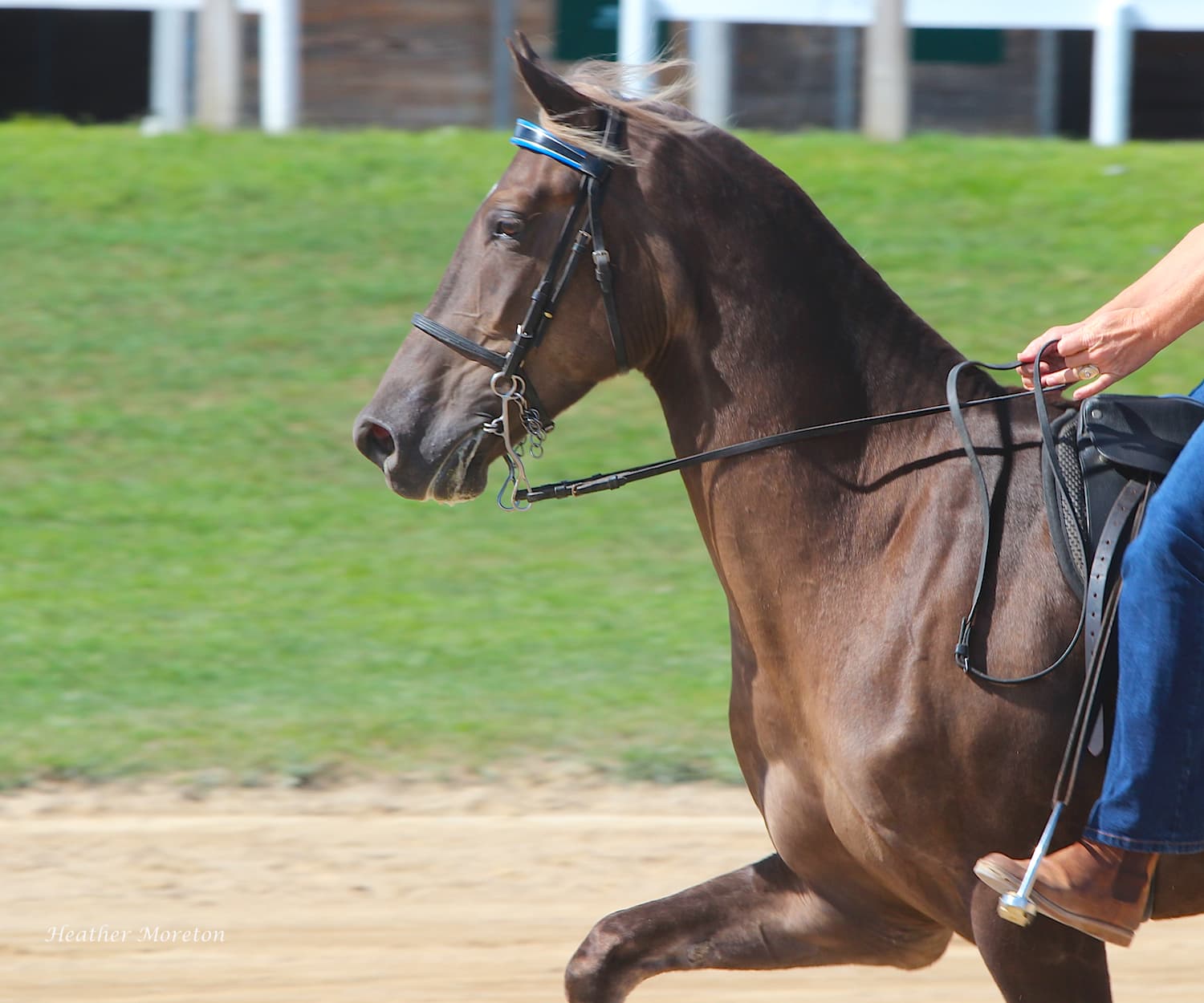
A Rocky Mountain Horse at the Kentucky Horse Park in 2012.

Rocky Mountain Horses descend from Kentucky working saddle horses
Eastern Kentucky families bred horses for travel, everyday work and riding. Tobe, a stallion owned by Sam Tuttle, became particularly influential in the bloodlines that survived. The Rocky Mountain Horse Association was founded in 1986 to organise preservation and establish breed criteria. Foundation animals were selected for their backgrounds and characteristics. This regional history explains the breed’s identity more fully than the familiar image of a chocolate-coloured horse, which represents only part of its range of appearances.
The RMHA standard gives a height range of about 1.42 to 1.63 m
The standard currently published by the Rocky Mountain Horse Association specifies 14 to 16 hands, approximately 1.42 to 1.63 m at the withers. It describes a balanced horse with adequate chest width, sloping shoulders and proportionate limbs. The characteristic gait has four evenly spaced beats in a lateral sequence. Feet on the same side advance in succession rather than landing together as in a two-beat pace. This pattern helps keep the horse’s back relatively steady beneath the rider.
Sources for this section: RMHA [2]
Rocky Mountain Horses can be colours other than chocolate
The RMHA accepts several solid body colours, with restrictions on white markings. Black, bay and chestnut horses therefore belong to the breed too. The chocolate colour with pale mane and tail is often associated with silver dilution, which lightens black pigment. A chestnut horse can carry the silver variant without displaying that familiar chocolate appearance. Visible colour consequently does not always show whether an individual carries silver. A targeted DNA test can answer that question more directly.
Sources for this section: RMHA [2] · UC Davis VGL [4]
Rocky Mountain Horses are strongly associated with trail riding
Rocky Mountain Horses are used for trail and pleasure riding and for gaited-horse shows. Their way of moving can feel different from a trot, with less bounce in the saddle. The association also offers versatility activities. The breed’s history as a family horse describes a selection goal, rather than guaranteeing every individual’s temperament. Training and experience still matter, particularly for a beginner rider or a horse expected to cover long distances in unfamiliar terrain.
Sources for this section: RMHA [3]
RMHA registration and breeding certification are separate steps
RMHA registration records a horse’s identity and ancestry, supported by DNA checks. Certification adds an examination of conformation, height, markings, temperament and gait by an authorised examiner. The parents must be certified for their foal to be registered under the association’s rules. These processes are therefore not equivalent. A registration certificate alone does not establish that all certification requirements have already been checked. Reading the horse’s actual status helps clarify what has been recorded and what has been assessed.
Sources for this section: RMHA [3]
The RMHA’s 25,000 registrations are a historical registry figure
The RMHA reports more than 25,000 registered horses in its pedigree database as of August 2019. This cumulative total is not a current count of living horses. The 2022 coat study used a different group: 183 Rocky Mountain Horses tested, with 117 retained after close relatives were removed. They had been submitted for coat-colour analyses. Their results do not necessarily represent every bloodline in the breed, and their number cannot be used as a breed population estimate.
Sources for this section: RMHA [1] · Avila et al. (2022) [5]
A Rocky Mountain Horse silver test can also inform eye-health assessment
The silver DNA test detects a variant that lightens black pigment. That variant is also associated with multiple congenital ocular anomalies, or MCOA, a syndrome affecting structures within the eye. Effects are generally more pronounced in horses with two copies. Chestnut horses can carry the variant without a chocolate coat. Testing can therefore be informative even when the colour looks unaffected. A veterinary eye examination is still needed to establish which abnormalities, if any, are present in the individual horse.
Sources for this section: UC Davis VGL [4] · Avila et al. (2022) [5]
Sources and review date
Profile reviewed on .
Breed organisations document history, registration rules and uses. The 2022 study examined horses submitted for coat-colour testing; its results describe that sample, rather than a census of the breed.
- RMHA — Association history
The breed’s history and the development of its breeding organisation.
- RMHA — Breed standard
Conformation, height and movement considered during assessments.
- RMHA — FAQ
Registration requirements, studbook categories and verification of ancestry.
- UC Davis VGL — Silver
Testing for the silver variant and its association with multiple congenital ocular anomalies (MCOA).
- Avila et al. — Genes, 2022
Avila and colleagues (2022): coat variants, sample sizes before and after removing close relatives, and limitations of the laboratory sample.