
Breeds · breed profile
The Quarter Horse
American Quarter Horse · QH
The Quarter Horse originated in the United States and takes its name from races over a quarter of a mile. Working cattle also shaped its breeding. Today, different bloodlines specialise in racing, western performance or conformation showing, while many Quarter Horses are ridden for recreation.
- Category
- Horse
- Country of origin
- United States
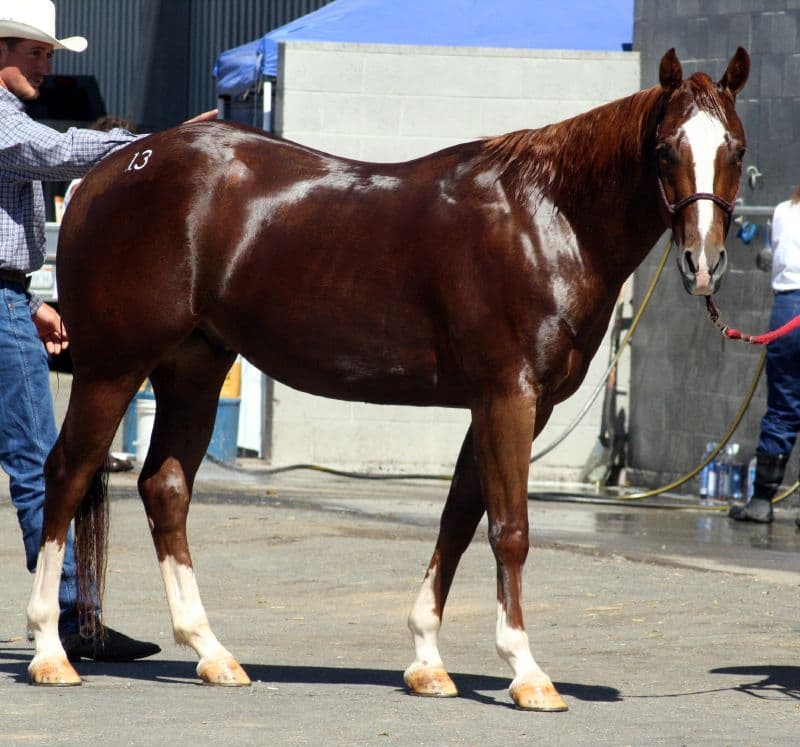
Chics River Dancer, a Quarter Horse gelding shown in hand on 8 June 2008.

The Quarter Horse: From colonial sprint racing to ranch work
The Quarter Horse: a name drawn from the quarter-mile race
The Quarter Horse’s roots lie in horses bred for short-distance racing in colonial North America. A quarter of a mile is about 402 metres: acceleration and speed over that distance gave the horse its name. Breeding and selection began centuries before a shared registry was established, so the history of these sprinters reaches much further back than the AQHA itself.
The Quarter Horse: Cattle work shaped the horse
As livestock farming expanded across the American West, these horses became useful ranch mounts. Riders needed to follow a herd, separate an animal and change direction quickly. Breeders valued the power to accelerate, the balance to turn and the willingness to settle back into quiet work after a sudden burst of activity. These demands help explain why agility became such an important part of the breed’s type.
The Quarter Horse: the AQHA has organised pedigrees since 1940
The American Quarter Horse Association, or AQHA, was founded in Texas in 1940 to record and preserve Quarter Horse pedigrees. A studbook links each horse to its parents, allowing families to be followed through the generations. Thoroughbreds contributed to the breed’s development, and their use in certain crosses is still governed by Appendix rules. The association’s foundation organised existing breeding traditions; it did not mark the first appearance of horses of this type.
The Quarter Horse: the French association was founded in 1981
Imports to France in the early 1980s accompanied the foundation of the Association française du Quarter Horse, or AFQH, in 1981. Its institutional history records an initial AQHA-recognised show in 1983 and affiliation in 1984. The AFQH brings owners and breeders together and organises breed activities; the American registration certificate remains an AQHA document.
Sources for this section: AQHA · conformation [2] · AQHA-NZ [3] · AQHA · 2026 [1] · AFQH [4]
The Quarter Horse’s desired balance and muscling
The Quarter Horse: AQHA conformation judging considers the whole horse
In the 2026 AQHA handbook, halter classes are in-hand competitions that assess conformation: the shape and proportions of the horse’s body. Judges consider balance, structural correctness, breed characteristics and muscling. Balance between body parts takes priority over simply having more muscle. This show assessment serves a different purpose from the pedigree and paperwork requirements for registering a foal.
The Quarter Horse: a short head and a well-proportioned neck
The AQHA conformation chart describes a short, broad head, small ears, wide-set eyes and clearly defined jaws. The neck should blend smoothly into the shoulders, with room at the throatlatch. These features aim for a proportionate horse that can move freely and work with its head lowered without crowding the throat area.
The Quarter Horse: a short back and powerful hindquarters
The desired outline combines long, sloping shoulders, a deep chest, a short back and a strong loin. The croup and thighs carry well-developed muscle. This build supports the acceleration, stops and changes of direction needed for work. Racing, halter and cattle-working bloodlines have followed different breeding priorities, which helps explain the different body types found within the registry.
The Quarter Horse: Correctly aligned limbs and regular movement
The AQHA looks for straight, structurally correct limbs, clean joints and sound feet. Its conformation chart describes rounded, roomy hooves with open heels. The horse should remain balanced when turning or stopping. The desired disposition combines attentiveness, cooperation and readiness to work; competition judges also assess regular gaits and the horse’s response to the rider’s cues.
The Quarter Horse: a descriptive height range rather than a worldwide entry limit
AQHA-NZ, the New Zealand association, describes an average height range of 14.1–15.2 hands, approximately 145–157 cm at the withers. In this notation, the digit after the point counts inches, not tenths of a hand. This is a descriptive guide to the type presented by that organisation. The American registration rules discussed here rely on parentage and the horse’s documentation; they do not turn that range into a universal breed limit.
Sources for this section: AQHA · 2026 [1] · AQHA · conformation [2] · AQHA-NZ [3]
Quarter Horse colours and the rules for white markings
The Quarter Horse: Colour descriptions used by the registry
The AQHA handbook describes bay, black, sorrel and chestnut, palomino, buckskin, dun, grullo, gray and several roan colours, as well as cremello and perlino. Sorrel and chestnut are separate descriptions among red-based coats. These names describe and record appearance. A colour’s inclusion in the handbook does not tell us how common it is in the breed.
The Quarter Horse: Gray, roan and dun describe different appearances
A gray horse may be born dark and gradually lighten as white hairs appear. In a roan coat, white and coloured hairs are mixed, with the head and lower legs generally remaining darker. Dun combines coat dilution with markings such as a dark stripe along the back. The handbook describes these visible features; a coat-colour DNA test searches for a particular variant to clarify a colour’s cause or inheritance.
The Quarter Horse: Extensive white markings can require DNA parentage verification
AQHA rule REG109.4 allows horses with white markings beyond its specified limits to be registered when DNA verifies them against both declared parents. Their certificates carry a notation about the markings, and some showing or Appendix advancement opportunities are restricted. A large white marking alone therefore cannot establish whether a horse is registered as a Paint Horse or a Quarter Horse.
Sources for this section: AQHA · 2026 [1]
The Quarter Horse: Cattle work, western events and racing
The Quarter Horse: From ranch work to cutting and working cow horse
On a ranch, the horse helps a rider move cattle, separate an animal or hold it away from the group. Cutting develops part of that work into competition: the rider separates a cow, then the horse follows its movements to prevent it from returning to the herd. Working cow horse combines a reined performance with work on a cow. Here, “cow sense” means the horse’s ability to anticipate and follow the animal’s movements.
The Quarter Horse: Different tasks in the arena
In reining, horse and rider follow a pattern of circles, lead changes, spins and stops. Competitive trail classes include obstacles such as ground poles or a gate. Western pleasure evaluates features including gait quality and the apparent ease of the performance. Each event requires its own training, even when riders use similar western equipment.
The Quarter Horse: Racing bloodlines and recreational riding
Quarter Horse racing continues the selection for speed over short distances. Other breeders focus on ridden disciplines, including the English-saddle classes provided for in AQHA rules. Trail riding and other recreational activities are also part of owners’ use of the breed. These different purposes explain how a racehorse and a cutting horse can share a registry while belonging to different families and having different builds.
Sources for this section: AQHA · 2026 [1] · AFQH [4]
The Quarter Horse: AQHA registration, the Appendix and DNA parentage
The Quarter Horse: the Numbered register and Appendix have different parentage rules
Under the ordinary procedure in the 2026 handbook, a foal with two AQHA Numbered parents can receive a Numbered certificate if it meets the other requirements. The Appendix includes offspring of a Numbered parent crossed with an eligible registered Thoroughbred or an Appendix parent. However, Appendix-to-Appendix and Appendix-to-Thoroughbred offspring are ineligible under REG105–106. A percentage of ancestry alone cannot replace checking the parents’ certificates.
The Quarter Horse: Advancement from the Appendix requires a specific application
An Appendix horse can move into the Numbered register through advancement. The performance route requires an eligible AQHA Register of Merit, together with the veterinary checks and assessment of white markings specified in REG104. Restrictions cover HYPP, excessive white markings, lack of contact between the central incisors and, for stallions, cryptorchidism. The handbook also provides for horses whose parents have both advanced. Entering a show does not by itself change a horse’s registration category.
The Quarter Horse: Comparing the foal’s DNA with its declared parents
DNA typing establishes a marker profile for a horse. Parentage verification compares the foal’s profile with those of the declared sire and dam to check compatibility. The 2026 handbook requires both parents’ DNA types to be on file before a foal is registered, with verified parentage required in the circumstances listed in REG102.8. Examples include transported cooled or frozen semen, embryo transfer and certain white markings. This comparison checks declared parents; disease tests examine other DNA differences.
The Quarter Horse: French SIRE identification complements the breed certificate
IFCE’s “Races et appellations” document, updated on 18 November 2025, places the Quarter Horse among breeds with a simplified procedure. The French identification document is issued using information on the foreign certificate of origin. AQHA registration and SIRE identification therefore serve complementary purposes. The same document lists the German Quarter Horse separately among breeds with an agreement for transferring information; these routes do not amount to a single French studbook replacing all foreign registries.
Sources for this section: AQHA · 2026 [1] · IFCE · SIRE [5]
The Quarter Horse: Worldwide registrations and French birth records
The Quarter Horse: the 2026 handbook reports over seven million registrations
The 2026 AQHA handbook reports more than seven million Quarter Horses registered worldwide. This is a cumulative registry figure built up through its history, rather than a count of horses alive in 2026. The records retain earlier generations, including horses that have died. Breeding has spread beyond the United States, with associations in countries including France and New Zealand; an association’s presence alone does not provide a country’s living horse population.
The Quarter Horse: 427 French birth registrations for 2024
IFCE’s Annuaire ÉCUS 2025 records 427 Quarter Horse birth registrations in France for 2024. The table uses SIRE data extracted on 21 October 2025 and labels the figures provisional because some files remained incomplete. It describes one annual generation recorded in that system, rather than all Quarter Horses of all ages living in France or all registrations in the worldwide AQHA registry.
Sources for this section: AQHA · 2026 [1] · IFCE · ÉCUS 2025 [6]
The Quarter Horse: Performance bloodlines and the six AQHA health tests
The Quarter Horse: the 2018 study compares 143 horses from six disciplines
A 2018 Frontiers in Genetics study looked for evidence of selection in the DNA of 143 Quarter Horses from six groups: cutting, halter, racing, reining, western pleasure and working cow horse. The horses had been selected from leading competitors ranked by earnings or points in 2009 and 2010, limiting the inclusion of siblings. Differences between the groups show the effects of specialised breeding. They are neither a survey of all recreational horses nor a DNA test that can reliably assign a foal to its best discipline.
The Quarter Horse: AQHA stallion panel requirements have separate effective dates
Health tests search for DNA variants associated with inherited disease. REG108.5 requires stallions’ panel results to be on file before registration of foals from breedings after 1 January 2015. The original five tests are HYPP, HERDA, GBED, PSSM1 and MH; MYHM was added effective 1 January 2023. The rule states that a stallion already tested to comply before a new test’s effective date need not be retested for the added variant unless explicitly required. This registry requirement does not mean every horse, including mares and foals, must have the same commercial panel.
The Quarter Horse: HYPP: the SCN4A test identifies a risk of muscle attacks
The HYPP test detects a SCN4A variant that disrupts muscle-cell function and can cause twitching, weakness or episodes of paralysis. One copy can be enough for signs to develop, so inheritance is dominant. The variant is associated with descendants of the stallion Impressive, although that ancestry does not prove an individual carries it. For foals born on or after 1 January 2007, AQHA applies parentage and testing requirements to these descendants, with specified exemptions when the relevant parents test negative; H/H horses born from that date are ineligible for registration.
The Quarter Horse: HERDA and GBED: finding carriers before planning a mating
The HERDA test detects the PPIB variant responsible for fragile skin that can tear and heal poorly. The GBED test detects the GBE1 variant that prevents normal production of glycogen, an energy store; affected pregnancies may be lost or foals may die young. Both diseases are recessive: a horse with one copy can pass it on without having the corresponding disease. Two carriers of the same variant have a 25% chance of an affected foal at each conception. The two parents’ HERDA and GBED results must therefore be read separately.
The Quarter Horse: PSSM1 and MH: muscle variants with different effects
The PSSM1 test detects a GYS1 variant associated with abnormal glycogen accumulation in muscle and episodes of pain or stiffness. The MH test detects a RYR1 variant linked to excessive calcium release inside muscle cells, which can trigger a severe crisis with overheating and muscle breakdown, particularly under certain anaesthetics. Both variants are dominant, and one copy is relevant to the horse’s management. A negative PSSM1 result cannot rule out other causes of muscle disease; an MH result provides specific information when planning anaesthesia.
The Quarter Horse: MYHM: a MYH1 variant indicates susceptibility
The MYHM test detects a MYH1 variant associated with two forms of muscle disease: immune-mediated myositis, in which the immune response attacks muscle, and muscle breakdown that can occur without exercise. Original research published in 2018 and VGL guidance link the variant to susceptibility, with potential triggering factors. One or two copies increase risk, but detection does not establish that an episode is happening or that one will inevitably occur. The test’s earlier name, IMM, referred only to the first presentation; MYHM encompasses both associated forms.
The Quarter Horse: a negative result applies to the variant actually tested
In these reports, N denotes the version without the targeted variant, rather than the absence of the gene. For example, N/HRD indicates one copy of the HERDA variant, while N/N means it was not detected. For a recessive disease such as HERDA, that distinction informs mating decisions; for a dominant or susceptibility variant, it also informs management of the horse. Parentage, colour and disease tests answer different questions, even when they use samples from the same hair roots.
Sources for this section: Frontiers · 2018 [7] · AQHA · 2026 [1] · VGL · HYPP [8] · VGL · HERDA [9] · VGL · GBED [10] · VGL · PSSM1 [11] · VGL · MH [12] · VGL · MYHM [13] · MYH1 · 2018 [14]
Sources and review date
Profile reviewed on .
The 2026 AQHA handbook sets out registration and competition rules. Association publications describe the breed’s history and desired type; original research and laboratory pages explain what DNA analyses measure. The French figures come from IFCE’s SIRE records.
- AQHA — Official Handbook of Rules and Regulations 2026 (PDF, RHA copy)
REG102 and REG104–109 cover parents, Appendix status, parentage, markings and health tests; REG114 covers colours and SHW350 halter judging. Effective 1 January 2026, subject to AQHA amendments.
- AQHA — American Quarter Horse Conformation Chart (PDF, AIQH copy)
AQHA anatomical guide distributed by the Italian association AIQH, with background on racing and ranch use.
- AQHA-NZ — About the American Quarter Horse
History, characteristics and a descriptive New Zealand height guide of 14.1–15.2 hands; this is not a worldwide registration limit.
- AFQH — Qui sommes-nous
French institutional history: foundation in 1981, a recognised show in 1983 and AQHA affiliation in 1984.
- IFCE — Races et appellations, 18/11/2025 (PDF)
Simplified identification procedure for the Quarter Horse, distinguished from the German Quarter Horse route. Internal update: 18 November 2025.
- IFCE — Annuaire ÉCUS 2025, p. 28 (PDF)
427 Quarter Horse birth registrations in France for 2024; provisional SIRE data at 21 October 2025, rather than a living population of all ages.
- Frontiers in Genetics (2018) — Genome-Wide Signatures of Selection Reveal Genes Associated With Performance in American Quarter Horse Subpopulations
Genomic analysis of 143 horses from six disciplines, selected among top competitors in 2009–2010. Research on selection signatures, rather than a discipline prediction test.
- UC Davis VGL — Hyperkalemic Periodic Paralysis (HYPP)
SCN4A variant, dominant inheritance, muscle episodes and interpretation of HYPP results.
- UC Davis VGL — Hereditary Equine Regional Dermal Asthenia (HERDA)
PPIB variant, fragile skin, recessive inheritance and identification of HERDA carriers.
- UC Davis VGL — Glycogen Branching Enzyme Deficiency (GBED)
GBE1 variant, impaired glycogen synthesis, recessive disease and consequences for pregnancies and foals.
- UC Davis VGL — Polysaccharide Storage Myopathy (PSSM1)
GYS1 variant, muscle glycogen storage and the scope of the PSSM1 test.
- UC Davis VGL — Malignant Hyperthermia (MH)
RYR1 variant and the risk of overheating and muscle breakdown, particularly with certain anaesthetics.
- UC Davis VGL — Myosin-Heavy Chain Myopathy (MYHM)
MYH1 variant associated with susceptibility to immune-mediated myositis and non-exertional muscle breakdown; interpretation of N/My and My/My.
- Finno et al. (2018) — A missense mutation in MYH1 is associated with susceptibility to immune-mediated myositis in Quarter Horses
Original Skeletal Muscle paper associating a MYH1 variant with susceptibility to immune-mediated myositis.