
Breeds · breed profile
The Purebred Spanish Horse
Pura Raza Española · PRE
The Purebred Spanish Horse is a Spanish riding horse with particularly close historical ties to Andalusia. Court riding, cattle work and dressage have shaped its breeding. PRE refers to horses entered in the official breed studbook, managed worldwide by ANCCE.
- Category
- Horse
- Country of origin
- Spain
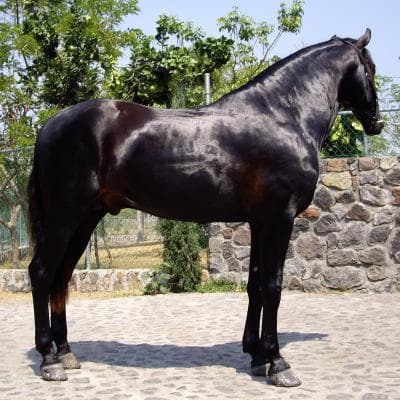
A black Purebred Spanish Horse, shown in profile.

The Purebred Spanish Horse: Origins and history of the PRE
The Purebred Spanish Horse: PRE and the name “Andalusian”
Pura Raza Española means “Purebred Spanish Horse”. The name “Andalusian”, widely used in historical accounts and outside Spain, reflects Andalusia’s role in its breeding. The name alone does not establish which register a horse belongs to. For a PRE, this is verified through the LG PRE ANCCE studbook, which links each registered horse to its parents.
The Purebred Spanish Horse: Court horses and breeding along the Guadalquivir
In the sixteenth century, Philip II reorganised royal horse breeding and ordered the construction of the Royal Stables in Córdoba. Mares and stallions bred along the Guadalquivir were brought together there. The demands of the court favoured agile horses with an imposing appearance, intended for riding and Renaissance equestrian exercises. This was an important stage in the development of the Spanish horse; the present studbook would be established several centuries later.
The Purebred Spanish Horse: the Carthusian strain and the stud at Jerez
Around the Carthusian monastery at Jerez de la Frontera, monks developed a breeding herd from which the families known as cartujanas descend. The official programme recognises this strain within the PRE: a group of horse families that contributed to the breed. In 1810, Pedro José Zapata bought horses from the herd and used a brand shaped like a bit, the Hierro del Bocado. After passing through several owners, the herd became Spanish state property in 1983. Yeguada Cartuja continues to breed and conserve this strain at Jerez.
The Purebred Spanish Horse: From earlier studs to the 1912 studbook
Wars in the early nineteenth century, followed by changes in agriculture and transport, disrupted breeding and the demand for horses. In January 1912, Spain established the PRE studbook under the military horse breeding service, Cría Caballar. The register created a common framework for recording ancestry, preserving each horse’s identity and parentage. Its establishment provides a precise administrative milestone within a much longer breeding history.
The Purebred Spanish Horse: ANCCE, SICAB and breeding today
Founded in Seville in 1972, ANCCE brings breeders together and represents the breed. In 1991 it launched SICAB, a show devoted to Spanish horses, after African horse sickness had disrupted trade and movement. The association has also managed the official studbook since 2007. Today’s breeding programme combines the preservation of PRE characteristics with improvements in conformation and dressage ability, using measurements, performance tests and family records.
Sources for this section: ANCCE · history [4] · MAPA · PRE programme [1] · LG PRE · rules [2] · Yeguada Cartuja · history [6] · ANCCE · association [5]
The Purebred Spanish Horse: the characteristics sought in the PRE
The Purebred Spanish Horse: a model set out in the Spanish breeding programme
The Purebred Spanish Horse (PRE) breeding programme approved by Spain’s Ministry of Agriculture on 15 June 2020 includes the PRE breed standard: the shared description that guides breeders’ choices. It calls for a well-proportioned horse whose height at the withers is close to its body length, with muscle and conformation suited to ridden work. The description also takes account of differences in development between mares and stallions.
The Purebred Spanish Horse: Head and neck
The head is of medium length, with a slightly convex outline from forehead to nose when seen from the side. The standard describes a muscular neck that joins the body well, with an arched upper line and abundant mane. A finer, less arched neck is generally sought in mares. Assessment considers proportions and the way the neck joins the head and body, as well as its size.
The Purebred Spanish Horse: Back, loin and croup
The desired back is strong, muscular and fairly straight. The loin, between the back and croup, is short and broad, with good connections between these regions. The croup is rounded, slightly sloping and a little longer than it is wide. In adult horses, it should be lower than the withers. Overall proportions should be harmonious, with a deep chest and well-developed ribs.
The Purebred Spanish Horse: Limbs, alignment and feet
The Purebred Spanish Horse (PRE) breed standard describes long, sloping shoulders, powerful forearms and strong hocks. Joints should be clearly defined, and feet compact, well developed and in proportion to the horse. Assessors also examine how the limbs line up beneath the body. In motion, they seek regular forward movement; winging, where the limbs swing outwards, is among the faults that incur a penalty.
The Purebred Spanish Horse: Height ranges and breeding thresholds
The Purebred Spanish Horse (PRE) breeding programme describes a usual height at the withers of 1.54–1.72 m for males and 1.52–1.70 m for females. These are descriptive ranges, rather than averages. For breeding approval, a male below 1.54 m or a female below 1.52 m is disqualified. Heights above 1.72 m and 1.70 m respectively are penalised faults: the rules therefore treat the lower and upper ends of the ranges differently.
The Purebred Spanish Horse: Regular movement and a precise response to the rider
The PRE is bred for ground-covering, elastic, rhythmic movement that combines elevation with forward travel. The programme emphasises ease of collection: the horse engages its hindquarters more and adjusts its balance to perform shorter, controlled movements. It also seeks energy, a balanced temperament and responsiveness to the rider’s aids. These goals connect conformation and movement with the cooperation needed for ridden work.
Sources for this section: MAPA · PRE programme [1]
The Purebred Spanish Horse: PRE coat colours and how they change
The Purebred Spanish Horse: Grey, bay and other colours
The official Purebred Spanish Horse (PRE) breeding programme describes grey and bay as the predominant PRE colours, without assigning percentages. The studbook also accounts for black, chestnut and coats lightened by dilutions such as Cream or Pearl. White markings and eye colour are assessed under specific rules: a pale coat and large white markings are different traits. The manual provides for coat colour testing to determine whether light eyes are consistent with a double dilution.
The Purebred Spanish Horse: a dark foal can become a grey adult
Greying progressively adds white hairs to a birth coat that may be bay, black or chestnut. A PRE that looks almost white as an adult may therefore have been very dark as a foal. This change in the hair does not turn its underlying base colour into another base colour. Genetic tests can help identify greying and colour variants that become difficult to distinguish from appearance once the horse has greyed.
Sources for this section: MAPA · PRE programme [1] · LG PRE · procedures and tests [3] · UC Davis · greying [11]
The Purebred Spanish Horse: Work, dressage and equestrian traditions
The Purebred Spanish Horse: From court riding to cattle work
Spanish horse breeding has been shaped by riding and court exercises, as well as rural uses. The programme specifically mentions cattle handling, work in the countryside and driving. In doma vaquera, developed from cattle work, the rider asks for changes of direction and pace, precise halts and prompt departures. These movements allow the horse to be positioned quickly in relation to the animals it is accompanying.
The Purebred Spanish Horse: Dressage and performance assessment
Dressage plays a central role in the PRE breeding programme. In competition, horse and rider perform a test: a sequence of movements at specified places in the arena. Judges assess qualities including regularity, suppleness, balance and accuracy. Young horse tests and performance recording also provide observations used in the assessment of breeding horses and their families.
The Purebred Spanish Horse: High school riding, displays and driving
At Jerez, the Real Escuela Andaluza del Arte Ecuestre passes on classical dressage and doma vaquera through training and public displays. High school riding develops advanced exercises after extensive training of both horse and rider. PRE horses are also ridden for leisure and used for driving. Conformation and movement shows assess the horse’s build and movement, serving a different purpose from a ridden dressage test.
Sources for this section: MAPA · PRE programme [1] · ANCCE · selection [10] · FEI · dressage [13] · Real Escuela · equestrian practices [12]
The Purebred Spanish Horse: Breeding and the PRE studbook
The Purebred Spanish Horse: One original studbook serving breeders in many countries
ANCCE, the Real Asociación Nacional de Criadores de Caballos de Pura Raza Española, manages the original studbook from Seville. It works with authorised veterinarians and partner associations abroad. The studbook preserves family links through its birth register, definitive register for approved breeding animals and register of non-breeding animals. PRE horses bred outside Spain are therefore part of the same system of ancestry records.
The Purebred Spanish Horse: Identifying a foal and checking its parents
The birth register accepts offspring of breeding animals admitted to the definitive register, with the required breeding and birth declarations. A veterinarian identifies the foal, records its markings, inserts or checks its microchip and takes a biological sample. The laboratory compares the foal’s DNA markers with those of the declared parents to check compatibility. This parentage check is compulsory before registration and helps detect errors in the recorded family relationships.
The Purebred Spanish Horse: a separate approval from three years of age
A horse in the birth register may be presented for basic breeding approval once it is three years old. An authorised veterinarian measures the horse and checks for the faults listed in the standard. A successful horse enters the definitive register as Apto como Reproductor, meaning approved for breeding. Registering a foal and approving that horse for breeding are thus separate stages, each with its own criteria and purpose.
Andalusian and PRE are separate calculator groups
The 2022 coat study lists Andalusian and Pura Raza Espanola separately. In some registries, Andalusian covers broader ancestry than PRE: the IALHA recognises Spanish and Portuguese lineages and combinations of the two. That does not establish that all the study horses belonged to the IALHA. This profile describes PRE under its own studbook rules, and the calculator retains separate data for the two study groups.
Sources for this section: LG PRE · rules [2] · LG PRE · procedures and tests [3] · MAPA · PRE programme [1] · IALHA [14] · Avila et al. (2022) [15]
The Purebred Spanish Horse: Where PRE horses are bred and what the numbers count
The Purebred Spanish Horse: From Spain to an international breeding population
PRE horses are bred throughout Spain, with a particularly strong base in Andalusia. The LG PRE also records horses in many countries across Europe, the Americas and other regions. In its report published on 11 March 2026, it states that the active holdings associated with its end-of-2025 census were spread across 71 countries. These figures cover the world, rather than Spain alone.
The Purebred Spanish Horse: the administrative census on 31 December 2025
The LG PRE reports a worldwide census of 291,138 horses on 31 December 2025, attached to 51,354 active ganaderías, the studbook accounts of keepers or breeders. Not all these accounts represent studs that produced foals during the year. Separately, it records 12,747 new birth-register entries processed during 2025: 6,286 males and 6,461 females. This last figure counts registrations handled during the year; it does not by itself count all foals born in 2025.
The Purebred Spanish Horse: Understanding the census
The census is updated using information reported to the studbook. The LG asks keepers to report deaths and changes of ownership, among other events. Its 2025 report does not establish how complete those notifications are, so the 291,138 is a reported administrative count rather than a verified count of living animals on that date. It also differs from the historical pedigree total, which retains deceased ancestors so that horse families can be traced.
Sources for this section: MAPA · PRE programme [1] · LG PRE · 2025 report [7] · LG PRE · census updates [8] · LG PRE · procedures and tests [3]
The Purebred Spanish Horse: Relatedness studies, DNA tests and breeding evaluation
The Purebred Spanish Horse: Why study shared ancestors?
Two PRE horses from different studs may have several ancestors in common. If they are mated, their foal can inherit DNA copies from the same ancestor through both its sire and its dam: this is the principle behind inbreeding. Planning matings therefore benefits from knowing how families are related and how much they have contributed to the breed, alongside the total number of horses.
The Purebred Spanish Horse: a 2022 study comparing pedigrees and DNA
Perdomo-González and colleagues compared several ways of estimating inbreeding. Their pedigree database contains 344,718 PRE horses born from the late nineteenth century to 2020, spanning many generations and including deceased horses. The team also analysed DNA from 805 horses from 365 studs, selected to keep average relatedness low. After quality checks, 540,294 markers were retained: reference points in the DNA used to compare the horses.
The Purebred Spanish Horse: What the comparison showed
The researchers compared inbreeding calculated from pedigrees with estimates based on long stretches of DNA in which the two inherited copies are alike. Horses with higher pedigree inbreeding tended to have more of these stretches in their DNA. The comparison confirms the value of deep, reliable pedigrees for monitoring PRE diversity. Values still differ according to the method and the number of generations studied. The 805 horses were selected to keep average relatedness low, so this group does not automatically represent the average inbreeding level of all PRE horses.
The Purebred Spanish Horse: Coat tests clarify colour and inheritance
The LG PRE coat colour genetics service tests factors including Extension, Agouti, Grey, Cream and Pearl. It helps identify the variants a horse carries and the possible colours of offspring with another tested breeding animal. The manual requires this service when a horse with light eyes is registered or assessed, unless it has already been tested, to check the relationship between eye colour and coat colour. This addresses a different question from parentage testing, which checks the declared parents.
The Purebred Spanish Horse: a DNA test and a breeding evaluation answer different questions
ANCCE’s published breeding values use performance records and family relationships to estimate what a horse may pass on for the traits assessed, particularly dressage and conformation. This differs from testing for a particular DNA variant. The programme also requires reproductive examinations and radiographs for certain higher breeding categories, including checks for osteochondrosis, a developmental disorder of bone and joint cartilage. These examinations assess the animal itself; they are not DNA tests for disease.
Sources for this section: Perdomo-González et al., 2022 [9] · LG PRE · procedures and tests [3] · MAPA · PRE programme [1] · ANCCE · selection [10]
Sources and updates
Profile updated on .
The Spanish breeding programme sets out the desired characteristics and registration requirements. Studbook documents explain the procedures and tests in use, while scientific studies investigate relatedness and genetic diversity within the breed.
- Spanish Ministry of Agriculture — PRE breeding programme (PDF, 2020)
Approved on 15 June 2020: standard, heights, colours, breeding approval and selection goals.
- LG PRE ANCCE — Studbook management rules (PDF, June 2022)
Establishment in 1912, management by ANCCE since 2007 and the studbook’s organisation.
- LG PRE ANCCE — Technical procedures manual (PDF)
Identification, parentage checks, breeding assessment and coat colour genetics service 243, including when it is required.
- ANCCE — PRE history and characteristics
Royal breeding in Córdoba, changes in uses and the development of ANCCE and SICAB.
- ANCCE — About the association
Foundation in Seville in 1972 and its role in PRE breeding, selection and promotion.
- Yeguada Cartuja — History and purpose of the stud
Breeding at Jerez, the Hierro del Bocado, state ownership from 1983 and conservation of the Carthusian strain.
- LG PRE ANCCE — 2025 report, published 11 March 2026
Worldwide administrative census on 31 December 2025, active holdings, countries and registrations processed in 2025.
- LG PRE ANCCE — Updating holding census records (20 November 2014)
Request for keepers to report departures and deaths to maintain the census.
- Perdomo-González et al. (2022) — Comparing pedigree and genomic estimates of inbreeding
Journal of Animal Science and Biotechnology, 13, 127. Pedigrees of 344,718 PRE horses up to 2020 and DNA from 805 horses from 365 studs.
- ANCCE — Introduction to the improvement programme
Performance recording, genetic evaluation for dressage and conformation, and breeding categories.
- UC Davis Veterinary Genetics Laboratory — Gray Copy Number
How grey horses’ hair changes and what genetic tests for greying measure.
- Real Escuela Andaluza del Arte Ecuestre — Exercises explained
Classical dressage, doma vaquera and movements drawn from cattle work, presented by the School.
- International Equestrian Federation — Dressage guide
How a dressage test works, its movements and the assessment of horse and rider.
- IALHA
Names, registry scope and membership requirements.
- Avila et al. — Genes, 2022
Avila and colleagues (2022): coat variants, sample sizes before and after removing close relatives, and limitations of the laboratory sample.