
Breeds · breed profile
Pony of the Americas
The Pony of the Americas was developed as a versatile mount for young riders
The Pony of the Americas, usually shortened to POA, is an American pony developed for young riders. It combines a small riding-horse build with leopard-complex patterns similar to those seen in Appaloosas. The POAC manages registration. Height, ancestry and coat characteristics affect a pony’s registration status, so spotting alone does not establish that a pony belongs to this breed.
- Category
- Pony
- Country of origin
- United States
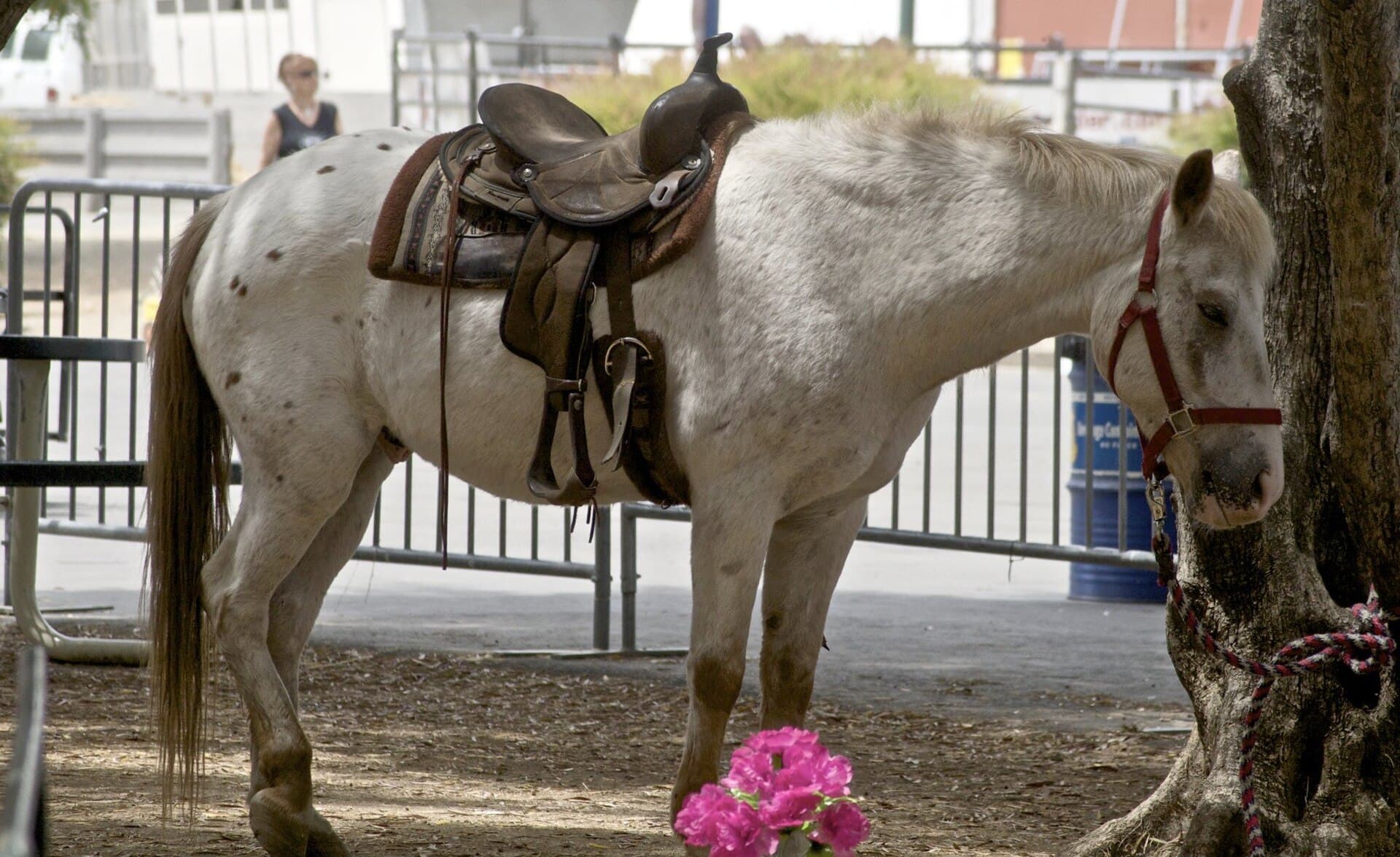
A spotted Pony of the Americas.

The Pony of the Americas began in the 1950s
Les Boomhower founded the Pony of the Americas Club in Iowa in 1954. The aim was a pony that children could ride and show in several disciplines. The colt Black Hand became the first registered animal. Breeders subsequently used several pony and small-horse backgrounds to develop the type. Height limits changed over time, with the present 56-inch upper limit taking effect in 1986. POA therefore names an organised breed, rather than serving as a general label for every spotted pony.
Sources for this section: POAC [1]
The POA standard describes a pony about 1.17 to 1.42 m tall
The POAC specifies an adult height of 46 to 56 inches at the withers, approximately 1.17 to 1.42 m. Its standard calls for balance, a short back, a deep chest, developed muscle and correctly aligned limbs. The head may have a slightly concave profile. These features describe the type sought in assessment. Ponies outside the height range can enter a different identification category, with different showing opportunities, rather than automatically having the same status as a pony meeting the permanent-registration requirements.
Sources for this section: POAC [2]
POA coat patterns take several forms
POAs can have leopard spotting, a white area over the quarters with or without spots, or white hairs that become more extensive with age. Mottled skin, the visible white part of the eye and striped hooves contribute to the characteristics considered by the club. These should not be confused with every form of pinto marking. The LP variant contributes to leopard complex, while other variants affect the amount of white. Two POAs can therefore have very different patterns without that difference alone explaining their registered ancestry.
Sources for this section: POAC [3] · UC Davis VGL [6]
POAs support young riders across several disciplines
POAs are used for western riding, jumping, dressage, trail riding and driving. Club activities include timed games, skill-based events and ridden or in-hand classes. The breed’s size and original purpose support its role as a young rider’s mount, but they cannot establish whether one pony suits a particular child. Education, experience and appropriate supervision remain important. A pony that has learned one activity still needs preparation before being expected to understand a different set of tasks.
Sources for this section: POAC [5]
POAC registration includes several categories
The POAC studbook records pedigrees and distinguishes tentative registration, permanent registration and identification categories. Moving to permanent status involves checking height and coat characteristics. Separate categories accommodate ponies outside the height limits or lacking sufficient colour characteristics. Some crosses with approved breeds are permitted. The precise status on a pony’s documents therefore says more than the mere presence of a registration number. It helps explain which breeding and showing conditions apply to that individual.
POA registry totals describe growth over time
The POAC’s published history records more than 40,000 cumulative registrations by 1996. That figure traces the registry’s growth since foundation; it does not mean that all 40,000 ponies were alive in 1996 or remain alive today. The 2022 coat study used a much smaller group: 58 POAs submitted to the laboratory, with 43 retained after close relatives were removed. This sample was used to study genetic variants, not to measure the current worldwide population of the breed.
Sources for this section: POAC [1] · Avila et al. (2022) [7]
The POA’s LP variant affects coat pattern and night vision
An LP test detects the leopard-complex variant and identifies whether a pony has one or two copies. Two copies, written LP/LP, are associated with congenital stationary night blindness: difficulty seeing in dim light from birth. The amount of white and the number of spots cannot reliably establish this genotype. Testing helps explain possible inheritance in foals and gives a veterinarian useful information when assessing vision. Coat appearance and an individual DNA result therefore have related but different roles.
Sources for this section: UC Davis VGL [6] · Avila et al. (2022) [7]
Sources and review date
Profile reviewed on .
Breed organisations document history, registration rules and uses. The 2022 study examined horses submitted for coat-colour testing; its results describe that sample, rather than a census of the breed.
- POAC — History
The breed’s history and the development of its breeding organisation.
- POAC — Judging criteria
Conformation, height and movement considered during assessments.
- POAC — Characteristics
Conformation, height and movement considered during assessments.
- POAC — Registration types
Registration requirements, studbook categories and verification of ancestry.
- POAC — FAQ
Uses of the horses and activities offered by breed organisations.
- UC Davis VGL — Leopard Complex
Testing for LP and the link between two copies of the variant and congenital stationary night blindness.
- Avila et al. — Genes, 2022
Avila and colleagues (2022): coat variants, sample sizes before and after removing close relatives, and limitations of the laboratory sample.