
Breeds · breed profile
The French Saddle Pony
Poney Français de Selle · PFS
The French Saddle Pony is a sport pony developed by crossing several breeds. Breeders seek a size suited to young riders, sporting ability and a temperament that makes ridden work easier. Its studbook records parents and specifies permitted crosses. PFS identifies ponies registered in this studbook; being born in France is not enough to qualify.
- Category
- Pony
- Country of origin
- France
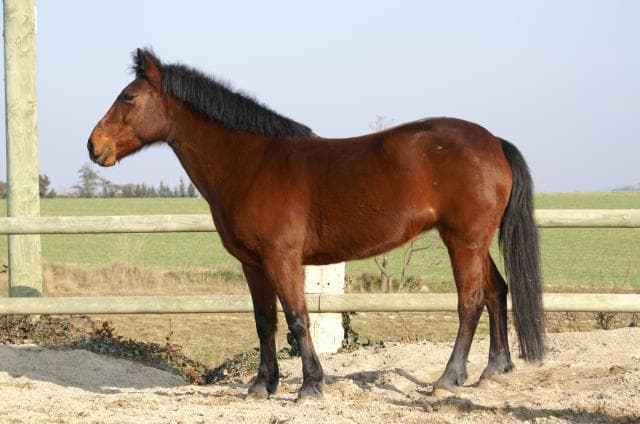
Gambie, a French Saddle Pony mare, photographed in profile in September 2009.

The French Saddle Pony: Developing a French sports pony
The French Saddle Pony: Local mares in western France and the first crosses
During the 1960s, recording local pony mares in Mayenne helped organise breeding that did not yet belong to a single defined breed. Brittany, Normandy and the Pays de la Loire formed part of this homeland. Connemara, New Forest, Welsh and Arabian stallions were used with these mares to produce riding ponies drawing on several sources of ancestry.
The French Saddle Pony: 1969: an association and a crossing framework
The association behind today’s ANPFS was founded in June 1969 by Jean Lassoux and Pierre Drieux. It organised pedigrees and the permitted combinations of breeding animals. The first breeding shows followed in 1970. The original aim was a pony for children that could jump and drive, with conformation approaching that of a riding horse.
The French Saddle Pony: Assessing young ponies before their adult careers
In 1991, the association established a young-pony performance circuit, subsequently opened to other breeds. Selection increasingly used movement, jumping, behaviour and sporting results alongside conformation. Organised performance testing of young stallions began in 2008 to examine their abilities under a structured procedure.
The French Saddle Pony: an open studbook with organised selection
Opening the studbook to foreign pony stallions in 1998–1999 widened the available families, including German, Belgian and Dutch ancestry. The ANPFS gained recognition as a breeding body in 2018, and its programme received ministerial approval in 2024. This history explains the PFS’s varied ancestry: crossing is part of its development, within the studbook’s framework.
Sources for this section: ANPFS · programme [1] · ANPFS · breed [2]
The French Saddle Pony: Sporting conformation and different height requirements
The French Saddle Pony: the balance of a small riding horse
The ANPFS programme seeks a broad chest, good shoulder, prominent withers, a strong back and correct limbs. Balance, ground-covering free movement and a temperament suited to use are part of the objective. The document emphasises this functional combination rather than one fixed head shape or silhouette: families from different crosses can meet the same sporting aim.
The French Saddle Pony: 148 cm: separating the breeding aim from entry conditions
The current description sets no minimum height and gives 148 cm as the ideal maximum. Taller animals can remain in the studbook. Initial registration, however, is limited to 148 cm unshod, alongside the other conditions for that route. Classes also have their own rules: the programme cites 148 cm unshod plus 1 cm for shoes for the National’s three-year-old male class. A competition height limit and a studbook entry condition are therefore different requirements.
The French Saddle Pony: Stallion approval and broodmare labels
Young male breeding candidates are assessed for conformation, movement and jumping ability, then through the applicable testing procedure. For older ponies, performance and the value of their ancestry also matter. Broodmare labels provide further information on conformation, families and results. These records help breeders plan matings; registering a foal does not grant future stallion approval.
Sources for this section: ANPFS · programme [1] · ANPFS · initial registration [3]
The French Saddle Pony: All coat colours are accepted in the PFS studbook
The French Saddle Pony: Colour does not determine breed membership
The French Saddle Pony breeding programme accepts all coat colours. The range of contributing populations helps explain why the PFS is not defined by one colour. The bay mare pictured here shows one possibility, without representing its frequency in the breed. Colour tests can identify variants that parents may pass on; admission depends on pedigree or registration rules rather than a particular colour-test result.
Sources for this section: ANPFS · programme [1]
The French Saddle Pony: From riding lessons to pony competition
The French Saddle Pony: a breed developed for children’s riding
The PFS was selected for riding from the outset. Its history therefore differs from that of an agricultural breed later redirected towards sport. Riding schools and leisure riding are among its uses, alongside specialist competition breeding. The programme also records use by adults, depending on the pony’s size and the activity involved.
The French Saddle Pony: Showjumping, dressage and eventing
In showjumping, pony and rider negotiate a course of fences without faults. Dressage involves a prescribed sequence of precise movements. Eventing combines dressage, cross-country over fixed obstacles and showjumping. Results and indices calculated by IFCE help breeders follow these abilities; a breeding value estimates the heritable component of an ability using performances and family relationships.
The French Saddle Pony: Driving remains part of its versatility
Driving was included in the initial breeding aim and remains in the current programme. It complements ridden uses, although PFS sporting selection relies mainly on riding disciplines. Young-pony classes provide information before the adult career; later results from the pony and its relatives add to the assessment.
Sources for this section: ANPFS · programme [1] · ANPFS · breed [2]
The French Saddle Pony: an open studbook with defined crossing rules
The French Saddle Pony: the ANPFS directs breeding; IFCE maintains records
The Association nationale du poney français de selle, or ANPFS, leads the breeding programme. IFCE applies the studbook rules on its behalf and handles identification and registration in SIRE. The programme consulted covers France and Belgium. By linking each pony to its parents, the studbook makes crosses and their descendants traceable across generations.
The French Saddle Pony: an eligible sire and a dam within the crossing framework
A stallion must be approved or authorised to produce PFS offspring under the provisions applicable to him. The framework accepts PFS mares and mares from other pony studbooks, including Welsh, Connemara, New Forest and Deutsches Reitpony. It also specifies other eligible categories and mares admitted as facteur de PFS, meaning authorised to produce offspring in this studbook. Some categories require at least one pony parent. An arbitrary cross between two breeds therefore does not automatically qualify as PFS.
The French Saddle Pony: Horse–pony crosses follow their own procedure
The French Saddle Pony studbook rules provide, for example, for a PFS-approved stallion measuring no more than 1.40 m unshod to be used with mares of specified horse breeds, including Selle Français, Arabian and Thoroughbred. Certain approved horse stallions may also be used with eligible pony mares of no more than 1.40 m. The application must reach the breeding committee before 31 December of the covering year. The two directions of crossing use different lists, so the precise combination must be checked in the rules.
The French Saddle Pony: Pedigree registration also checks the declared parents
Foal registration requires, among other things, a declared covering, a birth declaration to IFCE, identification, registration fees and compatible parentage testing. The laboratory compares the foal’s DNA with that of its declared parents to check this relationship. Foreign-born offspring can be admitted under the studbook’s conditions through an application to the ANPFS. Place of birth does not replace pedigree requirements.
The French Saddle Pony: Initial registration offers another route
The committee can examine ponies from specified administrative categories and, where provided for, exceptional applications. It considers conformation, movement, ancestry and any official performance, with a maximum of 148 cm unshod. This route admits an animal following assessment of its application; a pony does not automatically change breed because it was born or lives in France.
Sources for this section: ANPFS · programme [1] · ANPFS · horse–pony crosses [4] · ANPFS · initial registration [3] · IFCE · breed composition [7]
The French Saddle Pony: Distribution and documented French births
The French Saddle Pony: Western origins and a wider breeding area today
Births are distributed across France, with Normandy and the Pays de la Loire particularly important. The ANPFS also records growth in the Hauts-de-France and PFS ponies abroad, including through sales for sport. The territory covered by a breeding programme differs from the places where its ponies live or compete.
The French Saddle Pony: 1,892 registered French births for 2024
IFCE’s Annuaire ÉCUS 2025 records 1,892 French Saddle Pony births registered in France for 2024. The SIRE data were extracted on 21 October 2025 and remain provisional because some files were still open. This counts a generation of registered foals, rather than all living PFS ponies or all entries accumulated since the studbook began.
Sources for this section: ANPFS · programme [1] · ANPFS · breed [2] · IFCE · ÉCUS 2025 [5]
The French Saddle Pony: PFS diversity and the tests required of stallions
The French Saddle Pony: a diversity study published in 2009
Leroy and colleagues compared populations bred in France using 11 microsatellite markers, short sequences with different versions among animals. The PFS group contained 50 ponies born from 1996 to 2005, selected without shared parents. Their expected diversity was 0.79: this measures the probability of drawing two different versions of a marker from the group. It does not mean that 79% of ponies were free of disease. The result sheds light on the diversity associated with the breed’s multiple origins at that time.
The French Saddle Pony: PSSM1: testing for a muscle-disease variant
Type 1 polysaccharide storage myopathy, or PSSM1, causes abnormal glycogen accumulation in muscle and can produce stiffness and pain with exercise. The test looks for the causative GYS1 variant. One copy can confer disease risk, while diet and exercise also influence clinical signs. The PFS programme requires screening for all new stallions; this requirement does not measure the variant’s frequency in the breed.
The French Saddle Pony: Myotonia: identifying carriers in relevant families
The congenital myotonia studied in New Forest ponies delays muscle relaxation after contraction. Testing looks for the known CLCN1 variant; a pony with one copy can appear healthy while passing it on. For the PFS, screening has been required since the 2024 breeding season for stallions with a carrier ancestor within five generations. Exemption applies when each parent descending from a carrier has tested clear. The rule follows the relevant ancestry rather than treating every PFS as a New Forest.
The French Saddle Pony: Height testing helps inform crossing decisions
The French Saddle Pony breeding programme requests height testing for stallion candidates with a horse-type ancestor within three generations. It aims to give breeders more information about inherited height. A 2022 INRAE Transfert factsheet describes a three-marker test studied in a group including 48 sport ponies. A genetic result informs one component of height; it does not predict an exact adult measurement in centimetres or replace the measuring procedure required for a class or registration.
The French Saddle Pony: Reporting and publishing results under the programme
The genetic appendix requires a blood sample for these tests and results to be supplied to the ANPFS before stallion approval or authorisation is finalised. A positive result does not by itself exclude the stallion; the owner must take it into account when planning matings. These requirements apply to the specified stallions and circumstances. They are separate from foal parentage checks and from commercial panels offering additional analyses.
Sources for this section: Leroy et al., 2009 [6] · UC Davis · PSSM1 [8] · UC Davis · myotonia [9] · INRAE · height test [10] · ANPFS · programme [1]
Sources and updates
Profile updated on .
The programme currently linked by the ANPFS, uploaded in its April 2026 folder, cites ministerial approval on 4 July 2024. Its registration rules and testing appendix are distinguished from population statistics, diversity research and laboratory tests.
- ANPFS — Programme de sélection du Poney Français de Selle
Document linked by the ANPFS in its April 2026 folder; page 5 cites ministerial approval on 4 July 2024. History, conformation, crossing rules on pages 26–28 and tests on page 40.
- ANPFS — Le Poney Français de Selle
Origins, conformation, uses and distribution. Annual registration announcements are not living-population censuses.
- ANPFS — Inscription à titre initial
Entry routes, application and 148 cm unshod limit for this procedure.
- ANPFS — Croisement cheval–poney
Conditions for both crossing directions, pony-parent height and prior application.
- IFCE — Annuaire ÉCUS 2025, page 22
1,892 registered PFS births in France for 2024; provisional SIRE data extracted on 21 October 2025.
- Leroy et al. (2009) — Genetic diversity of a large set of horse breeds raised in France assessed by microsatellite polymorphism
Genetics Selection Evolution, 41:5, DOI 10.1186/1297-9686-41-5. Fifty PFS ponies born in 1996–2005 and 11 markers; Tables 1 and 2.
- IFCE — La composition raciale, 14 November 2024
Explains contributions from several breeds, using the open PFS studbook as an example.
- UC Davis — Polysaccharide Storage Myopathy
GYS1, muscle signs, dominant inheritance and the influence of diet and exercise.
- UC Davis VGL — Congenital Myotonia in the New Forest Pony
Recessive disorder, CLCN1 variant and carrier identification. The PFS requirement comes from its own programme.
- INRAE Transfert — Génotypage d’un gène majeur gouvernant la taille au garrot des Poneys Français de Selle, 22 March 2022
Institutional description of a three-marker test and a group of 48 ponies; breeding information rather than an exact prediction in centimetres.