
Breeds · breed profile
The Poitou donkey
Baudet du Poitou · Âne du Poitou
The Poitou is a large donkey breed from western France. Its breeding developed around mule production: a male donkey is mated with a Poitevin draught mare to produce a Poitevin mule. Female donkeys produce the donkey foals needed to maintain the breed. This history helps explain the powerful build breeders seek and the close connection between these three populations.
- Category
- Donkey
- Country of origin
- France
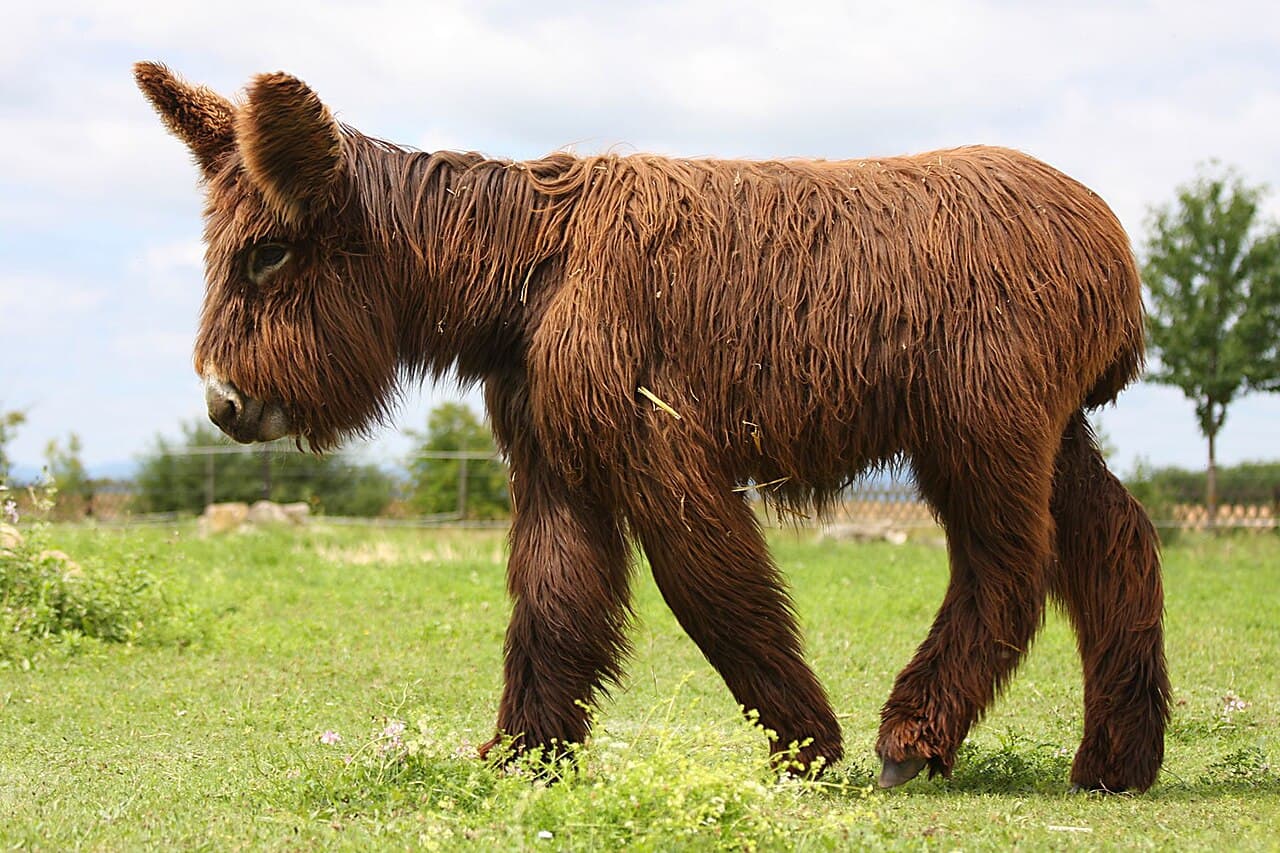
A one-year-old female Poitou donkey. The French breed name Baudet du Poitou applies to females as well as males.

The origins of the Poitou donkey and the rescue of the breed
The Poitou donkey: a donkey bred in Poitou to produce mules
The breed takes its name from Poitou in west-central France. Its original breeding area covers Deux-Sèvres and the neighbouring departments of Vienne, Vendée, Charente and Charente-Maritime. A description published in 1717 already identifies this donkey as breeding stock used to produce mules. Its documented history is therefore closely tied to that of the local horses bred to produce these hybrids.
The Poitou donkey: the male donkey, the mare and the Poitevin mule
A mule is the offspring of a male donkey and a mare. In Poitevin mule breeding, the father is a Poitou donkey and the mother a Poitevin Mulassier, a French draught horse breed. The offspring inherits genetic material from both parents. Since mules are usually sterile, mule production depends on maintaining both parent breeds: female donkeys are needed to produce future breeding males, and some mares must be mated with Poitevin stallions to maintain the horse population.
The Poitou donkey: From mule production to the decline of animal traction
In the nineteenth century, mule production supported a network of breeders and private establishments keeping breeding males. Poitevin mares were used extensively for this purpose. The studbook for the Poitou mule-producing breeds was established in 1884 to record animals and their ancestry. During the twentieth century, particularly with the spread of motorisation after the Second World War, demand for working mules collapsed. The donkey and horse breeders who supplied them lost their main market together.
The Poitou donkey: the 1977 survey and the conservation effort
In France, Annick Audiot’s 1977 survey found only 44 Poitou donkeys: 20 males and 24 females belonging to 14 owners. In November 1979, local organisations, the French national studs and the Marais Poitevin regional nature park agreed on a rescue programme. An experimental donkey breeding centre was to help organise reproduction, improve breeding techniques and pass on knowledge. Rebuilding the population subsequently involved tracing the surviving families and a regulated programme of crossing with female donkeys from outside the breed.
Sources for this section: RMP / IFCE · breeding programme [1] · CREGENE · conservation and uses [4] · Breed organisation · Poitevin mule [3]
The build sought in the Poitou donkey
The Poitou donkey: a large donkey with a powerful body and limbs
The Association nationale des races mulassières du Poitou defines the breed standard, the document describing the characteristics breeders seek. It calls for a large, long head, long open ears covered with hair and a strong neck. The back is long and straight, the loin well joined to the body and the croup as long as it is wide. The chest is broad, the ribs rounded, the limbs powerful and the joints very broad. The feet are wide and open. This build reflects selection for breeding animals intended to produce large working mules.
The Poitou donkey: How to read the height guidelines
The Baudet du Poitou breeding programme approved on 17 June 2023 gives an ideal minimum height at the withers of 1.40 m for an adult male and 1.35 m for an adult female, at five years old. These are targets in the breed standard. They are neither measured population averages nor a range covering every animal’s height. The programme does not present them as a rule that determines breeding approval on its own.
The Poitou donkey: How potential breeding animals are assessed
Male approval takes account of conformation, movement and, for breeding Poitou donkeys, the genetic contribution of the animal’s family. Judges assess both the animal and how strongly its ancestors are represented in the population, helping to retain less common families. The programme also includes behaviour assessments and practical work tests: in-hand training, carrying a pack saddle, driving or pulling. These tests allow assessors to observe the animal during training and actual work.
Sources for this section: RMP / IFCE · breeding programme [1] · Breed organisation · Poitou donkey [2]
The Poitou donkey’s dark colour and long coat
The Poitou donkey: Brown to black, with lighter areas
The Baudet du Poitou breed standard describes colours ranging from dark bay to black with light points: a dark coat with paler areas around the muzzle and eyes and underneath the body. The belly and inner thighs are light grey; the areas around the mouth, nose and eyes are silvery grey with a reddish border. The hair can lighten to a shade traditionally called fougère in French. Scattered white hairs and dark stripes along the back or across the shoulders are among the markings excluded by the standard.
The Poitou donkey: Long hair and the cords of the coat
Long hair can form felted cords when it is not detangled. The traditional French terms bourailloux and guenilloux refer to donkeys with this abundant coat. Hair length and colour are separate traits. Young donkeys may still have shorter-haired patches, while long cords develop with age. The genetic study discussed below concerns hair length, rather than the brown or black colour of the coat.
Sources for this section: RMP / IFCE · breeding programme [1] · Legrand, Tiret and Abitbol, 2014 [5]
The Poitou donkey: Mule breeding and the work donkeys do today
The Poitou donkey: Breeding males for working mules
Historically, the Poitou donkey’s main role was to supply males for mule breeding. Poitevin mules were valued for draught work and farming. Their uses also include carrying loads: a pack saddle holds the load on the animal’s back, such as walkers’ luggage on mountain trails. Breeders select the male donkey and the mare for complementary qualities to produce the working animal they seek.
The Poitou donkey: Driving, pack work and farm traction
Poitevin mule production continues today on a small scale. Poitou donkeys also work directly in leisure driving, carrying packs and some agricultural tasks, particularly market gardening, where they pull implements to cultivate the soil. For mules, the breeding programme also lists logging work, moving cut timber, and work in vineyards. These activities give the animals practical roles alongside the conservation of their parent breeds.
Sources for this section: Breed organisation · Poitevin mule [3] · CREGENE · conservation and uses [4] · RMP / IFCE · breeding programme [1]
The Poitou donkey: Poitou breeding and the studbook
The Poitou donkey: the breed association and the IFCE
The Association nationale des races mulassières du Poitou is responsible for the breeding programme and the breed’s direction. It delegates the practical maintenance of the studbook to the Institut français du cheval et de l’équitation, or IFCE, which records the animals in the SIRE database and issues their identification documents. The studbook links each animal to its parents, allowing families to be traced across generations. Males can receive approval for breeding Poitou donkeys or for mule production under the conditions applying to each use.
The Poitou donkey: Why the register has a Register A and a Register B
Register B records descendants of the grading-up programme, in which female donkeys from outside the breed were mated with Poitou males. Female descendants were then mated back to males of the breed over successive generations. Labels such as F1 and F2 track that progression. Register A includes purebred animals and some descendants of this programme admitted under the rules; descendants registered in Register A from F7 onwards are considered purebred. Entry of new foundation females into Register B closed on 1 January 2008. CREGENE reports that the Marais Poitevin park herd reached the seventh generation and completed its grading-up programme in 2024.
The Poitou donkey: Registering foals and checking their parents
Registration through ancestry requires, among other conditions, a declared mating with an approved male, a birth declaration, identification of the donkey foal and the parentage checks specified in the rules. In France, these checks apply to Register B females and to both sexes in Register A. The laboratory compares the foal’s DNA with that of its declared parents to check whether the parentage is compatible. The Poitevin mule register also checks the origins of the Poitou father and Poitevin mare, together with the other registration conditions.
Sources for this section: RMP / IFCE · breeding programme [1] · CREGENE · conservation and uses [4]
Where Poitou donkeys are bred and what the figures count
The Poitou donkey: a French breeding area and herds abroad
Breeding remains connected to the five departments of the breed’s original area, but has spread to other French regions and abroad. The 2023 breeding programme documents herds in Germany and Belgium, among other places, using breeding activity in 2021 and 2022. The association’s stated administrative area covers the European Union, the United Kingdom and Switzerland. This defines the scope of its programme, rather than listing every country where Poitou donkeys live.
The Poitou donkey: Births in 2024 and breeding animals in 2025
According to SIRE data published by the breed organisation, 123 Poitou donkey births were registered for 2024: 114 in France, six in Germany and three in Belgium. For 2025, the same source reports 47 active breeding males and 243 Poitou females covered in France. Registered births count the donkey foals recorded for one year; the other two figures track adults used for breeding in France during a different year.
The Poitou donkey: What these figures can tell us
The 243 females covered do not represent 243 births: a mating does not always result in a live foal, and birth occurs later. Similarly, the 47 active males exclude young animals, males not used that year and animals outside France. These indicators track breeding activity and the renewal of the breed. They do not give the total number of Poitou donkeys alive worldwide in 2026.
Sources for this section: RMP / IFCE · breeding programme [1] · Breed organisation · Poitou donkey [2]
The Poitou donkey: the breed’s families and DNA tests for long hair
The Poitou donkey: Keeping several families in future generations
After such a severe population decline, many animals may share the same ancestors. Recommended matings aim to limit inbreeding, meaning reproduction between related animals, and to pass on less common ancestry. The programme provides individual mating charts for females and considers the most widely represented ancestors when approving males. Breeders can therefore compare several males for the same female using their family relationships.
The Poitou donkey: a 2014 study of hair length
Legrand, Tiret and Abitbol investigated why Poitou donkeys have long hair. Their study, published in 2014, included 35 long-haired Poitou donkeys and 67 short-haired donkeys from six other French breeds, sampled in France between September 2012 and October 2013. They also used DNA from 131 horses and ponies as controls. The researchers studied FGF5, a gene involved in controlling hair growth.
The Poitou donkey: Two variants explaining long hair in the study group
Of the 35 Poitou donkeys studied, 31 had two copies of the FGF5 variant c.433_434delAT associated with long hair. The other four carried that variant together with a second variant in the same gene, c.245G>A, also associated with long hair. In both cases, both versions of the gene carry a change that reduces its usual role in limiting hair growth. Animals were included at their owners’ request, and the 35 Poitou donkeys had been selected for long hair. These results describe that group, rather than measuring variant frequencies throughout the breed.
The Poitou donkey: What the hair-length test is used for
A DNA test looks for these variants to clarify what an animal can pass to its offspring. A short-haired donkey can carry a long-hair variant without showing the trait, because inheritance is recessive: long hair appears with two long-hair versions, identical or different, one inherited from each parent. Testing can therefore help identify carriers in crossbreeding. It provides information about hair length; studbook membership depends on parentage and the registration rules described above.
Sources for this section: RMP / IFCE · breeding programme [1] · Legrand, Tiret and Abitbol, 2014 [5] · UC Davis · long-hair test [6]
Sources and review date
Profile reviewed on .
The breeding programme sets out the characteristics breeders seek and the studbook rules. The breed organisation and conservation body document the history and breeding activity; the research paper explains the findings on long hair. The breeding figures above are those published by the breed organisation when consulted on 6 November 2026.
- Races mulassières du Poitou — Poitou donkey breeding programme and Poitevin mule register (PDF)
Validated on 17 June 2023; hosted by the IFCE at a September 2025 address. Standard, selection objectives, Registers A and B, male approval, identification and parentage; breeding activity in 2021 and 2022.
- Races mulassières du Poitou — Baudet du Poitou
Breed presentation and SIRE data: registered births for 2024 by country and breeding activity in France in 2025. Consulted on 6 November 2026; these annual figures are not a worldwide census of living animals.
- Races mulassières du Poitou — Mule poitevine
Crossing Poitou males with Poitevin mares, the history of mule production, pack work, traction and driving.
- CREGENE — Baudet du Poitou
The 1977 survey, the start of the conservation effort in 1979, donkey uses and completion of the park herd’s grading-up programme in 2024.
- Legrand, Tiret and Abitbol (2014) — Two recessive mutations in FGF5 are associated with the long-hair phenotype in donkeys
Genetics Selection Evolution, 46, 65. Study of 102 donkeys sampled in France in 2012–2013, including 35 long-haired Poitou donkeys, with 131 control horses and ponies. Identification of two recessive long-hair variants.
- UC Davis Veterinary Genetics Laboratory — Long Hair (donkey)
Description of the donkey hair-length test and recessive inheritance of the two variants tested.