
Breeds · breed profile
Poitevin Mulassier
The Poitevin Mulassier, bred for draught work and mule production
The Poitevin Mulassier is a large draught horse whose mares were selected to produce mules with the Baudet du Poitou donkey. Its long frame, broad feet and abundant feathering are characteristic. Horse, donkey and hybrid are three distinct populations connected by a shared breeding history.
- Category
- Horse
- Country of origin
- France
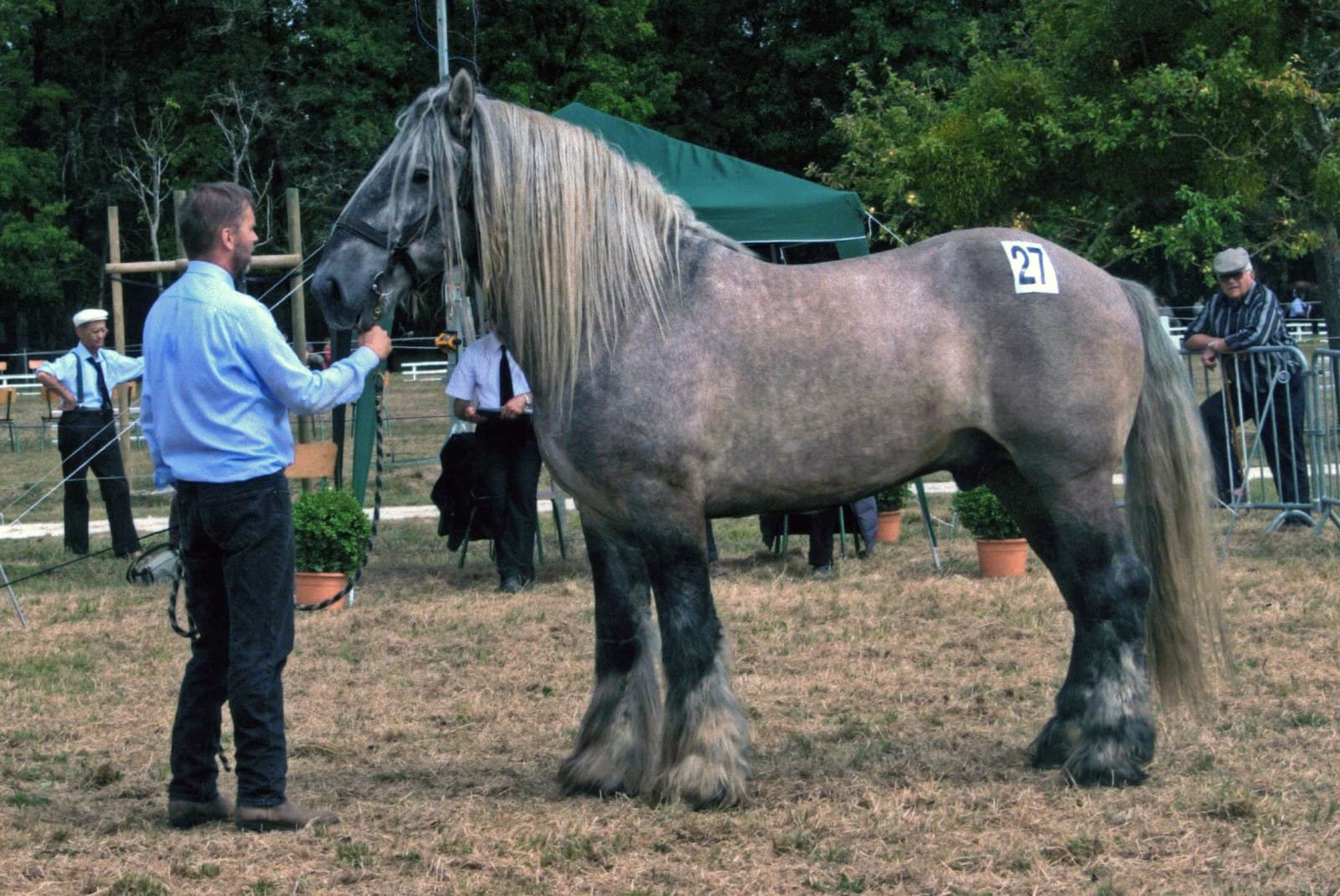
Leonardo 11, a Poitevin stallion shown in hand.

The Poitevin Mulassier: Marshland horses and mule breeding
The Poitevin Mulassier: a studbook established in 1884
The Poitevin’s development is associated with western France’s marshlands and the mule industry. The breeding programme presents early contributions from northern European horses as a historical hypothesis, not a demonstrated pedigree for every animal. The studbook for the Poitou mule-producing breeds was established in 1884. Today’s organisation brings together breeders and conservation partners working with the horse, donkey and mule.
Sources for this section: Races mulassières du Poitou [1]
The Poitevin Mulassier: a large horse with a long frame
The Poitevin Mulassier: Broad feet and abundant feathering
Races mulassières du Poitou describes the desired traits of the Poitevin Mulassier in its breeding programme. This document guides the choice of breeding animals. The Poitevin Mulassier breed standard describes a strong, fairly long head, sloping shoulder, long back and deep chest. Powerful limbs have broad joints and abundant feathering, meaning long hair around the lower legs. At age five, the desired minimum height is 1.65 m for males and 1.60 m for females. These are standard objectives, rather than a claim that every individual has the same dimensions.
Sources for this section: Races mulassières du Poitou [1]
The Poitevin Mulassier: a range of Poitevin coat colours
The Poitevin Mulassier: Preferred colours are not an exhaustive list
The Poitevin Mulassier breeding programme allows varied colours and particularly mentions isabelle, black, noir pangaré and grey, with limited white markings. Pinto patterns are excluded. These traditional descriptions identify accepted appearance but do not replace testing for the variant responsible for a dilution or greying. A horse’s visible colour therefore cannot establish every colour it may transmit to its offspring.
Sources for this section: Races mulassières du Poitou [1]
The Poitevin Mulassier: Draught work and Poitevin Mule production
The Poitevin Mulassier: Two complementary breeding purposes
Poitevin horses can be used for traction, driving and leisure activities. Mule production involves mating a Poitevin mare with a Baudet du Poitou jack to produce a Poitevin Mule. The resulting hybrid is not a Poitevin horse foal. Conserving the horse population also requires matings between eligible horses to produce replacement mares and stallions for future generations.
Sources for this section: Races mulassières du Poitou [1]
The Poitevin Mulassier: Registers A and B of the Poitevin studbook
The Poitevin Mulassier: Keeping the record of breeding contributions
The studbook is the register that records the identity and ancestry of animals admitted to the breed. The responsible organisation is Races mulassières du Poitou. The programme validated on 17 June 2023 distinguishes registers A and B. Offspring of two register A parents enter register A, while those with a register B dam and register A sire enter register B. Initial entry and movement between studbooks are possible under defined conditions. Documents for animals from grading-up crosses record their generation within the breed, so registration does not erase that ancestry.
Sources for this section: Races mulassières du Poitou [1]
The Poitevin Mulassier: Renewing horses alongside the mule industry
The Poitevin Mulassier: 74 registered horse foals in 2021
The Poitevin Mulassier breeding programme records 74 registered foals of the breed in 2021. It lists 26 Poitevin Mules separately, born from a Poitevin mare and a Poitou donkey jack. For 2022 it reports 210 mares put to breeding: depending on the male chosen, a mare can produce a horse foal or a mule. Some mares were covered twice, so the covering categories do not all represent different mares. Breeding remains associated with Deux-Sèvres, Vendée and neighbouring departments, with breeders elsewhere in France too.
Sources for this section: Races mulassières du Poitou [1]
The Poitevin Mulassier: Genetic diversity guides mating choices
The Poitevin Mulassier: Maintaining families rather than multiplying one line
Preserving diversity is a central programme objective. Stallion approval considers genetic contribution by examining ancestors and how widely the family is represented. DNA parentage testing checks declared origins; it does not certify freedom from inherited disease. In a small population, retaining different family lines preserves future mating options and reduces repeated breeding between close relatives.
Sources for this section: Races mulassières du Poitou [1]
Sources and review date
Profile reviewed on .
The documents below were used to prepare this profile of the Poitevin Mulassier. They explain which animals can enter the studbook and how breeding animals are selected.
- Races mulassières du Poitou — Studbook rules and breeding programme, 17 June 2023
Programme validated on 17 June 2023: standard, registers A/B and 2021 figures separating horses from mules.