
Breeds · breed profile
The Percheron
Cheval Percheron · heavy draught and diligencier types
The Percheron is a draught horse from the Perche region of western France. Transport, farming and international trade shaped the selection of horses that could pull with strength and active movement. The French studbook now describes a heavier draught type and a more extended diligencier type within the same breed, which also has established breeding populations abroad.
- Category
- Horse
- Country of origin
- France
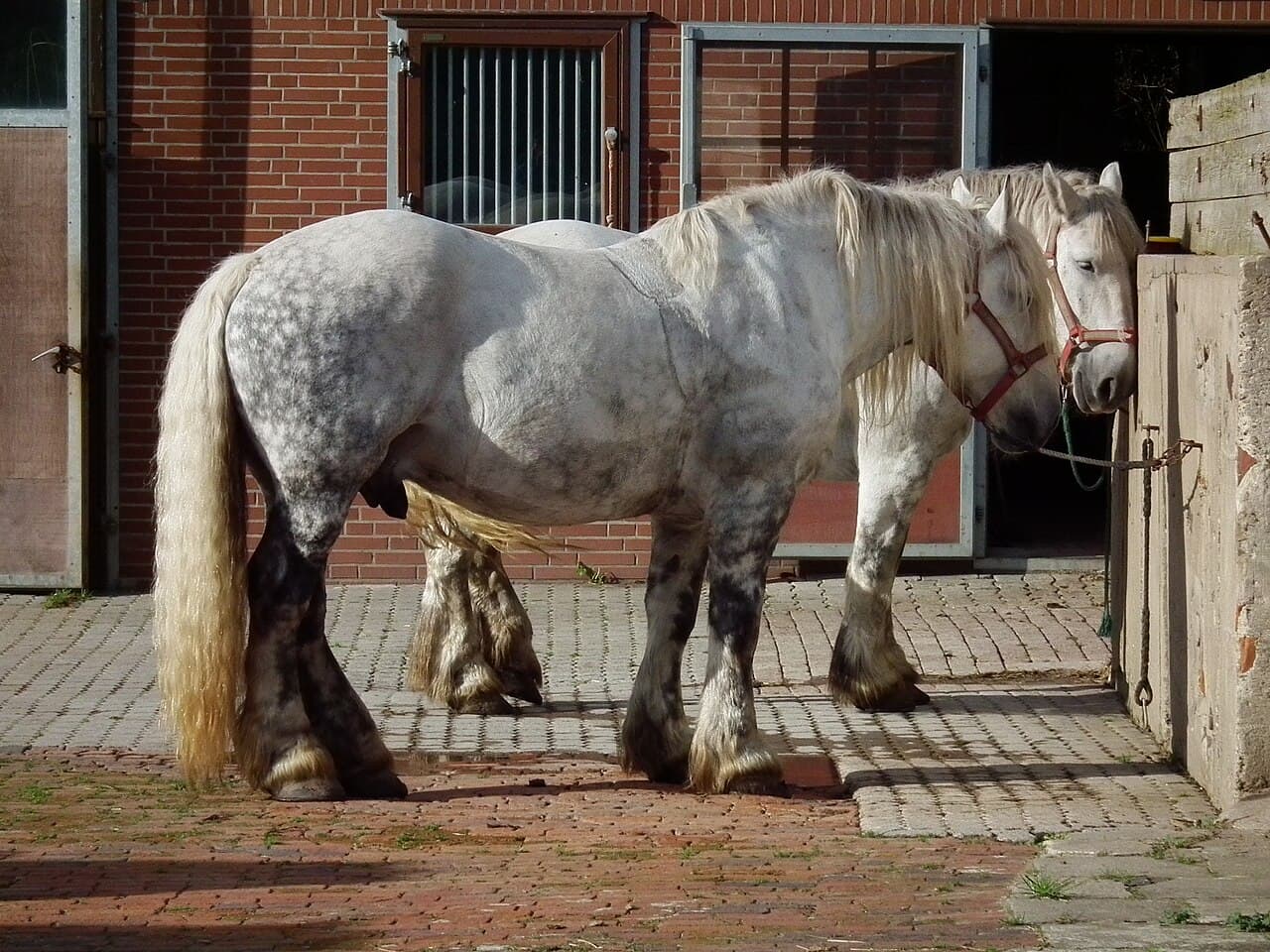
Grey Percherons photographed on the German island of Juist on 28 September 2010.

The Percheron: From the Perche to international breeding
The Percheron: Horses bred for pulling and travelling
The Percheron’s homeland lies around the Huisne valley, between Nogent-le-Rotrou, Mortagne-au-Perche and La Ferté-Bernard. During the nineteenth century, farms and urban transport needed horses that could move loads while maintaining an effective walk and trot. Parisian omnibuses, horse-drawn vehicles carrying groups of passengers, were among the markets that helped shape this breeding tradition.
The Percheron: the French studbook opened in 1883
Breeders founded the Société hippique percheronne de France (SHPF) and opened the studbook in 1883. This register records horses’ identities and families, allowing ancestry to be traced through generations. Its creation gave an existing breeding tradition a shared framework; it was not the moment when horses first appeared in the Perche.
The Percheron: Mechanisation changed the demand for horses
After the Second World War, tractors and motor vehicles replaced much of the work previously done by harness horses. Breeding continued through new uses and populations established overseas. The British Percheron Horse Society, founded in 1918, is one example of this international organisation. National societies maintain their own registers, with admission rules that need to be checked for the country concerned.
Sources for this section: Perche regional park [1] · British Percheron Horse Society [3]
Percheron build, limbs and movement
The Percheron: Two types in the French breed standard
The French Percheron breed standard describes two types within the same studbook. The heavier draught type is intended to pull substantial loads. The diligencier is lighter and is bred for driving and leisure, with movement suited to these activities. At inspections, judges assess each horse in relation to its type.
The Percheron: a structure suited to draught work
The Percheron studbook rules seek an expressive head, a medium to long neck, a sloping shoulder and a straight, muscular back. The hindquarters should be broad, the joints clearly defined and the hooves made of sound horn. Feathering on the lower limbs is limited. At both walk and trot, the desired action is active and ground-covering, with the hind legs reaching under the body.
The Percheron: a broad size range in the standard
The 2024 French standard gives a height range of 1.55–1.85 m and a weight range of 500–1,200 kg. These figures describe widely differing builds, from a lighter horse to a large draught animal. They are not a measured population average; the text notes that larger heights are particularly valued in French selection.
Sources for this section: SHPF / IFCE, 2024 [2]
The Percheron: Black and grey in the French register
The Percheron: Colour rules depend on the studbook’s country
The French studbook accepts black and grey in their various shades. The rules specify that chestnut, which sometimes occurs in North America, is not accepted in France. For an imported horse, both its original registration and the French admission conditions therefore matter; the breed name alone does not establish eligibility.
The Percheron: a grey horse may become almost white with age
Greying gradually lightens the hair of a horse born with a pigmented coat. A grey Percheron may pass through a dappled stage before appearing almost white in later life. Its adult appearance and foal colour describe different stages of that process. A photograph records appearance, but cannot establish a DNA test result on its own.
Sources for this section: SHPF / IFCE, 2024 [2]
The Percheron: From haulage to present-day work
The Percheron: Farming, transport and forestry
Percherons pulled farm implements, passenger vehicles and goods. The heavier type remains associated with work requiring substantial pulling power. In horse logging, for example, the horse draws timber to a place vehicles can reach. Horse and handler must combine effort with accurate steering through the spaces between trees.
The Percheron: Driving, leisure and local services
The Perche regional park describes present-day uses in recreational and competitive driving, riding, vineyards and the maintenance of natural areas. Some local authorities also use horse-drawn vehicles for rounds or visitor trips. The distinction between a heavy type and a diligencier becomes meaningful in relation to the task and the horse’s training.
Sources for this section: Perche regional park [1]
The Percheron: Registration and selection in France
The Percheron: the roles of SHPF and IFCE
SHPF represents the breed and helps define studbook rules; the Institut français du cheval et de l’équitation (IFCE) carries out the prescribed administration and registration. The rules distinguish entry by descent, initial entry under specific conditions and importation from a recognised foreign studbook. Registration as a foal and later acceptance for breeding are separate steps.
The Percheron: Parents accepted for breeding in the studbook
Entry by descent requires, among other conditions, an approved sire, a registered and confirmed dam, a declared mating and identification of the foal. Prospective stallions are examined by an approval panel. Mares also undergo confirmation before producing within the studbook, so a recorded pedigree does not replace this assessment.
The Percheron: What a DNA comparison checks
Parentage testing compares a foal’s DNA with that of its declared parents to check whether they are compatible. Since 2009, new stallions must have parentage checked before their first breeding permit; since 2010, mares must be DNA typed before their first offspring is registered. Typing provides an identification profile for comparisons. It does not automatically test disease variants.
Sources for this section: SHPF / IFCE, 2024 [2]
The Percheron: Distribution and annual birth figures
The Percheron: a French breed with several foreign studbooks
The French rules recognise Percheron studbooks in countries including the United States, Canada, the United Kingdom and Brazil. This distribution has produced populations selected in different settings. A horse may be registered again when it moves countries. Adding entries from different studbooks without matching identities therefore does not count distinct animals.
The Percheron: 897 births in France in 2021
Races de France reports 897 Percheron births in France in 2021. This is an annual production figure, not the number of Percherons alive in 2026. The studbook itself retains horses from many generations, including animals that have died. Its records answer questions about ancestry rather than providing a current census.
Sources for this section: SHPF / IFCE, 2024 [2] · Races de France, 2021 [4]
The Percheron: PSSM1, muscle research and family records
The Percheron: PSSM1 testing looks for a GYS1 variant
The PSSM1 DNA test detects a GYS1 variant that changes the production of glycogen, an energy store in muscle. A single copy can cause abnormal storage and muscle signs. UC Davis lists the Percheron among breeds for which the test is relevant. A negative result excludes the variant tested, but does not explain every other possible cause of muscle pain or exercise intolerance.
The Percheron: PSSM1: a 2012 study in a research herd
Naylor and colleagues genotyped 125 Belgian and Percheron horses at one Auburn University facility, then selected three groups of eight according to their number of copies of the variant. Muscle biopsies were available for 18 of these 24 horses. The findings linked two copies with more marked muscle pathology. This herd and the selected groups cannot establish the variant’s frequency across all Percherons.
The Percheron: Pedigree records and health tests answer different questions
Parentage testing supports reliable family records, whereas PSSM1 testing establishes whether a horse carries the variant studied. A health result and a comparison of ancestors therefore provide complementary information when planning a mating. A favourable result for one variant does not measure diversity across families, which also depends on how many breeding animals contribute and how widely they are used.
Sources for this section: UC Davis, PSSM1 [6] · Naylor et al., 2012 [5] · SHPF / IFCE, 2024 [2]
Sources and review date
Profile reviewed on .
The French Percheron rules in force since 1 January 2024 define the breed’s types, accepted colours and registration requirements. The Perche regional park and the British breed society document its history and uses. Birth figures and muscle-disease studies cover different years and groups of horses, identified in the profile.
- Parc naturel régional du Perche — Retracez son histoire
Regional history, the opening of the studbook in 1883 and current uses. Stories linking eastern ancestors to the Crusades are not treated as proven pedigrees.
- French Percheron studbook rules, effective 1 January 2024
Rules listed as current by IFCE at review: standard, types, colours, breeding, DNA typing and parentage. The internal 2024 date takes precedence over the hosting folder labelled 2023.
- British Percheron Horse Society — History
The British society’s foundation in 1918 and its own studbook history; its procedures do not replace French rules.
- Races de France — Percheron
897 births in France in 2021: a dated annual figure, not a current living population or worldwide total.
- Naylor et al. — Allele Copy Number and Underlying Pathology Are Associated with Subclinical Severity in Equine Type 1 PSSM
125 Belgian and Percheron horses from one facility, 24 selected for comparisons and 18 biopsied. A severity study rather than a representative breed survey.
- UC Davis Veterinary Genetics Laboratory — Polysaccharide Storage Myopathy (PSSM1)
Purpose of the GYS1 test, inheritance and interpretation. A laboratory offering does not establish current breed frequency or a French studbook requirement.