
Breeds · breed profile
The Paint Horse
American Paint Horse · APHA
The Paint Horse is an American riding horse bred for cattle work and western disciplines. Its breeding combines Paint Horse, Quarter Horse and Thoroughbred ancestry accepted by the American Paint Horse Association (APHA). Large white patches are familiar within the breed, but a Paint can also look solid: registration depends on its ancestry and the rules of its registry as well as its markings.
- Category
- Horse
- Country of origin
- United States
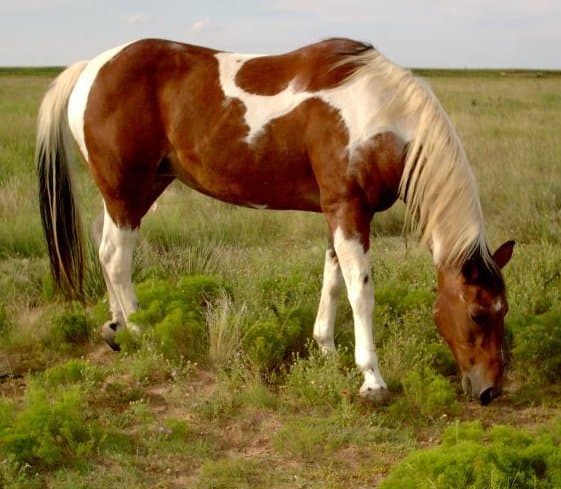
A tobiano Paint Horse grazing.

The Paint Horse: From working horses to an American breed registry
The Paint Horse: the stock-horse type connects the Paint with cattle work
Here, stock horse means a riding horse suited to working cattle. The Paint shares this breeding background with the Quarter Horse, while APHA also accepts Thoroughbred ancestry. This helps explain why its registry combines defined bloodlines with coat requirements, rather than bringing together every horse with white patches regardless of ancestry.
The Paint Horse: Two associations came together in 1965
On 16 February 1962, breeders in Texas founded the American Paint Stock Horse Association to preserve the pedigrees of these horses. In 1965 it merged with the American Paint Quarter Horse Association to form the American Paint Horse Association. A shared studbook could then connect horses with their parents within one organisation.
The Paint Horse: Different activities shape the breeding of different families
APHA went on to organise registration and competitions in conformation, western riding and racing. The handbook distinguishes what each activity assesses: an in-hand class examines body proportions, whereas a ridden class evaluates the horse in motion. Colour remains part of the breed’s identity within this breeding of riding horses.
Sources for this section: APHA · history [1] · APHA · 2026 handbook [3]
The Paint Horse: the athletic conformation sought by APHA
The Paint Horse: Balance comes before muscular bulk
A breed standard describes the horse that a breed organisation wants breeders to produce. In the 2026 APHA handbook, the ideal Paint is balanced first, with correct limb alignment and muscle distributed throughout its body. Judging therefore considers proportions and movement as well as substance, rather than simply rewarding the heaviest muscling.
The Paint Horse: a short head, sloping shoulder and strong back
The ideal has a short head with a broad forehead, large eyes, a clean throatlatch and a proportionate neck. A long, sloping shoulder, deep chest, short strong back and loin, and long croup complete the outline. A muscular hindquarter contributes to the combination of power and mobility sought in this horse.
The Paint Horse: Feet and limb alignment support movement
Legs should be straight and correctly placed beneath the body, with adequate bone and feet. Sloping pasterns help absorb the forces of movement. The handbook’s ideal is assessed through these proportions and examination at the walk and jog; it does not provide a measured average height for all Paint Horses.
Sources for this section: APHA · 2026 handbook [3]
The Paint Horse’s base colours and white patterns
The Paint Horse: White patterns lie over a base colour
A Paint can be chestnut, bay or black, or have a diluted colour such as palomino. Base colours and white patches arise through different genetic mechanisms. A horse that turns grey may also become lighter over time; registration photographs and markings present at birth help preserve its identification.
The Paint Horse: Tobiano, overo and tovero describe different patterns
Tobiano often produces large white areas crossing the topline. APHA uses overo as a broad category for patterns other than tobiano, including frame overo, some sabino patterns and splashed white. Tovero combines tobiano with other white patterns. Overo therefore does not mean one particular variant or a single genetic test result.
The Paint Horse: Minimal markings can conceal a white-pattern variant
The amount of white varies, and several variants can act in one horse. A coat test looks for the specific variants included in that analysis. It may explain subtle markings, but does not replace APHA’s ancestry and registration conditions. Equally, extensive white on a horse of other ancestry does not automatically make it eligible for the Paint registry.
Sources for this section: APHA · breed and patterns [2] · APHA · 2026 handbook [3]
Paint Horses at the ranch, in competition and for leisure
The Paint Horse: Following and separating cattle
Cattle events require a horse to follow an animal, turn and accelerate. Cutting involves keeping one animal apart from a herd, while other events combine cattle work with prescribed exercises. These tasks give a practical meaning to the balance and agility sought in the stock-horse type.
The Paint Horse: From western exercises to recreational riding
APHA competitions include reining, with circles, lead changes and stops; trail, with obstacles and manoeuvres representing situations encountered on a ride; and presentation classes. The association also supports racing and recreational activities. Each has its own criteria, and breed registration is not a sporting qualification.
Sources for this section: APHA · 2026 handbook [3]
How APHA registers a Paint Horse
The Paint Horse: Both parents must belong to accepted registries
Rule RG-015 in the 2026 handbook requires both parents to be registered with accepted organisations: APHA and its predecessors, AQHA for Quarter Horses, or the Jockey Club and Thoroughbred studbooks it recognises. A foal with at least one APHA parent can be eligible for Paint registration even when its white markings do not qualify for the Regular Registry. The Solid Paint-Bred Registry records the pedigrees of horses meeting its conditions.
The Paint Horse: a natural marking can qualify a horse for the Regular Registry
The appearance-based route requires solid white hair with some unpigmented skin beneath it, present at birth and extending more than two inches, or 5.08 cm, within areas defined by RG-070. Location matters as well as size. Certain extensions of leg or face markings require an additional Paint trait. Photographs allow APHA to assess these conditions.
The Paint Horse: the genetics route combines DNA, ancestry and visible traits
For a minimally marked horse, RG-070.E combines a laboratory result with Paint traits such as a blue eye or white leg marking. With two APHA parents, at least one accepted pattern variant and one trait are needed. With one APHA parent, the general rule requires one variant and two traits; exceptions for tobiano or multiple accepted variants allow one trait. APHA determines the category from the complete application.
The Paint Horse: a solid-looking Paint can also enter the Regular Registry
RG-020 provides a pedigree route for certain offspring of two APHA parents, at least one in the Regular Registry, with three connected generations of Paint ancestry on one side beginning with a parent. APHA’s explanatory page describes it for horses that do not qualify through the genetics route. A Regular Registry horse can therefore be recorded as solid: Regular does not necessarily mean visibly spotted.
The Paint Horse: DNA has verified declared parents for new registrations since 2022
APHA requires parentage verification for new registrations from 1 January 2022. The laboratory compares DNA markers from the foal with those of its declared parents to check compatibility. Horses whose parents are only AQHA or Thoroughbred registered must also meet colour conditions and provide the required coat-test results. These American procedures remain separate from identification and national formalities where the horse lives.
Sources for this section: APHA · 2026 handbook [3] · APHA · registration [4]
The Paint Horse: International breeding and a historical registry
The Paint Horse: the United States is the birthplace, not the only breeding country
APHA is based in Texas and works with owners and affiliated associations in several countries. Horses move and breed beyond the United States. The country of origin shown in the directory locates the breed’s development, while the APHA certificate follows a pedigree. Local identification procedures accompany this international organisation.
The Paint Horse: More than a million registrations are not a count of living horses
On its introductory page consulted on 8 November 2026, APHA reports having registered over a million horses since its foundation. This is an international historical total including deceased horses and several generations. It shows the scale of the registry, but does not give the living population in 2026 or the number of foals born that year.
Sources for this section: APHA · history [1]
The Paint Horse: What coat studies and health tests actually measure
The Paint Horse: the 2022 study concerns horses submitted to a laboratory
Avila and colleagues investigated colour and white-pattern variants in records from the University of California, Davis Veterinary Genetics Laboratory. The Paint group contained 2,080 horses before first-degree relatives were removed and 1,020 afterwards, with numbers varying by test. Owners had submitted these horses for coat testing, so the results describe that selected group rather than a random sample of all Paint Horses.
The Paint Horse: the LWO test detects the frame overo variant in EDNRB
The LWO test, also called OLWS, looks for an EDNRB variant linked to frame overo and the development of intestinal nerves. A horse with one copy can transmit the variant without having the lethal intestinal syndrome. Two copies cause a condition incompatible with life. Two carrier parents have a 25%, or one-in-four, chance at each conception of producing an affected foal. Limited white markings do not rule out carrier status.
The Paint Horse: APHA requires stallion results for six targeted conditions
Rule RG-110.E in the 2026 handbook requires stallion results for HYPP, PSSM1, MH, GBED, HERDA and OLWS before registration of foals from breedings after 1 January 2018. These tests look respectively for variants associated with hyperkalaemic periodic paralysis, one form of polysaccharide storage myopathy, malignant hyperthermia, an enzyme deficiency affecting glycogen metabolism, hereditary skin fragility and lethal white overo syndrome. The availability of broader commercial panels does not change this regulatory list.
The Paint Horse: Each result concerns the variant that was tested
The panel’s conditions have different inheritance patterns and consequences. Results must be read condition by condition, considering both prospective parents. A negative result means the targeted variant was not detected; the analysis does not investigate every possible cause of muscle weakness or disease. APHA requirements concern the results to file and registration eligibility, rather than a general certificate of health.
Sources for this section: Avila et al. · 2022 [5] · UC Davis · LWO [6] · APHA · 2026 handbook [3] · UC Davis · health panel [7]
Sources and review date
Profile reviewed on .
The 2026 APHA handbook sets out registration rules and the ideal conformation. Association pages explain the history and procedures; the 2022 study and laboratory references describe the variants studied and what the tests measure.
- APHA — About APHA
Foundation in 1962, merger in 1965, international presence and historical total above a million registrations; undated page consulted on 8 November 2026.
- APHA — The American Paint Horse Breed
Ancestry, colours, patterns and routes into the Regular Registry; detailed conditions checked against the 2026 handbook.
- APHA — Official Rule Book 2026
Official 423-page PDF available on 8 November 2026: RG-015, RG-020, RG-070, RG-110.E and conformation standard. Changes scheduled for 2027 are not applied early.
- APHA — Registration Guides
Photographs and DNA parentage verification for new registrations since 1 January 2022; American procedures distinct from national formalities.
- Avila et al. — Breed Distribution and Allele Frequencies… (Genes, 2022)
Original coat-variant study: 2,080 Paint Horses before relatedness filtering and 1,020 afterwards; test-specific groups and recruitment through test submissions, without a representative breed estimate.
- UC Davis VGL — Lethal White Overo
EDNRB variant, effects of one or two copies and risk from mating two carriers; the test targets this specific variant.