
Breeds · breed profile
The New Forest pony
New Forest Pony
The New Forest pony comes from Hampshire in southern England. Ponies grazing on the open Forest still help maintain its landscape, while breeders in Britain and abroad select registered stock for riding, sport and driving. Living in the New Forest and being registered in the New Forest Pony Studbook are different things.
- Category
- Pony
- Country or region of origin
- United Kingdom
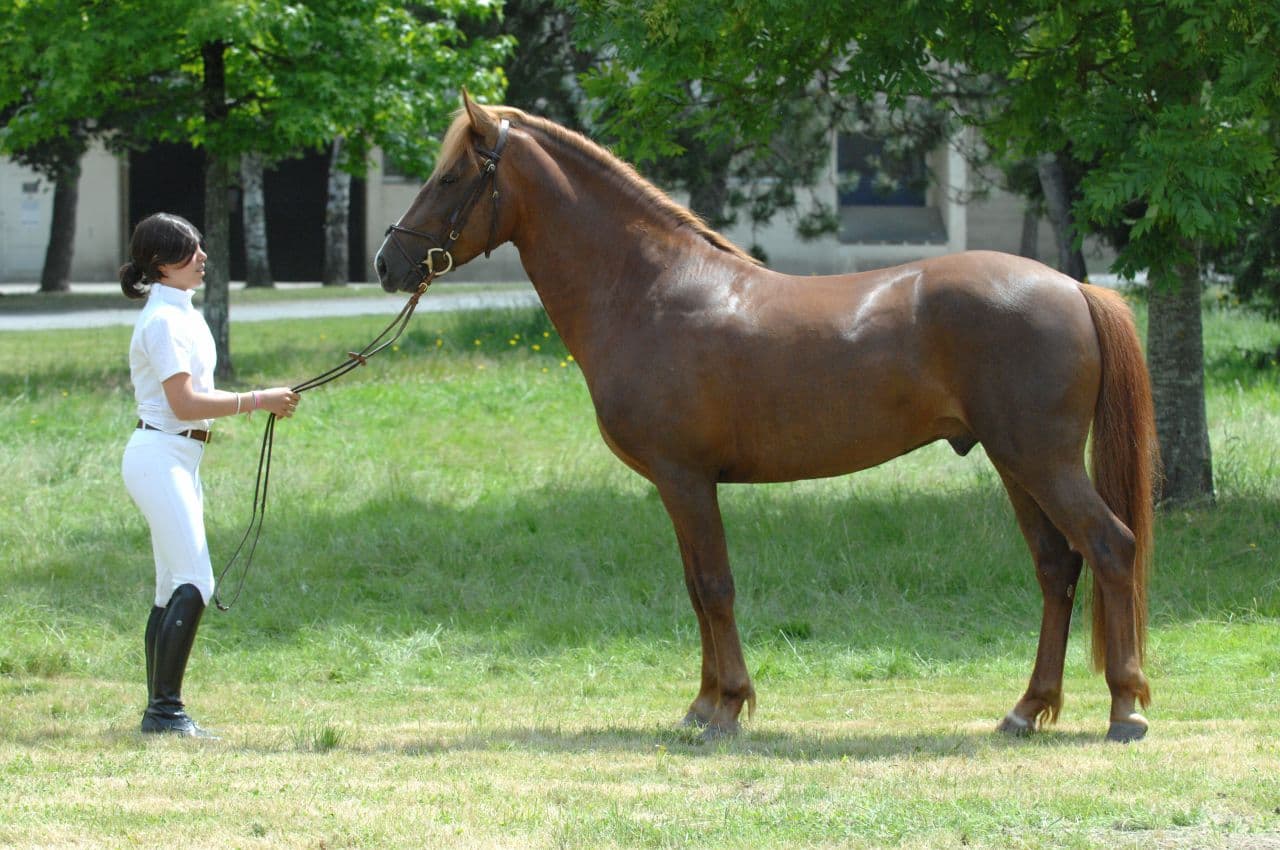
Rockenrol Gevaudan, a New Forest stallion photographed in France in 2009.

Origins and history of the New Forest pony
The New Forest pony: a breed shaped by Hampshire common grazing
The New Forest includes woodland, heath, grassland and wetlands. Commoners occupy properties with grazing rights, allowing them to turn out animals under the rules administered by the Verderers. These ponies have owners. Agisters, employed by the Verderers, supervise the livestock and organise seasonal round-ups for checks and care. This managed grazing system connects pony breeding with the landscape and the people who work there.
The New Forest pony: Working ponies and outside stallions
During the nineteenth century, Forest ponies were sold for work, driving and riding; local races also gave fast ponies a market. Selling and gelding good colts reduced the choice of future breeding males. Owners and Forest authorities introduced various stallions, including Arabians and British pony stock, to improve the herds. Today's New Forest breed grew from these breeding decisions, rather than an isolated population that remained unchanged.
The New Forest pony: Breeders organise a studbook
An improvement society began holding a stallion show in 1891. The Burley and District New Forest Pony Breeding and Cattle Society, founded in 1905, started the studbook and breed show. Breeding later focused more closely on New Forest families: from 1930, only New Forest stallions could run on the Forest. Recording each pony and its declared parents made it possible to follow these families across generations.
Sources for this section: NFPBCS · history [1] · Verderers · commoning [3] · NFPBCS · 2026 programme [2]
The New Forest pony: New Forest conformation and height
The New Forest pony: Substance and a working pony build
The New Forest Pony Breeding and Cattle Society (NFPBCS) publishes the breed standard, describing the traits breeders aim to produce. It calls for sloping shoulders, a deep body, strong quarters, straight limbs with plenty of bone, and sound, round feet. The aim combines the substance of a working pony with a build suitable for riding. Young male inspections assess the head, neck, back, limbs and overall balance.
The New Forest pony: Active movement and willingness to work
Movement should be free, straight and active without exaggeration. The standard seeks a pony that responds to training and to the rider or driver. For a British stallion licence, inspectors assess conformation, type, walk and trot; veterinary examination and DNA checks complete the process. Show results and permission to breed therefore belong to defined assessment procedures.
The New Forest pony: 148 cm is a breed ceiling
The British New Forest breeding programme updated in October 2026 sets an upper height limit of 148 cm and no lower limit. The French programme also specifies 148 cm, without shoes. These are standard limits, rather than a measured breed average. Showing divisions around 138 cm allow ponies of similar size to be compared; they do not create two breeds. Competition measurement requirements come from the relevant sporting rules.
Sources for this section: NFPBCS · 2026 programme [2] · IFCE · French programme 2026 [4]
The New Forest pony: Colours accepted in New Forest ponies
The New Forest pony: Base colours, roan and grey
The British New Forest breeding programme lists bay/brown, black and chestnut, together with roan and grey. A grey pony progressively loses pigment from its hair, so the birth registration form should record its birth colour even though its adult appearance changes. Piebald, skewbald and spotted patterns are not accepted in the approved section. White markings on the head and lower limbs must stay within the standard's boundaries.
The New Forest pony: One Cream copy and two copies have different effects
The current British text allows one copy of Cream, including in stallions. On chestnut it can produce palomino, on bay buckskin, and on black smoky black. Both parents must be fully registered in the main section, with neither carrying two Cream copies. A pony with two copies, such as a cremello, enters the X-Register. Coat testing can establish this status; these British conditions do not replace the French studbook's admission rules.
Sources for this section: NFPBCS · 2026 programme [2] · IFCE · French programme 2026 [4]
The New Forest pony: From Forest work to riding and driving
The New Forest pony: Grazing, transport and harness work
Pony grazing helps keep parts of the Forest open. It is part of livestock management: owners choose which animals to turn out, approved stallions cover mares, and herds are gathered for checks. Ponies also served in transport and harness. Riding still enables people managing the herds to travel over the New Forest's varied ground.
The New Forest pony: Leisure and organised sport
Away from the Forest, New Forest ponies are bred for leisure riding and several sports. The French programme names show jumping, dressage, eventing and driving. In eventing, the same horse and rider complete a dressage test, a cross-country course and a show-jumping round. Sporting selection runs alongside efforts to retain breed type and the qualities needed for outdoor breeding.
Sources for this section: NFPBCS · history [1] · Verderers · commoning [3] · IFCE · French programme 2026 [4]
The New Forest pony: New Forest registration and crossbred registers
The New Forest pony: Where a pony lives does not determine its registration
The NFPBCS holds the studbook of origin. Entry depends on parentage, records and programme requirements. A registered New Forest pony may be bred entirely off the Forest or abroad. Common grazing rights, meanwhile, concern animals owned by commoners: seeing a pony on the Forest does not reveal its studbook category. British Forest Bred status adds specific requirements for conception, birth and time spent on the open Forest.
The New Forest pony: Britain: approved section, X-Register and crossbreds
The British studbook separates the approved section from the X-Register for ponies that do not meet all its requirements. First Cross and Part-Bred registers are separate again. Under the chapter revised in April 2026, a First Cross has one approved New Forest parent and a fully registered purebred parent of another breed. Part-Breds need at least 25% registered New Forest ancestry, with conditions on parental registration. Neither crossbred register provides a route through grading up into the main section.
The New Forest pony: France: Registers A and B and a separate crossbred register
The French New Forest pony association runs the programme, delegating its application and studbook administration to the IFCE. Register A is the main section. Register B includes New Forest offspring with a parent in Register B or not approved for Register A, subject to the rules; a Register B pony cannot later move into A. The separate New Forest de croisement register requires at least 6.25% New Forest ancestry or a registered ancestor in the fourth generation under the 2026 text, with detailed conditions and exceptions. Its offspring cannot enter either A or B.
The New Forest pony: Parentage checks and breeding approval
Parentage testing compares a pony's DNA with that of its declared parents. Approved British colts must have a DNA profile and verified sire before licensing; some reproductive techniques require both parents to be verified. In France, male approval also includes the programme's own myotonia and PSSM1 requirements. Registering a foal and authorising a stallion to breed are therefore separate steps.
Sources for this section: NFPBCS · 2026 programme [2] · IFCE · French programme 2026 [4]
The New Forest pony: New Forest distribution and documented numbers
The New Forest pony: Breeding beyond the Forest
The studbook of origin works with overseas societies, including the French organisation. Off-Forest breeders maintain pony families and sporting selection, while Forest herds continue common grazing. For the 2026 breeding season, the National Park Authority announced 25 selected stallions to run on the Forest from 11 May to 22 June. That is the number of males authorised for this season, rather than the breed's total population.
The New Forest pony: France: 300 registered births for 2024, including crossbreds
The IFCE's ÉCUS 2025 yearbook reports 300 registered births for 2024 in its New Forest category, which includes crossbreds. The SIRE extraction is dated 21 October 2025 and remains provisional because some files are still being processed. This follows one French foal crop and combines purebred and crossbred registrations. It does not give a separate purebred birth total or the number of living New Forest ponies in France or worldwide.
Sources for this section: IFCE · French programme 2026 [4] · IFCE · ÉCUS 2025 [5] · National Park · 2026 season [6]
The New Forest pony: New Forest myotonia, PSSM1 and DNA testing
The New Forest pony: Myotonia investigated in a pony family
In 2012, Wijnberg and colleagues described a seven-month-old New Forest foal with stiffness and episodes of recumbency. They investigated CLCN1, a gene involved in restoring muscle cells to rest. The foal had two copies of the variant under investigation, while each clinically unaffected parent had one. The family investigation supported recessive inheritance; it did not measure how common the disorder was across the breed.
The New Forest pony: Myotonia testing identifies healthy carriers
The test detects the CLCN1 variant associated with this form of myotonia. A pony with one copy can pass it on without being affected. Two carriers have a one-in-four chance of producing a foal with two copies at each conception. British policy particularly targets descendants of Kantje's Ronaldo, with an exemption where both parents have tested clear. French rules have required all stallions to be tested since the 2014 breeding season; a carrier cannot be approved to produce Register A offspring.
The New Forest pony: PSSM1 testing detects a dominant muscle disorder risk
PSSM1 disrupts storage of glycogen, a sugar reserve in muscle, and can cause exercise-related pain and stiffness. The test detects the associated GYS1 variant. One copy is enough to increase disease risk, although signs vary. A parent with one copy has a one-in-two chance of passing it on at each conception. British stallion licensing requires a clear result. France has required results for all stallions since the 2021 breeding season and excludes positives from approval for Register A.
The New Forest pony: the February 2026 PSSM1 update
On 26 February 2026, the NFPBCS reported that retesting Woodfidley Top Gun's retained sample, previously reported clear, had detected one PSSM1 copy. His descendants can therefore no longer be assumed clear through that parentage without testing. The society offers voluntary testing for relevant descendants and states that a positive result does not automatically change their registration or breeding status. This descendant policy is separate from the clear-result requirement for stallion licensing.
Sources for this section: Wijnberg · myotonia [7] · UC Davis · myotonia [8] · UC Davis · PSSM1 [9] · NFPBCS · 2026 programme [2] · NFPBCS · February 2026 update [10] · IFCE · French programme 2026 [4]
Sources and updates
Profile updated on .
The British and French New Forest studbooks each have their own registration rules. The French birth figures quoted also include crossbred foals. The myotonia study follows a family of ponies in which this muscle disorder was observed.
- NFPBCS — History of the New Forest Pony, Dionis Macnair (2011)
Nineteenth-century selection, the societies of 1891 and 1905, and New Forest stallions after 1930.
- NFPBCS — Breeding Programme, updated October 2026
Standard, Cream, registers and parentage; crossbreds revised April 2026 and colt inspection February 2026.
- Verderers of the New Forest — Commoning
Property-based grazing rights, livestock owners and Forest grazing management.
- French association / IFCE — New Forest and New Forest de croisement breeding programme (2026)
Version referring to 2026 Q-named foals; Registers A/B, the 6.25% threshold and stallion tests.
- IFCE — ÉCUS 2025 yearbook, p. 22
300 French births for 2024 including crossbreds; provisional SIRE data at 21 October 2025.
- New Forest National Park Authority — The boys are back! (11 May 2026)
25 stallions turned out for the 11 May–22 June 2026 season.
- Wijnberg et al. — A missense mutation in CLCN1… (2012)
Original clinical report of a seven-month-old foal, family investigation and recessive candidate variant.
- UC Davis VGL — Congenital Myotonia in the New Forest Pony
CLCN1 testing, healthy carriers and recessive inheritance.
- UC Davis VGL — Polysaccharide Storage Myopathy (PSSM1)
GYS1 testing, dominant inheritance and variable muscle signs.
- NFPBCS — 2026 PSSM1 Update, 26 February 2026
Revised result for Woodfidley Top Gun, descendants and voluntary testing policy.