
Breeds and populations · Mustang
Mustang
Mustangs are populations descended from domestic horses living free
Mustang describes horses of the American West whose domestic ancestors escaped or were released. Their descendants live freely in separate herds. Such populations are described as feral: the horses live without daily husbandry but descend from domesticated animals. Mustangs do not all share the same build, ancestry or a single studbook. This profile therefore covers a group of populations rather than one uniform registered breed.
- Category
- Horse populations
- Country of origin
- United States
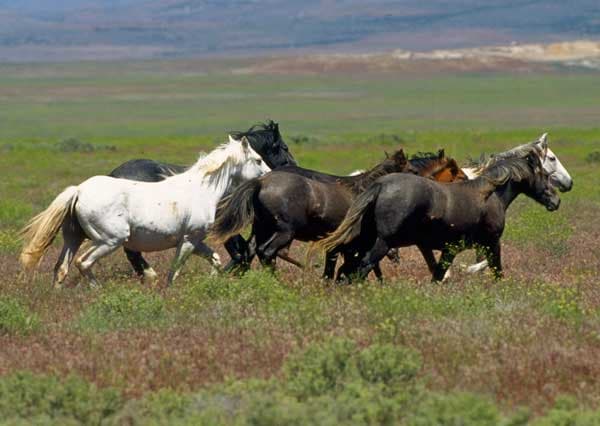
Free-roaming horses on open rangeland in the American West.

Mustangs descend from domestic horses introduced to the Americas
Present-day free-roaming populations developed from horses introduced from the sixteenth century onwards, with further contributions over time. Some horses escaped; others were released. Their descendants formed herds in different regions and environments. Describing every Mustang as solely descended from the earliest Spanish horses therefore oversimplifies a more varied history. The name now covers several western US populations whose local histories can differ substantially. A horse’s herd of origin can be more informative than the broad Mustang label alone.
Sources for this section: BLM [1]
Mustangs have no single shared height standard
Herd ancestry and living conditions vary, so Mustangs come in different sizes and builds. Some populations include lighter horses; others contain more heavily built animals. No single conformation standard applies to every horse called a Mustang. Life on open range requires movement between water and food sources, but it does not make every horse equally sound, equally easy to care for or equally suited to carrying a rider. Individual health, build and experience still need to be assessed.
Mustang coat colours reflect differences between herds
Mustang populations include a range of colours and white markings. Each horse inherits its coat variants from its parents, and their distribution can differ between herds. A dark dorsal stripe or diluted colour does not by itself prove a particular Spanish ancestry. Coat tests identify targeted DNA variants. They cannot reconstruct the complete history of a population or identify all of a horse’s ancestors. Appearance can be described accurately without claiming more about ancestry than the available evidence supports.
Sources for this section: Avila et al. (2022) [4]
A Mustang can become a riding horse after suitable preparation
Some horses removed from public rangelands enter private care through Bureau of Land Management procedures. Their adjustment to handling depends partly on previous experience. A horse raised with little human contact needs to learn to accept approach, a halter and routine care before ridden training. Some later become trail or working horses. Mustang is not a guarantee of a particular temperament or training level. The horse’s actual progress with people is more useful than assumptions based on its free-roaming background.
Sources for this section: BLM [2]
BLM records are not a single Mustang breed studbook
The Bureau of Land Management, or BLM, monitors horses on public lands under its management and arranges identification and, for some animals, placement in private care. It does not maintain one closed breed studbook defining all Mustangs. A horse’s administrative documents can record its identity and history within the programme without supplying a pedigree extending across several generations. These managed populations should also be distinguished from private registries devoted to particular bloodlines or names. Their registration requirements do not define every free-roaming herd.
Sources for this section: BLM [2]
The BLM estimated 61,523 free-roaming horses under its management in March 2026
For 1 March 2026, BLM programme data estimated 61,523 horses living on the western US rangelands covered by its programme. Burros were counted separately; including them brought the combined total to 85,466 animals. The horse figure therefore does not count every Mustang worldwide or all horses already placed in private homes. It is an estimate of free-roaming animals within a defined management area. Keeping that scope and date beside the number prevents it being mistaken for a worldwide breed census.
Sources for this section: BLM [3]
A small Mustang coat sample does not represent every herd
The BLM uses genetic analyses to monitor diversity in particular herds. The 2022 coat-colour study addressed a different question: which colour variants occurred in laboratory submissions. It included 44 horses identified as Mustangs, with 40 retained after close relatives were removed. The calculator’s frequencies come from that group and are not a representative average for every free-roaming herd. An individual horse’s DNA results provide the most direct information about its own coat variants and what it may transmit to offspring.
Sources for this section: BLM [1] · Avila et al. (2022) [4]
Sources and review date
Profile reviewed on .
The Bureau of Land Management documents the herds it manages and dates its estimates. The 2022 coat study concerns a different group: horses identified as Mustangs and submitted to a laboratory.
- BLM — Wild horse and burro myths and facts
The breed’s history and the development of its breeding organisation.
- BLM — Wild Horse and Burro Program
Published numbers, their dates and the population being counted.
- BLM — Program data, March 2026
Published numbers, their dates and the population being counted.
- Avila et al. — Genes, 2022
Avila and colleagues (2022): coat variants, sample sizes before and after removing close relatives, and limitations of the laboratory sample.