
Breeds · breed profile
Morgan
The Morgan is a versatile American horse with a documented foundation sire
Morgan bloodlines trace back to a stallion born in 1789, first known as Figure and later as Justin Morgan. The breed developed around compact horses used for both riding and driving. Modern Morgans take part in a wide range of leisure and competitive activities. The American Morgan Horse Association, or AMHA, maintains the principal US registry for the breed.
- Category
- Horse
- Country of origin
- United States
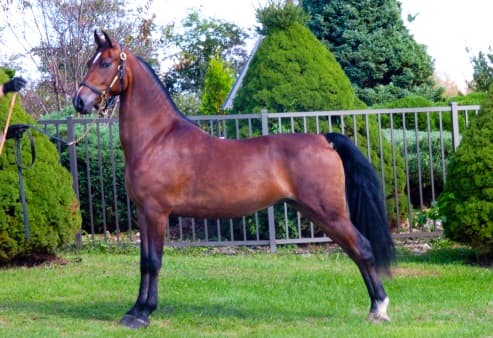
A Morgan presented in a standing side view.

The Morgan name comes from its foundation stallion’s owner
Figure was born in Massachusetts in 1789. After becoming the property of Justin Morgan, he eventually became known by his owner’s name. His descendants helped establish a recognisable population used on farms, for travel and in harness. Figure’s exact ancestry remains uncertain, so accounts of his parents should not be treated as a proven pedigree. Later organised registration preserved relationships between generations. That recorded history helps explain the breed’s identity without turning uncertain details about its founder into established facts.
Sources for this section: AMHA [1]
Morgans have a compact build and an upright neck
The AMHA gives a usual height range of 14.1 to 15.2 hands, approximately 1.45 to 1.57 m at the withers, while acknowledging smaller and taller individuals. In this notation, 14.1 means fourteen hands and one inch, not a decimal fraction of a hand. Typical features include a compact body, relatively short back, strong limbs and an upright neck. The breed shares a common type even when individual horses are trained for different riding and driving disciplines.
Sources for this section: AMHA [1]
Morgans are not restricted to three coat colours
Bay, black and chestnut are common, but the AMHA permits other colours and patterns when registration requirements are met. Palomino, buckskin and grey also occur. An unusual colour therefore does not automatically cast doubt on a Morgan’s recorded ancestry. DNA testing can help distinguish similar appearances or identify variants with little visible expression. Coat description, parentage and test results provide different information; none should be substituted for the others when considering what an individual horse may pass on.
Sources for this section: AMHA [1] · US Equestrian [2]
Morgans work under saddle and in harness
Morgans participate in dressage, jumping, western riding, trail riding and several forms of driving. Some families are more specialised, while the breed as a whole retains a broad range of uses. This does not mean one horse is already trained for all of them. A Morgan accustomed to pulling a carriage still needs to learn a rider’s aids, and a riding horse needs suitable preparation before being driven. Training and experience are as relevant as the breed’s reputation for versatility.
Sources for this section: US Equestrian [2]
The AMHA verifies Morgan foal parentage using DNA
The American Morgan Horse Association records Morgan identities and pedigrees. Since 2001, foal registration has required DNA parentage verification. A laboratory compares the foal’s markers with those of the declared sire and dam. The association distinguishes having a DNA profile on file from having parentage verified. These statements do not mean that the horse has been tested for every coat variant or inherited disease. They describe how its identity and relationship to its recorded parents have been checked.
Sources for this section: AMHA [3]
Morgan population figures need a date and a clear definition
The AMHA FAQ reports approximately 89,000 living registered Morgans as of 31 December 2015. This is a historical figure, not a current population estimate. The 2022 coat-colour study began with 465 Morgans and retained 266 after close relatives were removed. That smaller group serves a different purpose: it describes variants observed among horses submitted for laboratory testing. It should not be interpreted as an annual foal count or a representative sample of every Morgan family worldwide.
Sources for this section: AMHA [1] · Avila et al. (2022) [4]
Morgan parentage tests and coat tests have different purposes
A parentage test checks whether a horse’s DNA is consistent with its declared parents. A coat test looks for particular variants affecting pigments or white markings. Verified parentage therefore does not reveal all of a Morgan’s coat genotypes. The calculator’s breed frequencies come from the 2022 study group and support estimates when individual information is missing. A variant not observed in that group is not necessarily absent from every Morgan. Direct test results provide more specific evidence for the horse concerned.
Sources for this section: AMHA [3] · Avila et al. (2022) [4]
Sources and review date
Profile reviewed on .
Breed organisations document history, registration rules and uses. The 2022 study examined horses submitted for coat-colour testing; its results describe that sample, rather than a census of the breed.
- AMHA — About the Morgan: FAQ
Conformation, height and movement considered during assessments.
- US Equestrian — Morgan
Uses of the horses and activities offered by breed organisations.
- AMHA — Registry FAQ
Registration requirements, studbook categories and verification of ancestry.
- Avila et al. — Genes, 2022
Avila and colleagues (2022): coat variants, sample sizes before and after removing close relatives, and limitations of the laboratory sample.