
Breeds · breed profile
Missouri Fox Trotter
The Missouri Fox Trotter is a trail horse with a distinctive four-beat gait
The Missouri Fox Trotter developed in the American Ozarks. Its name refers to the fox trot, a gait in which a forefoot lands slightly before the opposite hind foot. This separation of the diagonal footfalls produces less bounce for the rider than an ordinary trot. Breeders valued the horse for long journeys and everyday work. Trail riding, pleasure riding and versatility events remain important uses.
- Category
- Horse
- Country of origin
- United States
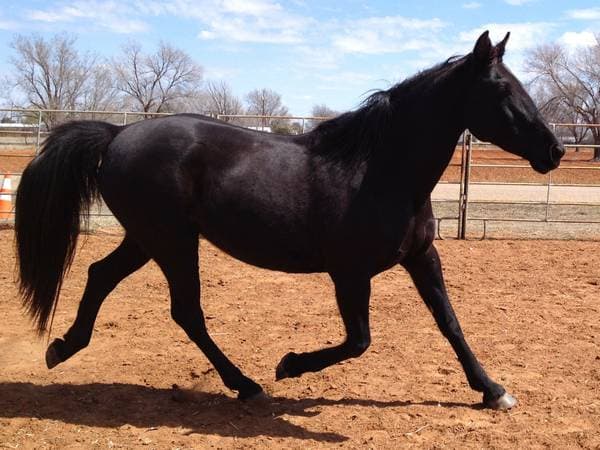
A Missouri Fox Trotter mare photographed outdoors.

Missouri Fox Trotters developed as working horses in the Ozarks
Nineteenth-century Ozark communities needed horses that could cross rough ground, work cattle and pull a buggy. Horses brought by settlers from neighbouring states supplied the breed’s early ancestry. Breeders retained animals whose gaits made long journeys comfortable. A breed association was established in Ava, Missouri, in 1948. Missouri later designated the Fox Trotter as its official state horse in 2002. Its history explains the emphasis on a useful all-round riding horse rather than a horse selected only for arena competition.
Sources for this section: MFTHBA [1] · Missouri Secretary of State [4]
The Missouri Fox Trotter’s fox trot has four separate beats
In an ordinary trot, a foreleg and the opposite hind leg move as a diagonal pair. In the fox trot, the forefoot reaches the ground slightly before that opposite hind foot. The horse remains in contact with the ground throughout, reducing the vertical movement felt by the rider. The association also recognises the flat foot walk, an active four-beat walk, and a three-beat canter. These are movement patterns that need to be observed in motion; a still photograph cannot identify them reliably.
Sources for this section: MFTHBA [2]
Missouri Fox Trotters have a range of coat colours
The Missouri Fox Trotter is not defined by one colour. The population included in the 2022 coat study carried several colour and white-pattern variants. A lighter shade can result from pigment dilution, whereas white markings arise through different genetic mechanisms. Two horses that look similar may therefore carry different variants. Targeted DNA results can give more precise information than a colour name on a document or in an advertisement, particularly when a variant has little visible effect.
Sources for this section: Avila et al. (2022) [5]
Missouri Fox Trotters are widely used for trail riding
Trail and pleasure riding are important uses for the Missouri Fox Trotter. Its working history also includes cattle work and carrying people who spent long hours in the saddle. Breed shows assess characteristic gaits, while other events showcase versatility. A comfortable gait does not replace physical preparation: a horse expected to cover long distances needs gradual conditioning for the intended terrain and workload. Its experience outdoors is also relevant when deciding whether it suits a particular rider.
Sources for this section: MFTHBA [1]
The MFTHBA maintains the Missouri Fox Trotter studbook
The Missouri Fox Trotting Horse Breed Association records horses and their parentage. Its 2025 rulebook explains that the registry remained open to qualifying foundation animals until 1983. After closure, registration required two permanently registered MFTHBA parents, subject to the association’s rules. A horse that can fox trot is therefore not automatically a registered Missouri Fox Trotter. The gait describes how it moves; the studbook establishes its recognised pedigree. These are related aspects of the breed, but they are different kinds of evidence.
Sources for this section: MFTHBA [3]
Missouri Fox Trotters are bred beyond the United States
The association records the breed’s presence in the United States, Canada, Europe and other regions. That international spread does not by itself provide a current count of living horses. Avila and colleagues’ 2022 study began with 64 Missouri Fox Trotters and retained 46 after close relatives were removed. These horses had been submitted for coat-colour testing. They form a laboratory sample, not a breed census or a count of registrations in one particular year.
Sources for this section: Missouri Secretary of State [4] · Avila et al. (2022) [5]
The calculator’s Missouri Fox Trotter data do not predict gait
The tests used in the 2022 study identify variants affecting coat colour. They do not measure the regularity of a fox trot or how comfortable a horse feels under saddle. The calculator uses observed frequencies for certain colour estimates when a parent’s genotype is unknown. Where an individual DNA result exists for the relevant variant, it provides direct information about that horse. Assessing gait still requires watching the horse move at different speeds, alongside considering its training and physical condition.
Sources for this section: Avila et al. (2022) [5] · MFTHBA [2]
Sources and review date
Profile reviewed on .
Breed organisations document history, registration rules and uses. The 2022 study examined horses submitted for coat-colour testing; its results describe that sample, rather than a census of the breed.
- MFTHBA — History of the breed
The breed’s history and the development of its breeding organisation.
- MFTHBA — Gaits
Conformation, height and movement considered during assessments.
- MFTHBA — Rulebook, 2025
Registration requirements, studbook categories and verification of ancestry.
- Missouri Secretary of State — State Horse
The breed’s history and the development of its breeding organisation.
- Avila et al. — Genes, 2022
Avila and colleagues (2022): coat variants, sample sizes before and after removing close relatives, and limitations of the laboratory sample.