
Breeds · breed profile
The Miranda donkey
Burro de Miranda · Raça Asinina de Miranda
The Miranda donkey is a Portuguese donkey breed from the northeast of the country, shaped by life on the Miranda plateau and work on small farms. Its long brown coat and large, hairy ears are characteristic features. Conservation now combines pedigree recording, support for breeders and new roles in exploring the local countryside and managing landscapes.
- Category
- Donkey
- Country of origin
- Portugal
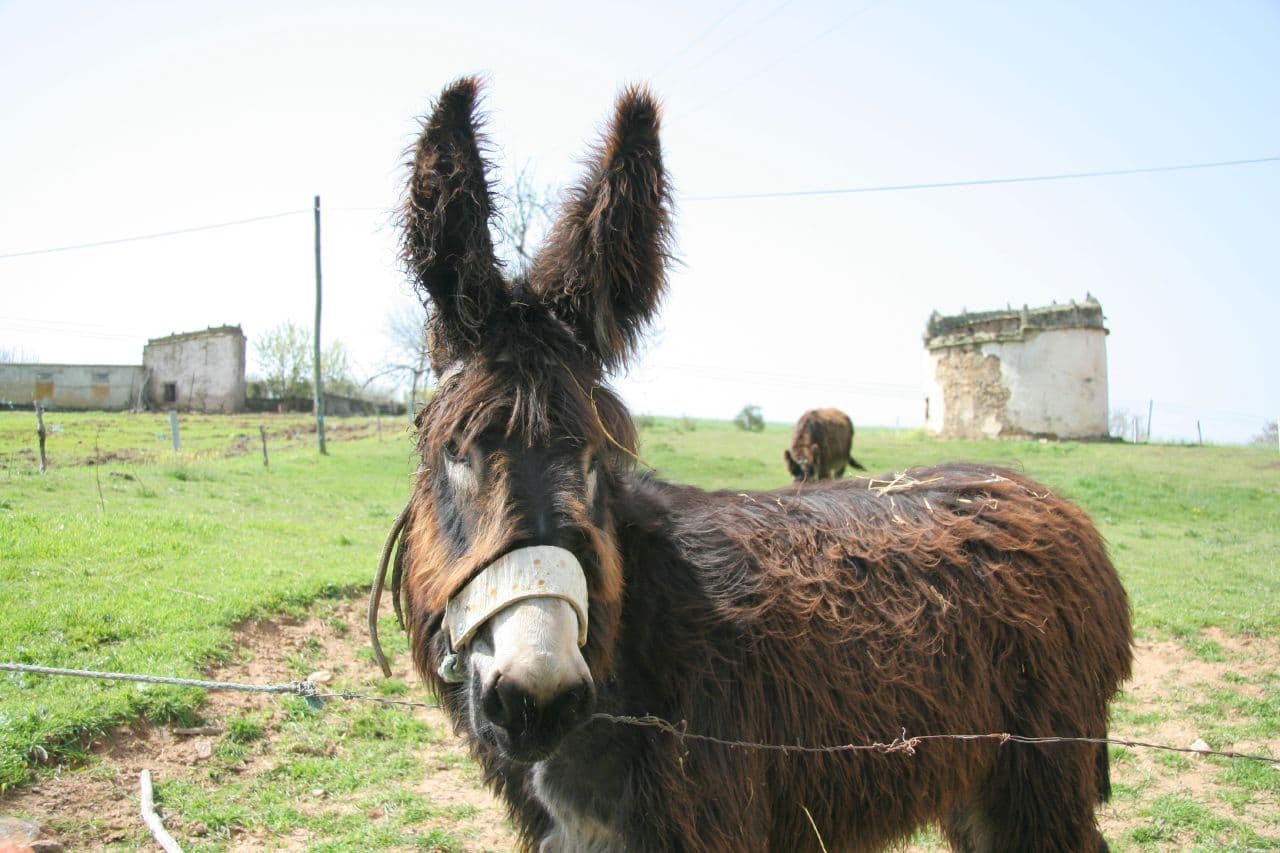
A young Miranda donkey photographed on 24 April 2006, before finishing its seasonal moult.

The Miranda donkey: a donkey breed rooted in the Miranda plateau
The Miranda donkey: Northeastern Portugal is the breed’s homeland
Burro de Miranda takes its name from the Miranda area in Trás-os-Montes. The Miranda plateau includes land around Miranda do Douro, Vimioso and Mogadouro, close to the Spanish border. Villages, small cultivated plots and journeys between farms formed the setting in which these donkeys lived and worked. The breed belongs to that local rural history; its name does not cover every donkey bred in Portugal.
The Miranda donkey: Farm work helped maintain donkey families
Donkeys pulled implements, carried loads and transported people on small farms. Their place in farming households allowed a recognisable group of animals to survive, distinguished by features including size and long hair. Mechanisation and the decline of some agricultural practices later reduced the reasons for breeding foals. Preserving the breed therefore also depends on passing on practical knowledge and enabling owners to arrange matings.
The Miranda donkey: the association began in 2001 and an initial register was approved in 2002
Observations in northeastern Trás-os-Montes, including work initiated by the Douro International Natural Park, supported recognition of this local population. The Associação para o Estudo e Proteção do Gado Asinino, or AEPGA, was established on 9 May 2001 to study and protect donkeys. After the breed standard was defined, Portugal’s agriculture ministry approved the initial recording regulations on 20 June 2002. These steps organised conservation of existing animals rather than creating a new population overnight.
The Miranda donkey: Conservation depends on supporting the breeders
Quaresma and colleagues examined pedigrees together with herd records in a study published online in 2013 and in Animal in 2014. They identified low replacement through births, unequal use of breeding males and an ageing population of owners. Finding families in a database is therefore only part of conservation: females must also have opportunities to breed, and several males need to contribute to future generations.
Sources for this section: AEPGA · history [1] · AEPGA · region [2] · AEPGA · uses [5] · Quaresma · 2014 [12]
The Miranda donkey’s head, body and height
The Miranda donkey: a substantial head and large, hairy ears
The Miranda donkey breed standard describes a straight head profile, broad forehead and well-developed jaws. Hair may form a fringe over the forehead. The ears are large, broad at the base and rounded at the tips, with abundant hair along their inner edges. The neck is short and thick. Assessors consider these features together when examining an animal.
The Miranda donkey: a sturdy body and strong limbs
The desired back is short, muscular and close to level, with a deep chest and a croup higher than the withers. The regulations describe strong limbs, substantial joints and broad hooves. Abundant hair can cover the lower limbs and hide part of the feet, so conformation assessment involves examining the body beneath the coat as well as its outer outline.
The Miranda donkey: the studbook rules specify over 125 cm and under 150 cm
The annex to the regulations supplied by AEPGA as the 2016 version gives an adult wither height above 125 cm and below 150 cm, with 135 cm recommended. These are standard criteria rather than a measured average for the whole breed. The association’s descriptive webpage retains a different lower threshold of over 120 cm. When reading studbook requirements, it is therefore necessary to distinguish the descriptive webpage from the regulations themselves.
The Miranda donkey: Ample movement and cooperation at work
The Miranda donkey breed standard describes ample but slow movement rather than the quick action of a sport horse. Strength and docility are among the desired qualities; docility here means willingness to cooperate with the person leading or handling the donkey. Breeding assessments examine both body shape and how the animal moves. Their purpose is to select animals to continue breeding within the studbook.
Sources for this section: AEPGA · standard [3] · AEPGA · regulations [4]
The Miranda donkey’s brown colour and long coat
The Miranda donkey: Dark brown with lighter areas
The Miranda donkey studbook rules describe a dark brown coat, lighter on the flanks and underside, with white hair around the muzzle and eyes. The standard calls for an absence of distinctive markings. These descriptions guide assessment of appearance; they are not laboratory measurements of variant frequencies. Coat colour and hair length cannot replace parentage and registration records.
The Miranda donkey: Abundant hair changes its appearance during the moult
The hair is long, coarse and especially abundant along the sides, on the face, beneath the jaws, around the ears and on the lower limbs. The source identifies the young donkey in the photograph as still shedding its coat: the seasonal replacement of hair. Its appearance illustrates why coat length and condition are also considered in relation to the season. The studies described here concern families and diversity, without assigning this hair to a horse coat-colour variant.
Sources for this section: AEPGA · regulations [4] · AEPGA · standard [3]
From agricultural work to the Miranda donkey’s modern roles
The Miranda donkey: Draught work, pack carrying and travel on small farms
Documented uses include pulling farm implements, carrying loads on the back and riding. Donkeys could work alone or alongside other equids on small plots. Mule production is also mentioned as a residual use: a male donkey mated with a mare can produce a mule. This is a different activity from breeding purebred Miranda donkeys, which relies on registered donkey parents.
The Miranda donkey: Educational visits and guided walks
AEPGA welcomes visitors at its breed promotion centre in Atenor, in Miranda do Douro municipality, and its educational activity centre near São Joanico in Vimioso. Guided visits and walks introduce people to the donkeys, their care and the surrounding area. These activities provide a modern role for animals once used mainly in farming and help pass on their place in local life.
The Miranda donkey: ASINIFIRE studies grazing for landscape management
In the cross-border ASINIFIRE project, AEPGA takes part in using Miranda and Zamorano-Leonese donkeys for managed grazing and animal traction. The Portuguese sites described include São Joanico and Vilarinho. The approach uses animals to consume vegetation and maintain open habitats while monitoring soils, vegetation and animal welfare. Reducing plant fuel is a project objective; the project description does not provide a measured effectiveness that applies to every type of land.
Sources for this section: AEPGA · uses [5] · AEPGA · visits [6] · AEPGA · ASINIFIRE [7]
The Miranda donkey: the studbook and DNA parentage verification
The Miranda donkey: AEPGA connects animals with their families
AEPGA manages the Miranda donkey studbook, known as LGRAM, within the recognition framework of Portugal’s Directorate-General for Food and Veterinary Affairs, DGAV. The studbook records identity, parents and admission of breeding animals. Its regulations distinguish the birth register from the breeding register: registering a foal and approving an adult for breeding are separate steps.
The Miranda donkey: a foal’s registration depends on its birth and parentage records
The procedure in the regulations requires parents entered in the breeding register, a birth declaration and laboratory confirmation of compatible parentage. Identification includes a physical description, microchip and individual document. The birth declaration serves as the application for entry, and the foal must also show the breed’s characteristics. Prompt reporting of births and changes to the herd keeps those records up to date.
The Miranda donkey: Breeding animals undergo a conformation and movement assessment
The Miranda donkey studbook rules normally provide for admission from four years for males and three years for females, allowing earlier admission where the technical officer considers development and conformation sufficient. Animals must meet the standard, be correctly identified and score at least 70 points in the specified assessment. An exceptional route also exists for animals with compatible pedigrees and a clear benefit to the breed; physical resemblance alone does not create an automatic right to registration.
The Miranda donkey: the laboratory compares a foal’s markers with its declared parents
To verify parentage, the laboratory establishes a DNA profile from several variable regions, then compares the foal’s profile with those of the declared sire and dam. The versions inherited by the youngster must be compatible with its parents’ profiles. The regulations name CIBIO’s molecular testing centre at the University of Porto for this work. The result checks the recorded families; it cannot be inferred from the donkey’s coat length or colour.
Sources for this section: AEPGA · history [1] · AEPGA · regulations [4]
The Miranda donkey: Where the breed lives and what the reports count
The Miranda donkey: a northeastern homeland with breeding elsewhere in Portugal
AEPGA places the historical population around Miranda do Douro, Vimioso, Mogadouro and Bragança, with an important concentration in the north of Miranda do Douro municipality. Owners have also moved animals to other Portuguese regions. Dispersal can leave females far from available males, so tracking holdings and organising matings matters alongside mapping where animals are found.
The Miranda donkey: the 2002 survey describes the programme’s beginnings
For the initial survey in 2002, AEPGA reports about 930 females and 20 breeding males in the population monitored. It presents these figures as an early warning accompanying the establishment of conservation work. They are historical figures, rather than a count of donkeys alive today, and cannot be compared directly with a database that adds together several generations.
The Miranda donkey: the March 2025 report examines 5,018 donkeys born in 1973–2024
The demographic report dated 31 March 2025 analyses 5,018 animals in AEPGA’s pedigree file, born between 1973 and 2024. It includes males and females across successive generations, including animals that have died. The file supports research on recorded families and their renewal; it does not count 5,018 donkeys alive in Portugal. Its scope is the set of records included in the breed studbook extract.
The Miranda donkey: the extract includes 123 animals born in 2024
The same report’s annual table records 123 animals with a birth year of 2024, all with both parents identified in that file. This counts the records for that generation in the extract analysed. It is neither a census of every Portuguese donkey nor a count of all living adults of the breed. It helps track family renewal within the studbook.
Sources for this section: AEPGA · distribution [8] · AEPGA · history [1] · AEPGA · 2025 [9]
The Miranda donkey: DNA analysis, pedigrees and breeding decisions
The Miranda donkey: the molecular study retained 126 donkeys for diversity analysis
AEPGA’s 2022 summary describes more than 1,400 samples collected between 2005 and 2020. Researchers initially selected 136 donkeys, including 54 males and 82 females, to examine 16 microsatellites. These markers are short repeated DNA sequences whose lengths vary between animals. After checking profile quality and removing directly related animals, 126 donkeys remained for diversity analysis. This selected group is therefore not a count of the entire population.
The Miranda donkey: the markers show retained diversity in the sampled group
Genetic diversity describes differences in DNA between animals. With the markers used, the study found diversity comparable to several Spanish donkey breeds and no sharply separated genetic groups within its sample. This describes the organisation of that group. It does not establish that every mating pairs distant relatives: that question requires examining the relationship between the two particular animals.
The Miranda donkey: the 2025 pedigrees reveal matings between close relatives
The 2025 report looks for shared ancestors in pedigrees and identifies matings including siblings and parents with their offspring. It also records 2,989 animals with both parents unknown among the 5,018 files studied. Without those names, the calculation cannot find all shared ancestors, so an undetected relationship does not necessarily mean no relationship exists. Accurate birth records and contributions from several families help breeders plan future generations.
The Miranda donkey: the 2025 INIAV evaluation combines measurements and family relationships
The evaluation published by INIAV and its partners in 2025 combines pedigrees with conformation and movement records collected from 2003 to 2025. Its BLUP method estimates the inherited component of traits such as height or coat score while accounting for factors including age, sex and holding. It also uses records from relatives and descendants. An estimated breeding value is therefore a selection tool with a different purpose from a DNA test for a specific variant.
The Miranda donkey: Parentage, diversity and disease screening answer different questions
A parentage DNA profile checks declared parents, while comparing profiles across a group helps study its diversity. A disease test instead searches for a specific DNA change whose effect has been established for the species and disease concerned. The Miranda donkey analyses presented here address families, diversity markers and evaluation of measured traits. They do not turn disease panels marketed for certain horse breeds into screening programmes for this donkey breed.
Sources for this section: AEPGA/CIBIO · DNA [10] · AEPGA · 2025 [9] · INIAV · 2025 [11] · AEPGA · regulations [4] · Quaresma · 2014 [12]
Sources and review date
Profile reviewed on .
AEPGA, which manages the studbook, provides the rules, breed descriptions and monitoring records. Molecular research, pedigree analysis and breeding evaluations answer different questions; their dates, animals and methods are identified below.
- AEPGA — Burro de Miranda
AEPGA history: foundation on 9 May 2001, register approval on 20 June 2002 and the first historical survey.
- AEPGA — Planalto Mirandês
Location of the Miranda plateau and the role of villages, farming and local traditions.
- AEPGA — Descrição morfológica (Padrão)
Conformation, hair and movement descriptions. Its lower height threshold of over 120 cm differs from the 2016 regulations’ annex.
- AEPGA — Regulamento do Livro Genealógico da Raça Asinina de Miranda (2016, PDF)
Regulations still supplied by the breed manager: identification, parentage, birth and breeding registers, admission and standard. The annex specifies over 125 cm and under 150 cm, with 135 cm recommended.
- AEPGA — Aptidões zootécnicas
Draught work, riding, pack carrying, residual mule production and the breed’s changing uses.
- AEPGA — Visitas/Caminhadas
The Atenor and São Joanico centres, educational visits and guided walks; schedules and prices are not reproduced.
- AEPGA — ASINIFIRE
Objectives and sites of the cross-border grazing and animal-traction project. Fuel-reduction objectives are not a measured effectiveness rate.
- AEPGA — Área geográfica de implantação
Northeastern Portuguese homeland and dispersal to other regions; the importance of access to breeding animals.
- AEPGA — Caracterização genética por análise demográfica do Burro de Miranda (31/03/2025, PDF)
Report dated 31 March 2025: 5,018 records for animals born in 1973–2024, including 123 born in 2024. The 2,989 files with unknown parents limit relationship analysis.
- AEPGA/CIBIO — Caracterização genética do Burro de Miranda (2022, PDF)
Summary of a 16-microsatellite study: over 1,400 samples from 2005–2020, 136 donkeys initially selected and 126 retained after filtering.
- INIAV et al. — Raça Asinina de Miranda: Avaliação Genética 2025 (PDF)
Evaluation using pedigrees and records from 2003–2025, with BLUP estimates of breeding values for measured traits.
- Quaresma et al. — Pedigree and herd characterization of a donkey breed vulnerable to extinction (Animal, 2014)
Published online in 2013, in volume 8(3), pages 354–359 in 2014. Original research on pedigrees, holdings, replacement and male contributions.