
Breeds · breed profile
The Mérens horse
Mérens · cheval ariégeois
The Mérens is a mountain horse from Ariège, recognised by its black coat and compact build. Once used for transport and rural work, it is now bred mainly for leisure. Its breeding programme combines outdoor hardiness and working assessments with DNA checks that answer different questions about each horse.
- Category
- Horse
- Country of origin
- France
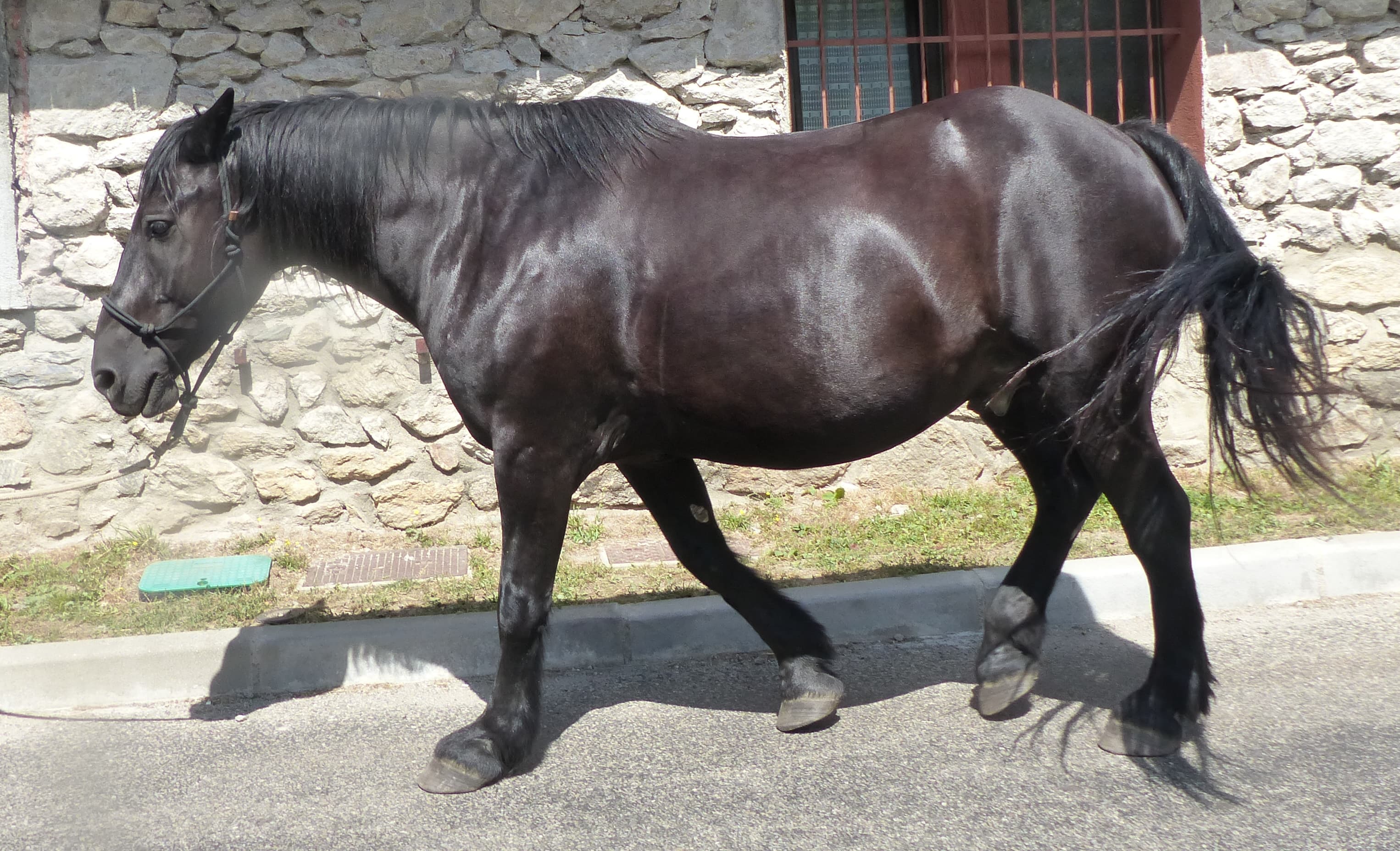
A Mérens horse shown at a walk in Orgeix, Ariège, on 18 August 2023.

The Mérens horse: the Mérens, from Ariège’s valleys to leisure riding
The Mérens horse: a horse for transport and rural work
The breed’s home lies in the Ariège Pyrenees, particularly the upper Ariège valley. Carrying loads on a pack saddle and pulling agricultural equipment called for sturdy horses able to make good use of available forage. Seasonal movement to high summer pastures, known locally as estive, remains part of some breeders’ management.
The Mérens horse: the studbook opened in 1947
Breeders organised selection through shows and their association, SHERPA. On 27 March 1947, a prefectural decree opened the studbook under the supervision of the French national studs. Recording parents and breeding animals provided a framework for selection as mechanisation gradually reduced demand for working horses.
The Mérens horse: New uses helped the breed survive
Leisure riding, trekking and driving created new markets. Today’s programme seeks to preserve hardiness and the diversity of families while selecting horses that work willingly. These changing uses explain the breed’s development; resemblance to horses in cave paintings is not evidence of a direct prehistoric pedigree.
Sources for this section: SHERPA · programme [1] · FAO · historical uses [2]
The Mérens horse: the build and movement sought in the Mérens
The Mérens horse: a compact horse with a broad back
SHERPA Mérens France describes the desired traits of the Mérens in its breeding programme. This document guides the choice of breeding animals. The Mérens breed standard describes an expressive head, broad forehead, straight or slightly concave profile and fairly short ears. The neck is long and well set, the shoulder sloping, the back broad and supported, and the loin muscular. Strong joints and hard black hoof horn support movement that should cover ground with active use of the hindquarters.
The Mérens horse: Desired heights are breeding targets
The Mérens breeding programme gives a desired average adult height of 1.49 m for males and 1.45 m for females. These figures express the standard’s aims; they are not averages calculated from all living Mérens. Selection also considers tractability, balance and ease of use through presentations and working assessments.
Sources for this section: SHERPA · programme [1]
The Mérens horse: the Mérens’ black coat and the foal’s first hair
The Mérens horse: Foal coats may look much lighter
The Mérens breed standard requires black, but describes foals born black, silver-grey or café-au-lait in appearance. This first fluffy coat is shed after weaning. Silver-grey here describes the young hair’s appearance; it does not mean progressive greying, the process that makes a Camargue increasingly pale as it ages.
The Mérens horse: Seasonal shades are documented
The Mérens breeding programme mentions reddish seasonal tones and values a slightly rubican flank, where a few white hairs are mixed into the coat. Such visual descriptions do not replace colour testing. Two black-looking horses can carry different variants, including a recessive variant that does not alter their own appearance but can be passed to offspring.
Sources for this section: SHERPA · programme [1]
The Mérens horse: Trekking, driving and practical work with the Mérens
The Mérens horse: From draught work to mountain pack transport
Historical uses included farm work, transport and military packing. These declined as engines took over. Current selection retains an interest in sure-footedness, stamina and willingness to work, which remain useful when a horse crosses varied terrain or pulls a carriage.
The Mérens horse: Leisure uses involve practical skills
The Mérens breeding programme covers leisure riding, trekking, driving and groundwork. It also includes TREC, a sport combining navigation, control of pace and obstacles inspired by trail riding, such as a narrow passage. These activities allow the horse’s responses and movement to be assessed in a practical setting.
Sources for this section: SHERPA · programme [1] · FAO · historical uses [2]
The Mérens horse: the Mérens studbook and breeding assessments
The Mérens horse: SHERPA and IFCE have complementary roles
SHERPA Mérens France directs selection, while IFCE performs the registry operations entrusted to it. Registration by descent requires an approved sire, parents entered or accepted as breeding contributors, a black coat, birth declaration and identification, among other conditions. The French term facteur de Mérens refers to a breeding animal admitted under specific studbook provisions.
The Mérens horse: DNA checks the declared parents
A mare must have a DNA profile before her first offspring is registered. This records markers that can be compared with those of the foal and sire. Stallion candidates also undergo parentage verification, with a technical exception subject to the commission’s decision. Checking ancestry does not test for a muscle disease.
The Mérens horse: Approval is separate from breed registration
Stallion candidates are presented from three years of age. They must meet the approval-test requirements, or the route available for certain sporting performances, and receive a favourable decision from the commission. Since the 2019 breeding season, PSSM1 and colour-test results have been required for stallion covering certificates. Additional PSSM1 criteria apply to new candidates from 2022.
Sources for this section: SHERPA · programme [1]
The Mérens horse: Mérens breeding areas and the programme’s figures
The Mérens horse: Ariège remains central to a wider European network
The breed is raised elsewhere in France and in several European countries. The programme lists registers in Italy, the Netherlands, Belgium and Switzerland, followed by expansion of activities into Germany and Czechia in 2017. This describes the organisation of breeding; it does not itself provide a worldwide horse count.
The Mérens horse: 328 offspring registered in France for 2022
The report dated 20 June 2023 records 328 registered offspring, 572 mares covered to produce Mérens and 60 active stallions in France for 2022. Registrations measure annual registry activity, rather than all living animals. Of the 147 French breeders participating in the programme in 2022, 103 were in Occitanie.
Sources for this section: SHERPA · programme [1]
The Mérens horse: What PSSM1 testing contributes to Mérens selection
The Mérens horse: Testing a variant affecting muscle energy storage
The PSSM1 test detects a GYS1 variant associated with abnormal accumulation of glycogen, an energy store in muscle. A single copy can be associated with muscle problems. A horse with one copy should therefore not be described simply as a healthy carrier. A negative result does not rule out other causes of muscle disease.
The Mérens horse: Admission rules do not measure disease frequency
The IFCE distributes the Mérens breeding programme under the name “PS 2024”. Since 2022, its PSSM1 criterion allows stallion candidates with no copy or one copy of the variant; candidates with two copies are excluded. A horse with one copy can still develop muscle problems, so breeding approval does not guarantee good health. The programme states that neither SHERPA nor the IFCE publishes the results required for covering certificates. This testing requirement therefore does not reveal the proportion of horses carrying the variant in the breed.
Sources for this section: SHERPA · programme [1] · UC Davis · PSSM1 [3]
Sources and review date
Profile reviewed on .
The SHERPA programme distributed by IFCE as PS 2024 contains a report dated 20 June 2023 and rules with different starting dates. The historical publication hosted by FAO documents changing uses; UC Davis explains the PSSM1 test.
- SHERPA Mérens France — Breeding programme distributed by IFCE as PS 2024
Standard, report dated 20 June 2023, registration, parentage and Article 8 PSSM1 rules; the 2019 URL folder does not date every provision.
- CNCE and UNIC — Le cheval de Mérens, Animal Genetic Resources Information, no. 13
Historical account of breeder organisation, summer grazing and uses. Old population figures and prehistoric ancestry narratives are not treated as current data or genetic evidence.
- UC Davis VGL — Polysaccharide Storage Myopathy (PSSM1)
GYS1 variant, possible effects with one or two copies and test scope; no Mérens-specific prevalence inferred.