
Breeds · breed profile
The Lusitano
Lusitano · Puro Sangue Lusitano (PSL)
The Lusitano is a horse from Portugal, bred particularly for riding. Its history is linked to working cattle on horseback and to dressage, in which a horse learns to perform precise movements with its rider. Today, Lusitanos take part in competitions including dressage and working equitation.
- Category
- Horse
- Country of origin
- Portugal
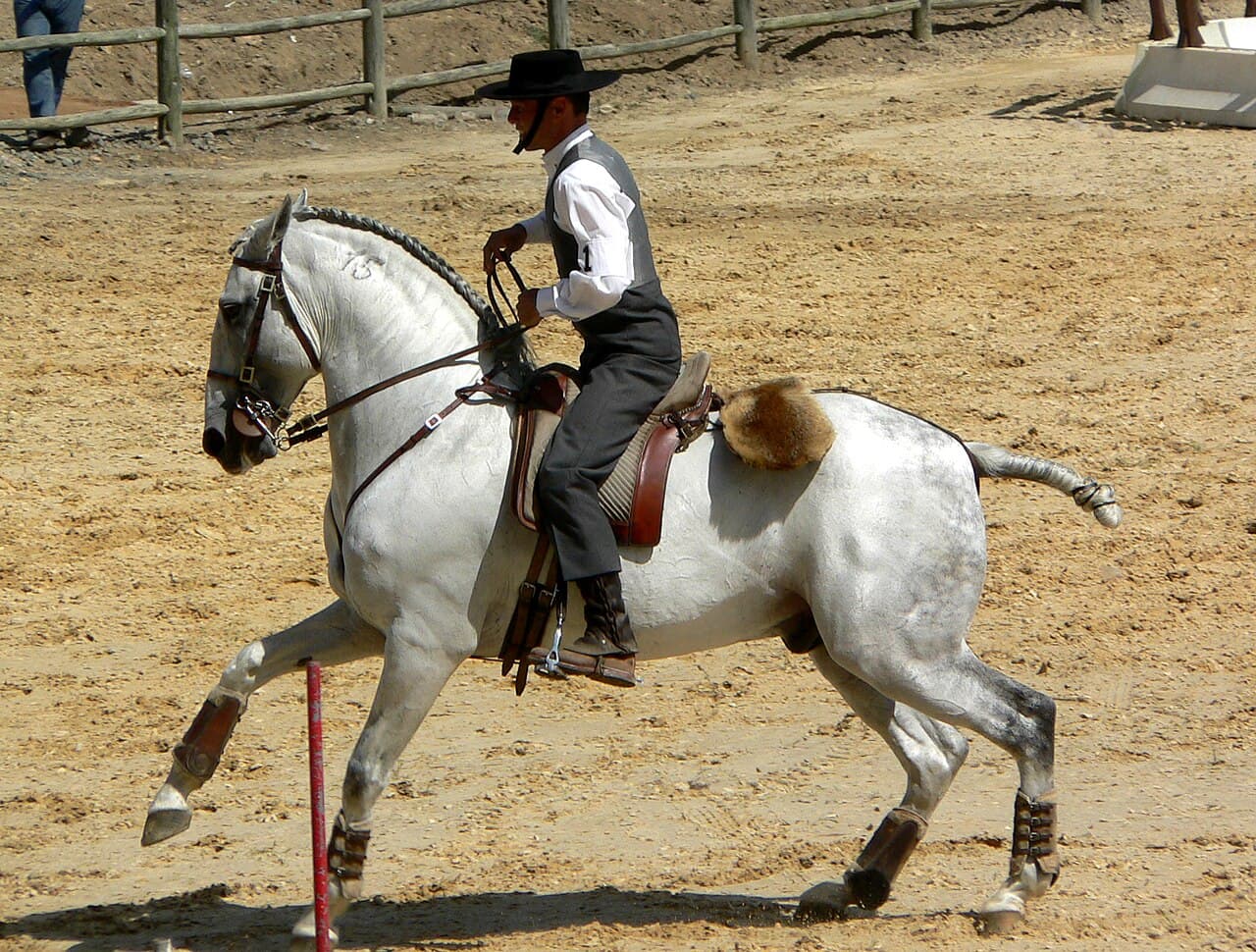
A grey Lusitano stallion being ridden in an arena.

Origins and history of the Lusitano
The Lusitano: Iberian horses bred in Portugal
The Lusitano is a Portuguese breed of Iberian horse. “Iberian” refers to the Iberian Peninsula, the land that includes Portugal and Spain. Within Portugal, Lusitano breeding is particularly associated with Ribatejo, Alentejo and Portuguese Estremadura, regions in the centre and south of the country. The name “Lusitano” refers to Lusitania, a Roman province that covered much of present-day Portugal and part of Spain.
The breed was shaped by the needs of army riders, cattle work and mounted bullfighting, in which a rider faces a bull on horseback. These activities called for horses that could turn, stop and move off quickly while responding to their rider’s signals. Over successive generations, breeders chose parents with these qualities in the hope of passing them on to their foals.
The Lusitano: the Alter stud and horses of the royal court
One royal breeding establishment helped shape this history: the Alter stud, founded in 1748 during the reign of King João V. A stud is an establishment where horses are bred. Alter was intended to supply horses for the royal court and high school riding, an advanced form of dressage in which horse and rider perform precise movements after lengthy training. Mares brought from Spain helped establish the original herd.
At court, riding was taught at an academy known as the Picaria Real. The Marquis of Marialva was one of its leading teachers in the eighteenth century. In 1790, Manoel Carlos de Andrade published A Luz da Liberal e Nobre Arte da Cavalaria, a riding treatise that records methods of training horses and riders at the time.
The Lusitano: the studs that preserved the horse families
Several studs played a major part in shaping today’s Lusitano: those of the Veiga and Andrade families, the Alter stud and the Portuguese national stud, known as Coudelaria Nacional. Their names appear in the breed’s lineages. A lineage here means a group of horse families that share ancestors connected with the same stud. Mares and stallions from these studs therefore appear in the pedigrees of many Lusitanos.
During the nineteenth and twentieth centuries, wars and periods of political unrest disrupted horse breeding. Machinery gradually replaced some of the horses used in farming and the army. Crossbreeding with other breeds also changed some studs. Against this background, keeping Lusitano horse families going became an important part of breeders’ work.
At Alter, a preservation programme began in 1942 to rebuild the Alter Real lineage, whose numbers had fallen very low. It started with 11 mares and 3 stallions. Breeders organised their matings and, generation after generation, selected horses to continue the stud’s breeding programme.
The Lusitano: the modern register of the breed’s families
Private breeders and public studs were already keeping records of their horses’ names and ancestry in the nineteenth century. In the 1960s, the modern studbook organised these records across the breed. It keeps the names of horses and their parents, allowing earlier generations to be traced just like a human family tree. The APSL, the Portuguese association of Lusitano breeders, was founded in 1989 and was entrusted with managing this register.
The Lusitano: a living riding tradition
Established in 1979, the Portuguese School of Equestrian Art carries on the traditions of the Picaria Real with Lusitanos from the Alter stud. It demonstrates traditional Portuguese riding exercises to the public. The ways the horses are trained, the riders’ clothing and the equipment used all help pass on this heritage of the royal court.
In 2024, UNESCO inscribed equestrian art in Portugal on the Representative List of the Intangible Cultural Heritage of Humanity. This recognition concerns skills passed down through generations: learning to ride and train horses, maintaining riding traditions and making the equipment used. Riding schools, breeders, cattle handlers and craftspeople all help pass on this knowledge.
Sources for this section: DGAV · breeding regions [12] · Vicente · history and studs [15] · Alter stud [3] · APSL · association history [13] · Parques de Sintra · School history [16] · UNESCO · equestrian art in Portugal [17]
Traits breeders look for in the Lusitano
The APSL publishes the Lusitano breed standard: the document describing the horse breeders aim to produce. It gives them shared criteria for choosing the future mothers of their foals, the mares, and the future fathers, the stallions. The overall aim is a horse with a compact body and rounded contours, whose body length is close to its height at the shoulders.
The Lusitano: the head and neck
Seen from the side, the line from the forehead to the nose should curve slightly outwards. The neck is of medium length, arched and broad at its base, where it joins the shoulders.
The Lusitano: the back and hindquarters
The Lusitano breed standard calls for a fairly level back and a short, broad, muscular area between the back and the croup. The croup is the upper part of the hindquarters, above the back legs and before the start of the tail. It should be strong and rounded.
The Lusitano: the legs and hooves
Breeders look at how the legs are positioned beneath the body when the horse stands. They also assess the shape of the joints, the muscles of the legs and well-formed, proportionate hooves.
Average heights given by the APSL
- Mares
- 1.55 m
- Stallions
- 1.60 m
Height is measured at the withers, the point at the base of the neck above the shoulders. These averages refer to horses aged 6.
The Lusitano: Supple, active movement
At walk, trot and canter, the standard calls for supple, lively and elevated movement, in which the horse lifts its legs well while travelling forwards. Judges therefore observe both how the legs move and how the body travels as a whole.
The Lusitano: an energetic horse that works with its rider
Behaviour is also part of the breeding aim. The standard combines energy with a willing temperament. Here, willingness means readily accepting the signals given by the person handling or riding the horse and working with them. The aim is to preserve a lively horse that responds to its rider’s requests.
The Lusitano: Assessing mares and stallions for breeding
Judges assess the body shape, known as conformation, and the movement of mares and stallions presented for breeding approval. The result helps determine whether a horse can be entered in the breeding section of the Lusitano studbook.
Sources for this section: APSL · standard [1] · APSL · studbook [2]
Lusitano coat colours
A horse’s coat colour is the colour of its hair. The APSL’s description of the breed names grey and bay as the most common colours in Lusitanos. A bay horse has a brown body with a black mane, tail and lower legs.
A grey Lusitano can be born with a dark coat. As the horse grows older, white hairs appear and gradually become more numerous: this change is called greying. The same horse can therefore look very different as a foal and as an adult. Its original colour remains its base coat colour even after the hair has grown lighter.
Explore horse coat coloursSources for this section: APSL · standard [1] · UC Davis · grey [7]
The Lusitano: Working with cattle and taking part in sport
Cattle work is one of the uses that helped shape Lusitano breeding. The rider uses the horse to accompany and direct cows or bulls. When the rider needs to turn or stop to follow the cattle, the horse must respond accurately. These are tasks involved in moving and managing herds on farms.
In sport, Lusitanos take part in disciplines including dressage and working equitation. In dressage, horse and rider perform a sequence of movements at specific places in an arena; judges assess the quality and accuracy of those movements. Working equitation draws on the tasks of riders who worked with cattle. Obstacle courses can include opening and closing a gate from the saddle, or crossing a small bridge. Horse and rider learn to move together accurately to complete these exercises.
Sources for this section: APSL · standard [1] · APSL · dressage [8] · APSL · working equitation [9] · FEI · understanding dressage [10] · USA Working Equitation · obstacles [11]
The Lusitano: Breeding and the register of horse families
The APSL is the Associação Portuguesa de Criadores do Cavalo Puro Sangue Lusitano, the Portuguese association of Lusitano breeders. It manages the studbook, the register that links each horse to its parents. It also works with breeders’ associations in other countries to keep track of horses bred there.
Entering a foal in the birth register records its identity and parents. A horse presented for approval as a breeding stallion or mare goes through a separate assessment. Examiners look at features including the shape of its body and the way it moves.
A DNA test helps verify the foal’s declared parents; this is called parentage verification. DNA carries information passed on by the father and mother. The laboratory compares certain parts of the foal’s DNA with those of the mare and stallion declared as its parents. This comparison helps reveal an error in the recorded parents.
Sources for this section: APSL · studbook [2]
Where do Lusitanos live, and how many are there?
Lusitanos are bred in Portugal and in other countries. The APSL lists breeders’ associations in countries including France, Brazil and the United Kingdom. This list shows where breed associations are present, but it cannot tell us how many Lusitanos are alive worldwide today.
The register also keeps the names of horses that have died. It can, for example, trace a stallion, his foals that grew into adults, and their own foals. Its total therefore brings together several generations. To follow horse numbers today, we can count living animals, foals born in a particular year, or stallions and mares used for breeding. Each count answers a different question.
Sources for this section: APSL · associations [4] · Vicente et al., 2012 [5]
The Lusitano: Understanding genetic studies and DNA tests
In 2012, Vicente and colleagues studied family relationships among Lusitanos. They found that some families had far more descendants than others. Large numbers of horses can therefore share the same ancestors. To understand genetic diversity, meaning the differences in DNA between horses, researchers also look at how much each family contributes to the breed.
In 2022, another team studied differences in DNA that help determine hair colour. They compared horses from several breeds, including a group of Lusitanos. The figures below show how many Lusitanos were included in that study.
The owners had sent samples to the laboratory to have their horses’ coat colours tested. That choice can influence the results: an owner might, for example, request a test because a horse has an unusual colour. Horses with that colour could then be more common among the tested animals than across the breed as a whole. The study’s percentages therefore describe the group of horses tested.
A DNA test answers a specific question. For coat colour, the laboratory looks for differences in DNA that explain hair colour. For an inherited disease, meaning a disease that can pass from parents to foals, it looks for the change in DNA linked to that disease. The result is interpreted according to what the test looked for.
Sources for this section: Vicente et al., 2012 [5] · Avila et al., 2022 [6]
Sources and review date
Profile updated on .
These documents provide the information behind the page: the breed description and registration rules, the history of the Alter stud, sporting uses, and studies of horse families and DNA.
- APSL — Lusitano breed standard
Description of the Lusitano’s body, movement and colours, with average heights given for horses aged 6.
- APSL — Studbook rules (PDF, approved in 2022)
Rules for registering foals and breeding animals, and verifying parents through DNA testing.
- Coudelaria de Alter — History of the stud
The founding of Alter in 1748, eighteenth-century court riding and the preservation of the Alter Real lineage from 1942, starting with 11 mares and 3 stallions.
- APSL — Overseas partner associations
Lusitano breeders’ associations in different countries.
- Vicente, Carolino and Gama (2012) — Genetic diversity assessed by pedigree analysis
Livestock Science, 148, 16–25. A study of family links among 53,411 horses, using records spanning 1824–2009.
- Avila et al. (2022) — Coat colour variants across 28 horse breeds
Genes, 13, 1641. The study compares DNA from horses of 28 breeds. The Lusitano group falls from 129 to 102 after family relationships are checked.
- UC Davis Veterinary Genetics Laboratory — Grey and copy number
An explanation of how grey horses’ hair changes colour and the underlying differences in DNA.
- APSL — Dressage
APSL information about dressage and competitions involving Lusitanos.
- APSL — Working equitation
An introduction to working equitation and its different trials.
- International Equestrian Federation — A guide to dressage
An explanation of the movements horse and rider perform and how judges assess them.
- USA Working Equitation — 2026 rules and obstacle descriptions (PDF)
Examples of working equitation exercises, including crossing a bridge and opening a gate from the saddle.
- DGAV — Introduction to the Lusitano breed (PDF)
Portuguese breeding regions: Ribatejo, Alentejo and Portuguese Estremadura; an introduction to the breed’s characteristics.
- APSL — Association history and breeding aims
The APSL’s foundation in 1989, management of the studbook and the development of military, farming and sporting uses.
- Parques de Sintra — Portuguese School of Equestrian Art
The School’s role in passing on traditional Portuguese riding with Lusitanos from the Alter stud.
- Vicente (2015) — Characterization and selection of the Lusitano horse breed
Doctoral thesis, University of Lisbon, 2015. The origin of the name, breeding history and early records; the influence of Veiga, Andrade, Alter Real and Coudelaria Nacional.
- Parques de Sintra — History of the Portuguese School of Equestrian Art
The eighteenth-century Picaria Real, the founding of the School in 1979 and the transmission of the exercises, clothing and equipment of Portuguese tradition.
- UNESCO — Equestrian art in Portugal
Inscribed in 2024 on the Representative List of the Intangible Cultural Heritage of Humanity. Skills, practices and the role of schools, breeders, cattle handlers and craftspeople.