
Breeds · breed profile
Lipizzan
The Lipizzan, a horse of classical dressage and driving
The Lipizzan is a horse used for driving and haute école, the advanced work of classical dressage. The breed developed at Lipica and several other European studs. Its often very pale appearance usually results from greying, the gradual whitening of the hair.
- Category
- Horse
- Country of origin
- Slovenia
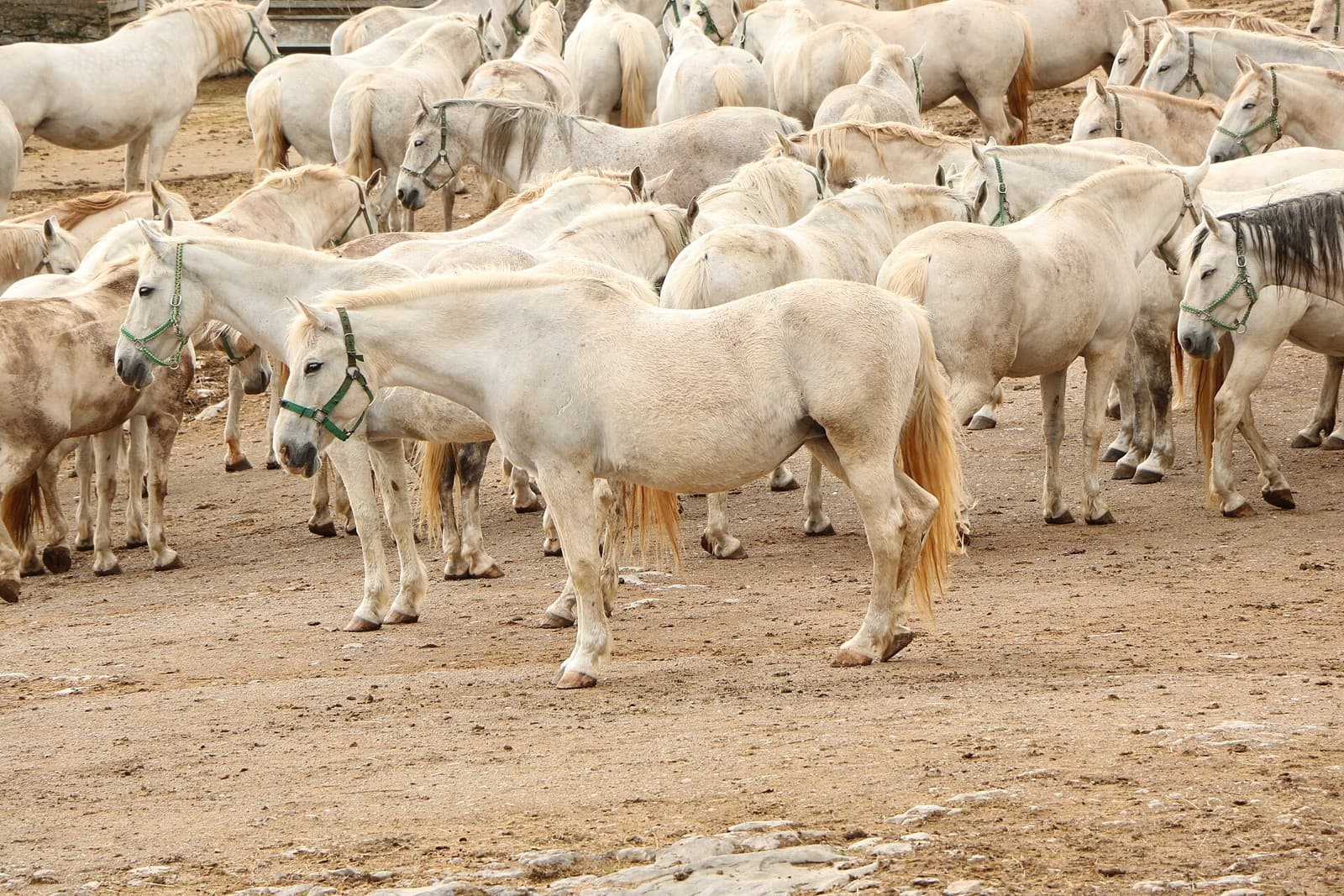
Lipizzans together at Lipica Stud in Slovenia.

The Lipizzan: Lipica and a history shared across borders
Archduke Charles II founded Lipica Stud in 1580 in the Karst, now part of Slovenia. Local mares were crossed with Spanish, Neapolitan, Danish and Kladruber horses, followed by Arabians in the nineteenth century. Studs in Austria, Croatia, Hungary, Italy, Romania and Slovakia also contributed to the breed's history. The name therefore connects a specific birthplace with a shared European heritage.
Sources for this section: Lipica [1] · Genska banka [2]
The Lipizzan: a baroque build and high-set neck
Lipica describes a medium-sized baroque horse, meaning a powerful body with rounded outlines and a high-carried neck. The expressive head has large eyes, medium-sized ears and open nostrils. Broad withers, a long flat back, rounded muscular croup and deep chest support the overall build. Mane and tail are abundant. Movement should be energetic, supple and elevated while retaining a regular rhythm.
Sources for this section: Lipica [1]
The Lipizzan: a grey horse may look white
Many Lipizzans are born dark and progressively develop more white hairs. An almost white adult can therefore be genetically grey. This change in hair colour should not be confused with every other cause of depigmentation. The adult appearance alone cannot reliably reveal the foal's original base colour.
Sources for this section: Lipica [1]
The Lipizzan: Classical schooling and carriage driving
Classical training gradually develops balance and greater weight-bearing by the hindquarters. Some horses later learn advanced haute école movements. Driving, both in displays and competition, is another important outlet. These activities require sustained education; they are skills developed in individual horses rather than automatic consequences of breed membership.
Sources for this section: Lipica [1]
The Lipizzan: Pedigrees maintained by breeding organisations
Lipica Stud records the parentage of its horses and runs a Slovenian breeding programme with the Lipizzan breeders’ organisation. Other European countries have their own studbooks, whose organisations cooperate to trace the breed’s families. For a Lipizzan born in France from 2024, breed documents are issued by the competent foreign organisation. The horse must then be recorded in SIRE, France’s equine identification database. The breed document records its origins, while SIRE provides its administrative registration in France.
Sources for this section: Lipica [1] · Genska banka [2] · IFCE — SIRE [3]
The Lipizzan: Slovenian figures for 2025
Slovenia's genetic resource registry estimates 1,191 purebred Lipizzans in the country in 2025. It separately lists 246 registered breeding mares and 32 breeding stallions. Those categories should not be added to the total, and the figures are not a worldwide census. They describe one national population within the breed.
Sources for this section: Genska banka [2]
The Lipizzan: Pedigrees help conserve genetic diversity
Following pedigrees helps identify shared ancestors before a mating. The Slovenian genetic resource registry includes avoiding matings between close relatives among its conservation aims. Horses bearing different line names can still share other ancestors, so a line name cannot replace examination of the whole pedigree. Grey coats provide no measure of how closely two horses are related.
Sources for this section: Genska banka [2]
Sources and review date
Profile reviewed on .
The documents below were used to prepare this profile of the Lipizzan. They explain which animals can enter the studbook and how breeding animals are selected.
- Lipica — Lipizzan horses
Studbook document covering selection, registration, breeding assessments and dated figures where available.
- Genska banka — Lipicanski konj, données 2025
Slovenian genetic resource registry: history, conservation and national population figures for 2025, rather than worldwide totals.
- IFCE — Quels papiers pour mon cheval ?
SIRE procedures and responsibilities for identification documents and foreign studbooks.