
Breeds · breed profile
Knabstrupper
The Knabstrupper is a Danish breed known for leopard-complex spotting
The Knabstrupper is a Danish breed often recognised by its spotted coat. Its markings range from a largely white body with coloured spots to much less obvious signs. The Danish association KNN runs several programmes for horses, ponies and classical types. Knabstruppers therefore do not share one fixed height or one identical coat pattern. Their registered ancestry matters alongside their appearance.
- Category
- Horse
- Country of origin
- Denmark
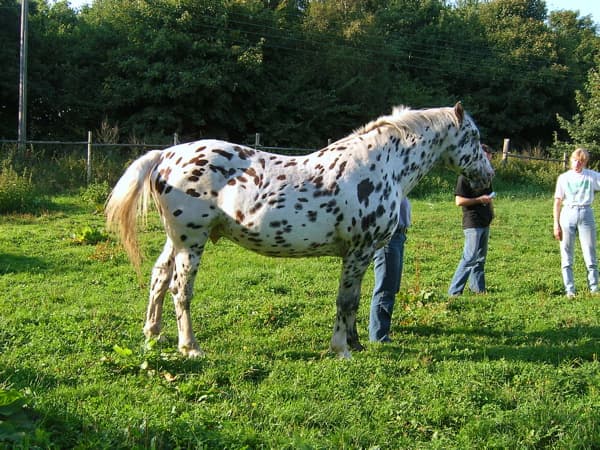
Xantos, a spotted Knabstrupper.

The Knabstrupper takes its name from the Knabstrup estate
The Knabstrup estate in Denmark bred useful working and riding horses in the early nineteenth century. A mare known as Flæbe became influential there. Her 1813 foal, by a Frederiksborg stallion, contributed to the developing family. The breed’s later history includes outcrossing, periods of decline and preservation work. Modern Knabstruppers belong to a breeding population that expanded and changed beyond the original estate, rather than a single family kept unchanged since its foundation.
Sources for this section: KNN [1]
KNN programmes recognise different Knabstrupper types
KNN’s Knabstrupper Horse programme, revised in March 2026, describes a balanced riding horse standing over 1.48 m at the withers. It also makes provision for undersized animals whose pedigrees justify keeping them in that programme. Separate programmes cover classical types, ponies and miniature ponies. Height limits must therefore be read alongside the programme name. The riding-horse threshold does not apply to every Knabstrupper, and a smaller animal is not necessarily an incorrectly registered member of the breed.
Knabstrupper spotting is part of the leopard complex
Leopard-complex characteristics can include coloured spots on white areas, mottled skin, striped hooves and the visible white part of the eye around the eye. Their expression varies, so not every horse has large, clearly separated spots. The LP variant contributes to this pattern, while other variants affect the amount of white. KNN also sets conditions for breeding solid-coloured horses and excludes some colours from breeding inspections, including greying. Coat appearance and registration eligibility must therefore be considered together with the applicable programme rules.
Sources for this section: KNN [2] · UC Davis VGL [4]
Knabstruppers are used for riding and driving
KNN’s programme describes a versatile horse suitable for dressage, jumping, eventing and driving. Assessments consider movement and behaviour, with jumping or harness work included according to the test. Striking markings may make a horse memorable, but they do not show how much training it has received. For a riding or competition Knabstrupper, its build, experience and way of working provide practical information. The breed’s range of types also means that the individual horse matters more than one general image of a spotted horse.
Sources for this section: KNN [2]
Knabstrupper registration and breeding assessment are distinct
KNN maintains a studbook recording horses and their ancestry. Its programmes specify accepted pedigrees, permitted outcrosses and assessment requirements. The main section of the Knabstrupper Horse programme requires at least three generations of approved ancestry, with supplementary sections for other situations. Programmes described as purebred have their own conditions. To understand a horse’s status, readers need the relevant programme and section as well as its breed name. Even a very characteristic spotted coat does not establish these details.
Knabstrupper breeding is organised in Denmark and abroad
KNN coordinates breeding and inspections in Denmark and with breeders in other countries. Its programmes provide a framework for recognised ancestry and international breeding activity. Avila and colleagues’ 2022 coat-colour study included 91 horses identified as Knabstruppers, with 71 retained after close relatives were removed. This was a group of horses submitted for laboratory testing. It was not a count of annual foal births, breeding animals or the worldwide living population.
Sources for this section: KNN [3] · Avila et al. (2022) [5]
A Knabstrupper LP test also gives information about night vision
The LP DNA test determines whether a horse carries zero, one or two copies of the leopard-complex variant. Horses with two copies, written LP/LP, have congenital stationary night blindness: they have difficulty seeing in dim light from birth. The result therefore matters beyond coat appearance. The number of spots cannot reliably establish the number of LP copies. Testing the parents can clarify possible inheritance, while a veterinarian can advise on the horse’s vision and any necessary care.
Sources for this section: UC Davis VGL [4] · Avila et al. (2022) [5]
Sources and review date
Profile reviewed on .
Breed organisations document history, registration rules and uses. The 2022 study examined horses submitted for coat-colour testing; its results describe that sample, rather than a census of the breed.
- KNN — Knabstrupperens historie
The breed’s history and the development of its breeding organisation.
- KNN — Knabstrupper Horse, 2026
Registration requirements, studbook categories and verification of ancestry.
- KNN — Breeding principles, 2026
Registration requirements, studbook categories and verification of ancestry.
- UC Davis VGL — Leopard Complex
Testing for LP and the link between two copies of the variant and congenital stationary night blindness.
- Avila et al. — Genes, 2022
Avila and colleagues (2022): coat variants, sample sizes before and after removing close relatives, and limitations of the laboratory sample.