
Breeds · breed profile
Irish Cob
The Irish Cob, a powerful horse shaped by Irish driving traditions
The Irish Cob is a compact, powerful horse with an abundant mane and tail and long hair around the lower legs, called feathering. France Irish Cob organises breeding in France to preserve this traditional appearance and qualities suited to driving and leisure riding. Breeding inspections include observation of movement and behaviour.
- Category
- Horse
- Country of origin
- Ireland
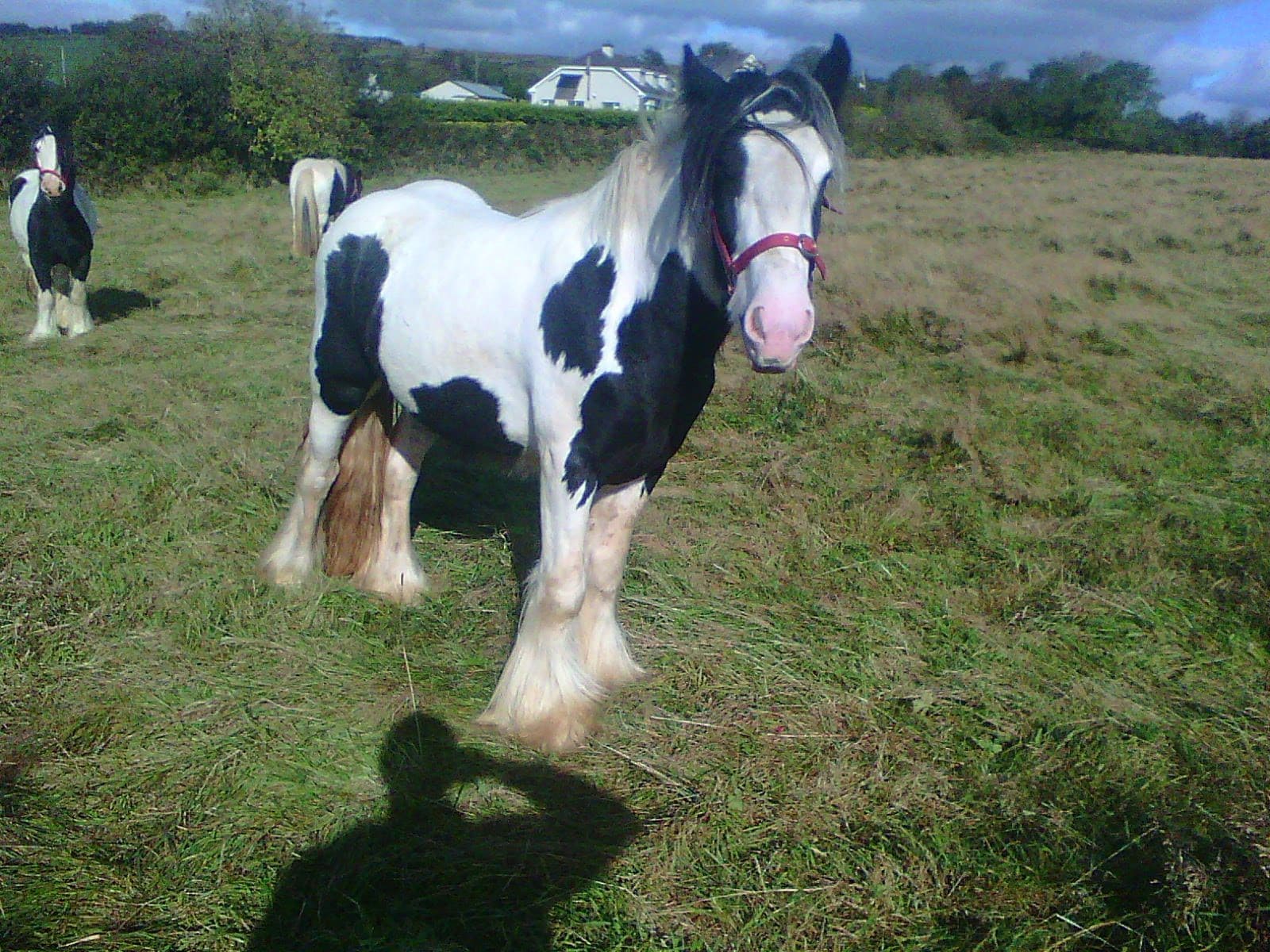
Irish Cobs at pasture in Killarney, Ireland.

The Irish Cob: a horse associated with travelling families
Ireland's travelling communities helped develop horses capable of pulling family vehicles and undertaking everyday work. Breeding and practical use maintained the type before modern studbooks formalised it. Related commercial names, including “Gypsy” and “Vanner”, do not by themselves identify the registry in which a particular horse is recorded.
Sources for this section: France Irish Cob [1]
The Irish Cob: a short back and generous hindquarters
France Irish Cob describes the desired traits of the Irish Cob in its breeding programme. This document guides the choice of breeding animals. The Irish Cob breed standard requires a height below 1.70 m. The head should be proportionate, with a broad forehead and open, well-spaced eyes. A compact body combines a developed chest, short back and broad, rounded, strongly muscled croup. Bone is medium to heavy. Mane, tail and feathering (the long hair around the lower legs) contribute to the type, while inspection also considers limb alignment, feet and movement.
Sources for this section: France Irish Cob [1]
The Irish Cob: Pinto patterns are familiar but not compulsory
The Irish Cob breeding programme permits a wide range of colours. Horses with large white patches are well known, but this is not the only accepted appearance. Colour alone cannot distinguish an Irish Cob from another cob or a crossbred horse. Markings form part of identification and must be considered alongside the horse's documents.
Sources for this section: France Irish Cob [1]
The Irish Cob: Driving and leisure riding
Vehicle traction shaped the breed's historical selection. Modern uses include leisure driving, hacking and ridden work. The programme seeks a willing, manageable horse and assesses behaviour during presentations. Heavy feathering also means that handlers need to part the hair to inspect and care for the skin and feet underneath.
Sources for this section: France Irish Cob [1]
Irish Cob and Irish Cob Partbred
France Irish Cob runs the French programmes in relation to the Irish mother studbook. The Irish Cob and Irish Cob Partbred studbooks have different admission requirements; the latter records eligible crosses. Initial registration involves inspection under the relevant procedure. The actual studbook named in the papers is therefore more informative than a broad label used in an advertisement.
The Irish Horse Board lists Gypsy Cob and Gypsy Vanner among names used abroad for the Irish Cob. These names refer to horses of a similar type, but a name alone does not establish registration with a particular studbook. The 2022 coat study keeps Gypsy Cob and Gypsy Vanner as separate groups, as does the calculator. This profile describes the Irish Cob under the cited breeding programme. It provides context for the names without combining their sample sizes or genetic frequencies.
Sources for this section: France Irish Cob [1] · Irish Horse Board [2] · Avila et al. (2022) [3]
The Irish Cob: Registered French births in 2022
The 2024 programme reports 188 registered foals born in France in 2022. This annual total is not the number of all living Irish Cobs and should not be casually combined with Partbred figures. French breeding is spread across several regions and includes imported horses as well as locally bred lines.
Sources for this section: France Irish Cob [1]
The Irish Cob: Pedigree and inspection provide different evidence
An Irish Cob’s pedigree records its parents and ancestors. When a parentage test is carried out, the laboratory compares selected DNA markers with those of the declared parents. A breeding inspection asks a different question: does the horse have the physical traits and movement sought by the studbook? A disease test must instead look for a specific DNA variant linked to that condition. Crossbred horses retain their separate identification in breeding records.
Sources for this section: France Irish Cob [1]
Sources and review date
Profile reviewed on .
The documents below were used to prepare this profile of the Irish Cob. They explain which animals can enter the studbook and how breeding animals are selected.
- Irish Cob et Irish Cob Partbred — Programme de sélection 2024
Studbook document covering selection, registration, breeding assessments and dated figures where available.
- Irish Horse Board
Names, registry scope and membership requirements.
- Avila et al. — Genes, 2022
Avila and colleagues (2022): coat variants, sample sizes before and after removing close relatives, and limitations of the laboratory sample.