
Breeds · breed profile
The Icelandic horse
Íslenski hesturinn · Icelandic Horse
The Icelandic is a small riding horse whose history is intertwined with Iceland’s settlement and rural life. Tölt and, in horses that perform it, flying pace are important in its breeding. The breed is now raised in many countries, with a shared international register, WorldFengur, and breeding assessments coordinated by FEIF.
- Category
- Small horse
- Country of origin
- Iceland
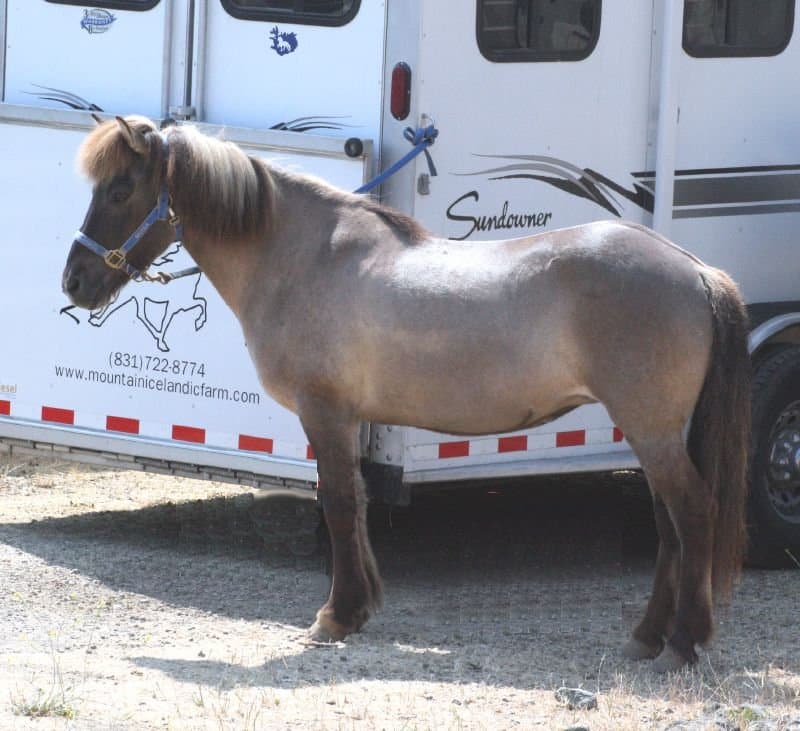
An Icelandic horse photographed from the side on 14 June 2008, showing its long mane.

The Icelandic horse: the horse in Iceland’s history
The Icelandic horse: Horses brought by the settlers
The breed’s ancestors arrived with the settlers who began populating Iceland in the late ninth century. These people came particularly from Norway and the British Isles. Their horses then bred in island conditions, where available resources and winter weather strongly influenced husbandry. The breed’s history cannot be reduced to one founding stallion or a resemblance to a modern breed.
The Icelandic horse: Transport, farms and periods of crisis
For centuries, horses carried people and loads between farms, transported mail and helped with agricultural work. Breeders needed animals able to travel along tracks and make use of the available pasture. Climatic crises and the 1783 Laki eruption caused heavy losses. These events also reduced the number of families able to contribute to later generations.
The Icelandic horse: Organising selection in the twentieth century
In the early twentieth century, agricultural advisers and local associations organised comparisons of breeding animals. The first breeding association was founded in the southeast in 1904. Whether to prioritise working or riding horses became a subject of debate. After the Second World War, machinery reduced traction and transport work; equestrian gatherings, leisure riding and selection for ridden qualities gained importance.
The Icelandic horse: FEIF and a register shared across countries
FEIF, the International Federation of Icelandic Horse Associations, was founded in 1969 to coordinate national organisations. Growing breeding populations abroad created a need to share identities, pedigrees and results. WorldFengur was established in 2000 by the Icelandic authorities with FEIF and opened to the public in 2001. It connects pedigrees recorded in different countries.
Sources for this section: FEIF · history [1] · FEIF · WorldFengur [4]
The Icelandic horse: Icelandic riding conformation, tölt and pace
The Icelandic horse: Conformation that supports ridden movement
FEIF’s breeding goal seeks a strong, supple horse whose conformation supports ridden movement. It combines an expressive head, a well-set, raised neck, a long sloping shoulder, a supportive back and a long muscular croup. Correct limb alignment and good feet are also important. Abundant mane, tail and winter hair are characteristic of the breed’s appearance.
The Icelandic horse: Descriptions and breeding goals have different roles
The breeding-goal section of FEIF’s 2026 rules places most horses between 135 and 146 cm at the withers and prefers at least 138 cm, while allowing variation in size. The French 2021 appendix gives a preferred range of 135–155 cm. These figures have different functions and dates; they are not one worldwide registration threshold. Icelandic horse remains the breed’s name, independently of height-based sporting categories.
The Icelandic horse: Tölt: four regular beats without suspension
In tölt, the feet land in the same order as in walk: left hind, left fore, right hind, right fore. The desired rhythm has four evenly spaced beats, with one or two feet on the ground. The absence of a phase when all four feet leave the ground together explains its smooth feel for the rider. Judges assess rhythm, balance, suppleness and the ability to change speed.
The Icelandic horse: Four or five gaits according to the abilities shown
Flying pace is a fast gait in which the legs on the same side move together, with a moment of suspension. It is ridden over short distances. A four-gaited Icelandic is presented in walk, trot, canter and tölt; a five-gaited horse adds flying pace. The distinction describes the abilities trained and demonstrated. A DNA result does not measure tölt quality or the preparation needed to produce regular pace.
Sources for this section: FEIF · 2026 rules [2] · FFCI / IFCE · 2021 [6] · Horses of Iceland · gaits [3]
The Icelandic horse’s range of colours
The Icelandic horse: Breeding that retains many colours
The French regulation accepts all colours. FEIF documents describe chestnut, bay, black, grey, tobiano and several dilutions, among others. Colour does not determine the ranking of ridden qualities. Pedigrees and test results help explain how different colours can occur within the same family.
The Icelandic horse: Greying and Silver are different changes
A grey horse lightens with age as white hairs appear. Silver dilution mainly affects black pigment, particularly lightening the mane and tail, and may be invisible on a chestnut base. A chestnut with flaxen hair is therefore not automatically Silver. This distinction also matters for health because the Silver variant is associated with congenital eye abnormalities.
Sources for this section: FEIF · 2026 rules [2] · FFCI / IFCE · 2021 [6] · UC Davis · Silver / MCOA [9]
Icelandic horses in leisure riding and gait competitions
The Icelandic horse: From farm journeys to recreational riding
The history of travel between farms continues today through hacking and trekking. Tölt can provide a comfortable gait over sustained distances when the horse has been prepared for the effort. Breeding goals seek a willing, cooperative horse suitable for different riders. Training develops that cooperation and the ease of transitions.
The Icelandic horse: Competitions that assess gait quality
On an oval track, sport tests compare tölt alone, four gaits or five gaits. Judges assess movement quality and the horse-and-rider performance. Pace is also shown on a straight track in races and technical tests. Breeding assessments serve a different purpose: describing potential breeding animals to support breeders’ decisions.
Sources for this section: FEIF · 2026 rules [2] · Horses of Iceland · gaits [3]
The Icelandic horse: WorldFengur, FEIF assessments and the French studbook
The Icelandic horse: the international record of families
WorldFengur records horses’ identities, parents, offspring and assessment results. FEIF and Icelandic organisations work with national registrars. In Iceland, the Agricultural Advisory Centre, RML, runs the project on behalf of the Farmers Association, BÍ. Ancestry must trace to eligible Icelandic horses. Registration records that ancestry; it does not mean the horse has won a breeding award.
The Icelandic horse: Describing a horse and estimating breeding value
A full assessment combines conformation judging with a ridden presentation of gaits and riding qualities. Results feed into BLUP estimates, a statistical method that uses performances and family relationships to estimate what a breeding horse may pass on. Since 2025, selected competition results have supplemented breeding assessments in this calculation. A BLUP index is a selection estimate rather than a guarantee of an individual foal’s performance.
The Icelandic horse: Foal registration and stallion approval
The French regulation is developed with the Fédération française du cheval islandais and administered by IFCE. It provides for registration by descent and import, with requirements for parents, declarations and identification. Compatible DNA parentage is required before a stallion’s first covering book, apart from specified exemptions. French approval can be temporary through the end of the sixth year; permanent approval requires a ridden presentation from five years of age, with provisions for recognised foreign assessments.
Sources for this section: FEIF · WorldFengur [4] · FEIF · 2026 rules [2] · FFCI / IFCE · 2021 [6] · WorldFengur · 2025 report [5]
The Icelandic horse: Icelandic foals registered across several countries
The Icelandic horse: 13,287 births from 2024 in the WorldFengur 2025 report
The WorldFengur 2025 report gives 13,287 horses for the 2024 birth cohort in its country-of-birth series. These include 5,628 born in Iceland, 2,241 in Germany, 1,609 in Denmark and 90 in France. The figures show substantial breeding outside Iceland, supported by a common register and shared goals.
The Icelandic horse: a foal crop does not count all living horses
The table covers 2024 births known to the register when the report was prepared, even though the document is titled 2025. It does not count living horses of every age or necessarily identify their current country of residence: a horse may have been exported since birth. WorldFengur also retains deceased horses in its pedigrees. This preserves family history but means the cumulative register cannot be used as a living population count.
Sources for this section: WorldFengur · 2025 report [5]
DMRT3, gaits and Silver testing in Icelandic horses
The Icelandic horse: the 2012 investigation of pacing ability
Andersson and colleagues first compared 30 four-gaited and 40 five-gaited Icelandic horses, then genotyped a further 352 Icelandics. They identified a DMRT3 variant that changes a protein involved in the neural circuits coordinating the limbs. Two copies were strongly associated with pacing ability. Some four-gaited horses also carried two copies, showing that other biological factors, maturity and training contribute to how the gait is expressed.
The Icelandic horse: the DMRT3 test identifies a predisposition
The test looks for the DMRT3 variant to help explain coordination possibilities and inheritance to foals. It complements observation and ridden results, which assess rhythm, stride, balance and ease of transitions. It cannot provide a future tölt or pace score. The groups selected to compare gaits in the 2012 study do not establish the variant’s current frequency throughout the breed.
The Icelandic horse: Silver testing helps identify an eye-health concern
The Silver test detects a PMEL variant associated with colour and Multiple Congenital Ocular Anomalies, or MCOA. Abnormalities are generally more marked with two copies than with one. On a chestnut coat, the variant can be carried without visible Silver dilution, so testing can reveal it and guide an eye examination. This targeted test and DNA parentage have different purposes and do not form a health panel required for every Icelandic horse.
Sources for this section: Andersson et al. · 2012 [7] · UC Davis · DMRT3 [8] · UC Davis · Silver / MCOA [9]
Sources and updates
Profile updated on .
The FEIF 2026 rules describe international goals and assessments. The French regulation published by IFCE carries an internal date of 2021; the WorldFengur 2025 report includes births from 2024.
- FEIF — The Icelandic Horse: History of Horse Breeding
Breeding history, crises, agricultural advisers, the 1904 association and FEIF’s foundation. Saga narratives are distinguished from historical events.
- FEIF — Breeding Rules and Regulations, 2026
Valid from 1 April 2026; B8 breeding goals, gait descriptions, assessments and registration. Breeding-goal heights differ from the older general description retained in this document.
- Horses of Iceland — The five gaits
Tölt, flying pace and their use, from the promotional project involving Icelandic breed stakeholders.
- FEIF — WorldFengur international register
Established in 2000, opened in 2001; identities, pedigrees and breeding results.
- WorldFengur — Annual report 2025
BÍ/RML operation, updated BLUP and the 2020–2024 birth table on page 5. The 2024 total is 13,287.
- FFCI / IFCE — French Icelandic horse studbook regulation, 2021
Still linked from the IFCE index consulted on 8 November 2026; registration, temporary and permanent stallion approval, parentage and French standard.
- Andersson et al. (2012) — DMRT3 and gait coordination
Nature, 488:642–646. Initial comparison of 30 four-gaited and 40 five-gaited horses; 352 additional Icelandics genotyped.
- UC Davis VGL — SynchroGait (DMRT3)
Purpose and interpretation of the coordination-variant test, distinct from assessing gait quality.
- UC Davis VGL — Silver and MCOA eye abnormalities
PMEL variant, pigment effects, hidden carriage on chestnut and the role of an eye examination.