
Breeds · breed profile
Highland
The Highland, a sturdy pony from the Scottish Highlands
The Highland is a compact Scottish pony with substantial bone and a dense winter coat. Carrying, pulling and travelling over demanding ground have shaped its use. The Highland Pony Society standard describes its conformation, varied coat colours and the white markings permitted for each sex.
- Category
- Pony
- Country or region of origin
- United Kingdom
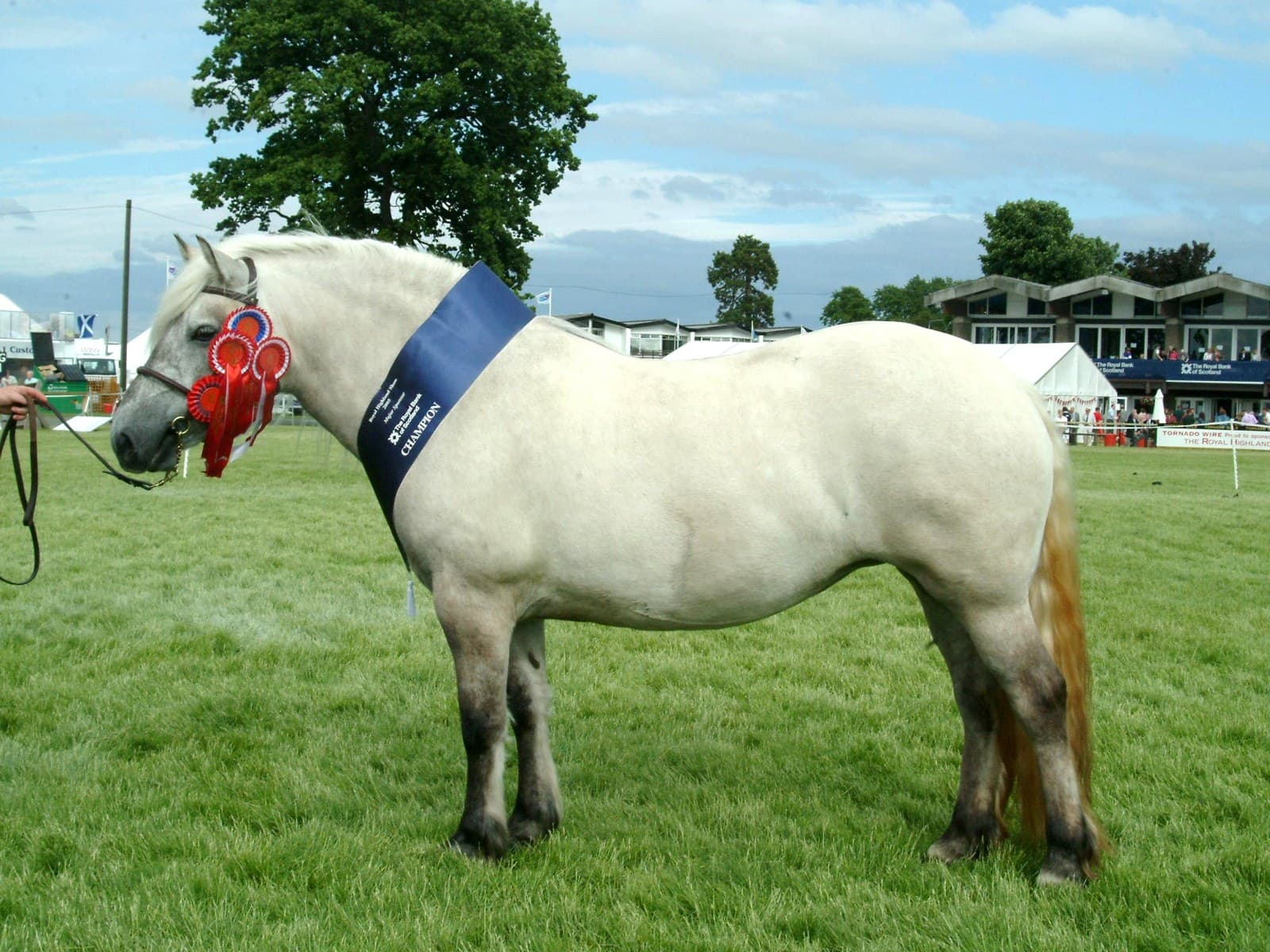
Grace of Carlung, Highland Pony champion at the 2005 Royal Highland Show.

A pony shaped by Highland life
The Highland: Carrying and travelling across Scottish terrain
Highland pony history is connected with rural work in the Scottish Highlands and islands. Carrying loads, farm work and travel favoured a strong, economical pony. The Highland Pony Society maintains the original studbook and provides an international framework for the breed. Leisure riding has broadened its uses while preserving the importance of a functional build and manageable temperament.
Sources for this section: Association française du poney Highland [1] · Highland Pony Society [2] · RBST [3]
The Highland: Compact proportions and substantial bone
The Highland: the French standard describes 1.32–1.48 m
Association française du poney Highland describes the desired traits of the Highland in its studbook rules. This document guides the choice of breeding animals. The rules of the French Highland studbook effective from January 2023 describe a height of 1.32–1.48 m. The body is compact with a deep chest and powerful hindquarters. The neck should not be excessively long, and limbs have short cannon bones (the long bones above the fetlocks) and well-formed feet. Movement is straight and free. A dense undercoat beneath longer winter hair provides protection, while the mane and tail remain abundant.
Sources for this section: Association française du poney Highland [1] · Highland Pony Society [2]
The Highland: Dun shades, grey and primitive markings
The Highland: Appearance can change with age
The Highland colour range includes several traditional dun shades, grey and darker colours. A dorsal stripe and leg barring may occur. Standard colour names are not all genetic test results: progressive greying and dilution with primitive markings are different processes. French stallion rules strongly restrict white and allow only a small forehead marking within the specified conditions.
Sources for this section: Association française du poney Highland [1] · Highland Pony Society [2]
The Highland: Riding, driving and pack work
The Highland: Several uses supported by a strong build
The Highland is used for trail riding, driving and pack work, which means carrying loads on its back. These activities continue its role in transport and work across Scottish terrain. Breeders seek a manageable pony with a gentle temperament and easy movement to preserve these abilities. The same qualities are useful to leisure riders and drivers.
Sources for this section: Association française du poney Highland [1] · Highland Pony Society [2]
The French studbook and the Highland Pony Society
The Highland: Recognised ancestry and stallion approval
The studbook is the register that records the identity and ancestry of animals admitted to the breed. The responsible organisation is Association française du poney Highland. French registration is based on studbooks recognised by the Highland Pony Society. Stallion candidates assessed in France must be at least three, with certified identity and a DNA profile. Stallions already approved by a recognised foreign studbook remain approved; presentation in France allows them to receive a classification. Assessment combines conformation, movement, behaviour and age-appropriate aptitude tests.
Sources for this section: Association française du poney Highland [1]
The Highland: Conservation beyond the breed’s home region
The Highland: Keeping breeding networks and families active
Scotland remains the Highland’s home, while recognised societies and studbooks support breeding elsewhere, including France. The French rules consulted do not supply a recent census of all living ponies. Conservation is better assessed through registered births, breeding animals in use and family representation, always stating the country and year when comparing population figures.
Sources for this section: Association française du poney Highland [1] · RBST [3]
The Highland: the required examinations are not a DNA health panel
The Highland: Genetic identity and veterinary findings have different roles
A DNA profile supports genetic identification and parentage verification. French approval also requires a veterinary certificate addressing matters such as dermatitis and the normal presence of both testicles. These assessments serve different purposes and do not prove freedom from all inherited disease. Pedigrees must also inform breeding choices so that a range of future mating options remains available.
Sources for this section: Association française du poney Highland [1] · IFCE — Equipédia [4]
Sources and updates
Profile updated on .
The documents below were used to prepare this profile of the Highland. They explain which animals can enter the studbook and how breeding animals are selected.
- Association française du poney Highland — Studbook rules and breeding programme, 2023
French rules effective from January 2023: standard, registration and approval, distinguished from the British original studbook.
- Highland Pony Society — Breed description and standard
Conformation, historical uses, coat colours and restrictions on white markings in stallions.
- Rare Breeds Survival Trust — Highland Pony
British conservation context and the society’s foundation in 1923; no living world population is extrapolated.
- IFCE — Insect bite hypersensitivity, February 2026
Insect bite hypersensitivity and clinical diagnosis; does not establish a breed-specific frequency.