
Breeds · breed profile
Henson
The Henson, a leisure horse developed around Somme Bay
The Henson is a leisure horse developed around Somme Bay for trail riding and other outdoor rides. Its founders crossed Fjord ponies with riding horses, then selected a population over successive generations. Recognised as a breed in 2003, it has its own breeding rules: a Fjord cross is not automatically a Henson.
- Category
- Horse
- Country of origin
- France
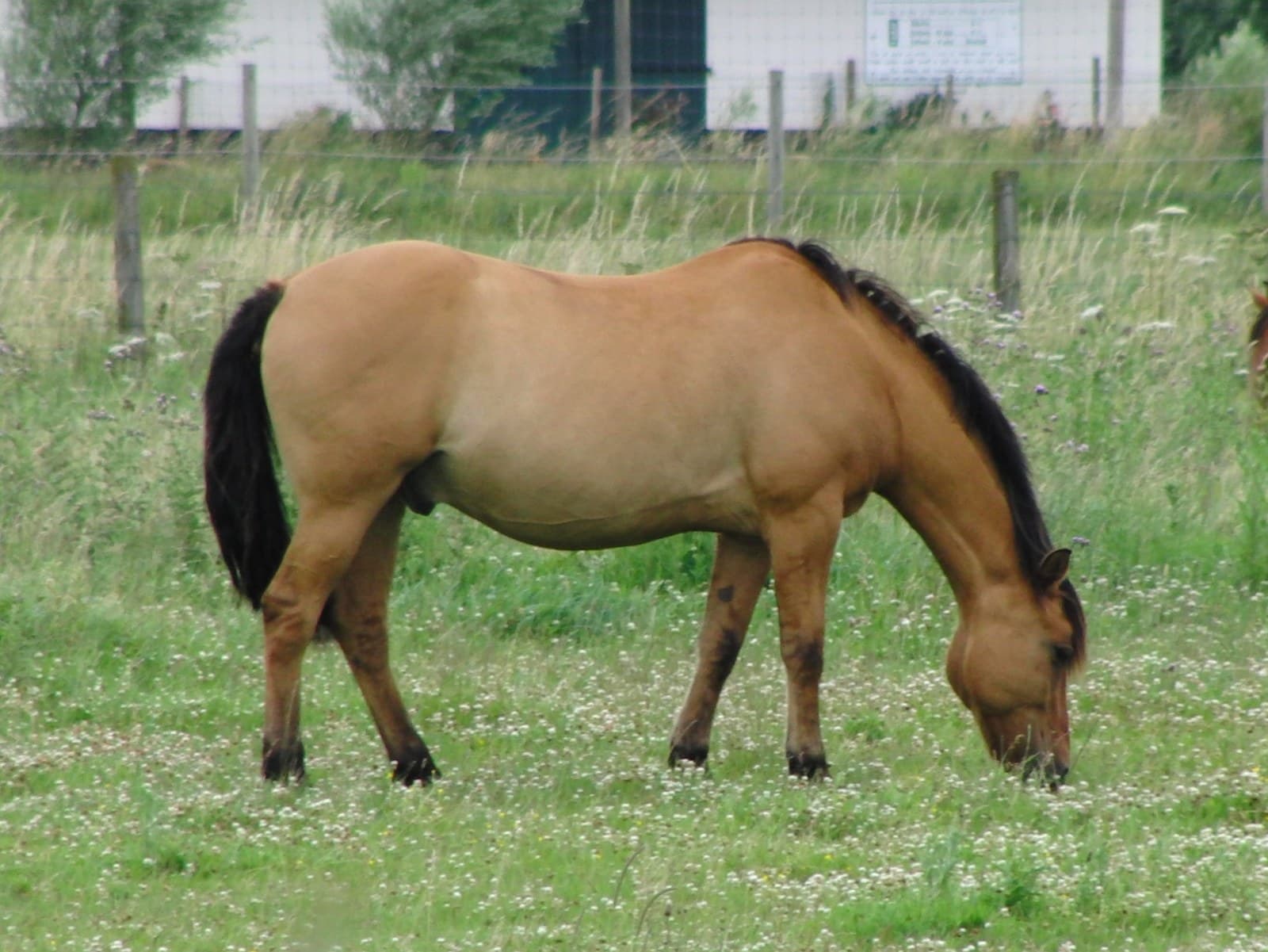
A Henson grazing at Haras Henson de Saint-Jean in Rue, Somme.

The Henson: Developing a leisure horse breed
The Henson: From founder crosses to a shared breeding programme
The Henson project centred on a horse suited to group rides and equestrian tourism around Somme Bay. The Association du cheval Henson was established in 1983. Initial Fjord crosses were followed by selection over several generations. Recognition in 2003 gave the population and its practical breeding aims an official framework, rather than simply naming a recurring type of cross.
Sources for this section: Association du cheval Henson [1]
The Henson: a sturdy horse with covering movement
The Henson: a target height of 1.50–1.60 m
Association du cheval Henson describes the desired traits of the Henson in its breeding programme. This document guides the choice of breeding animals. The Henson breed standard describes a horse standing 1.50–1.60 m, with an open chest, long sloping shoulder and strong back. The head is straight to slightly concave, with fairly short ears. Feet should be broad and well formed. Breeders seek easy, ground-covering movement consistent with leisure work that may continue for several hours, alongside a build suited to carrying a rider.
Sources for this section: Association du cheval Henson [1]
The coat called “isabelle Henson”
The Henson: the dorsal stripe is part of the selected appearance
The breed description includes sandy to brown shades, a dorsal stripe and sometimes leg barring. Dark and lighter hairs occur together in the mane. The traditional French expression isabelle Henson describes the appearance selected by breeders; it does not by itself establish a DNA result for a particular dilution. The rules also allow bay mares among confirmed breeding females.
Sources for this section: Association du cheval Henson [1]
The Henson: Tourism, trail riding and driving
The Henson: Selection with practical use in mind
Guided rides and trekking through the bay’s landscapes are closely associated with the Henson. Driving and other leisure activities provide further uses. Breeders seek ease of handling and behaviour suited to working in a group. Practical training includes group movement and familiarity with situations encountered during outings.
Sources for this section: Association du cheval Henson [1]
The requirements for breeding a Henson
The Henson: Fjord contributions remain controlled
The studbook is the register that records the identity and ancestry of animals admitted to the breed. The responsible organisation is Association du cheval Henson. The rules in the July 2023 programme require at least one Henson parent, an approved sire and a confirmed dam or an accepted contributing mare. Contributing breeding animals must satisfy ancestry conditions, including 25–50% Fjord ancestry. The rules exclude registration of offspring produced by artificial insemination or embryo transfer. These conditions distinguish the registered breed from an informal leisure-horse cross.
Sources for this section: Association du cheval Henson [1]
Births and the diversity of the Henson
The Henson: 49 registered births in 2022
The Henson breeding programme reports 49 registered births in 2022, compared with 46 in 2021, with breeding strongly concentrated in the Somme. These are annual generations, not a census of all living Hensons. The programme seeks wider mating choices and a range of bloodlines. It also limits stallion use according to age within this relatively small breeding population.
Sources for this section: Association du cheval Henson [1]
The Henson: Extension and Agouti testing
The Henson: Selecting colour without implying disease
Extension and Agouti analyses examine variants involved in producing and distributing black pigment. Stallion candidates must not carry the chestnut variant and must have two copies of the Agouti variant selected for bay. Requirements differ between categories of mares. These tests concern coat colour; pedigree relationships and the balance between family lines are also needed to assess and conserve genetic diversity.
Sources for this section: Association du cheval Henson [1]
Sources and review date
Profile reviewed on .
The documents below were used to prepare this profile of the Henson. They explain which animals can enter the studbook and how breeding animals are selected.
- Association du cheval Henson — Studbook rules and breeding programme, July 2023
Programme dated July 2023: origins, standard, 49 births in 2022 and Fjord, Extension and Agouti rules.