
Breeds · breed profile
Hanoverian
The Hanoverian is a German sport horse bred for dressage and jumping
The Hanoverian is a sport horse from northern Germany. Breeders combine recorded pedigrees, inspections and performance results when selecting future breeding horses. The Hannoveraner Verband manages the studbook, which records horses and their parents. Dressage, jumping and eventing are important breeding goals, alongside producing horses that amateur riders can enjoy. Hanoverian breeding is also established outside Germany.
- Category
- Horse
- Country of origin
- Germany
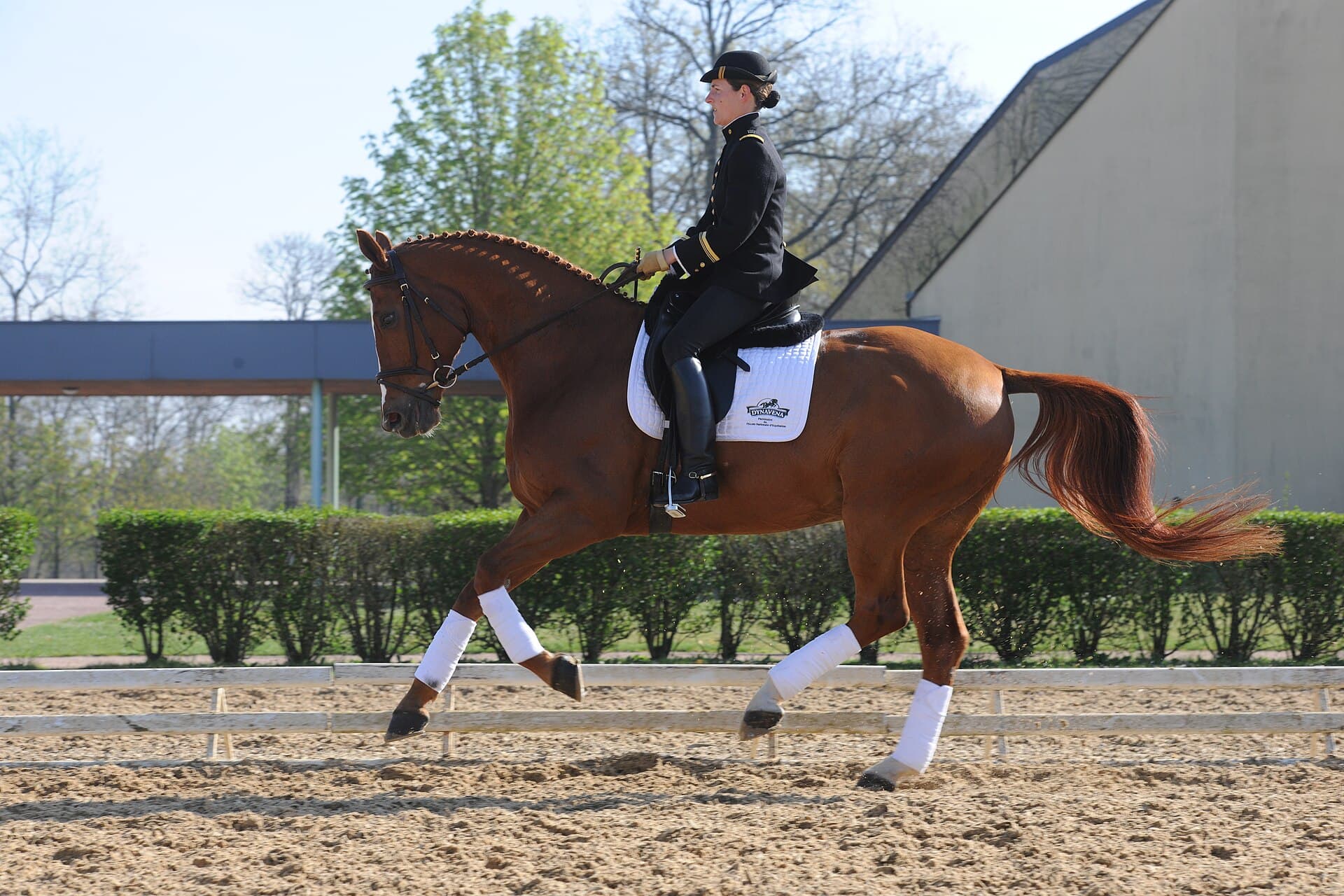
The Hanoverian Liaison competing in dressage with Pauline Basquin.

Hanoverian history is closely linked to Celle State Stud
Founded in 1735 in what is now Lower Saxony, Celle State Stud played a central role in Hanoverian breeding. Its stallions helped produce horses for agriculture, transport and military service. As those needs changed, breeders adjusted their priorities. The growth of equestrian sport gradually shifted selection towards riding horses. Today’s Hanoverian is therefore the product of a changing breeding programme, rather than an unchanged version of an eighteenth-century working horse.
Sources for this section: Hannoveraner Verband [1]
The Hanoverian breeding goal combines balance and useful movement
The Hannoveraner Verband’s breeding programme describes a balanced horse with a functional back, sound limbs and regular movement. It gives an average target height of about 1.68 m at the withers. This is a breeding objective, not a measurement that every Hanoverian must match exactly. Assessments consider conformation, gaits and sporting aptitude. Dressage and jumping horses can meet different priorities within the same studbook, because the demands of the two sports are not identical.
Sources for this section: Hannoveraner Verband [1]
The Hanoverian studbook accepts all coat colours
The Hannoveraner Verband states that all colours can be admitted when ancestry and registration requirements are met. The breed is therefore not restricted to the bay, chestnut, black and grey commonly associated with sport horses. An unusual colour does not automatically exclude a horse from the studbook, and a familiar colour does not prove membership. Identification and pedigree records establish the horse’s recognised background. Coat-colour DNA tests can clarify particular variants, but they do not replace those records.
Sources for this section: Hannoveraner Verband [2]
Hanoverians are bred for several equestrian disciplines
Dressage and jumping have prominent roles in Hanoverian selection. Eventing combines dressage, cross-country and show jumping, requiring a broader set of abilities. The breeding programme also includes leisure riding and driving. A young horse’s movement and behaviour provide useful early information, while later training and competition add further evidence. A good inspection result is consequently one part of the picture: it does not mean that an untrained horse already has the experience needed for a particular rider or competition.
Sources for this section: Hannoveraner Verband [2]
Hanoverian breeding allows selected outside ancestry
The Hannoveraner Verband records pedigrees and sets conditions for breeding approval. Horses from other recognised studbooks can be admitted when they meet the programme’s requirements. A preliminary register also accommodates certain horses with incomplete pedigrees. These categories do not all confer the same status: documentation and the eligibility of offspring depend on the parents’ registration. The Hanoverian name should therefore be checked against the horse’s actual registry and parentage, rather than inferred simply from where it was born.
Sources for this section: Hannoveraner Verband [2]
Hanoverian breeding figures are not a worldwide census
The Hannoveraner Verband’s programme dated 14 January 2025 reports 14,043 mares and 482 stallions in the breeding population recorded on 20 December 2022. Those are registered breeding animals, not every Hanoverian alive worldwide. The 2022 coat-colour study examined a different group: 36 horses identified as Hanoverians, with 31 retained after close relatives were removed. Registry figures and laboratory sample sizes serve different purposes and should not be treated as interchangeable population totals.
Sources for this section: Hannoveraner Verband [1] · Avila et al. (2022) [3]
Hanoverian coat genetics do not measure sporting ability
Coat tests identify variants affecting pigment or white markings. The 2022 study’s frequencies describe tested horses, and the number tested can differ between variants. These results do not measure dressage ability or jumping technique. Estimates of inherited sporting merit instead draw on performance information from horses and their relatives. Such estimates can help breeders compare potential matings, but cannot guarantee the achievements of a future foal. An individual coat result remains more direct evidence of its colour variants than a breed-level estimate.
Sources for this section: Hannoveraner Verband [1] · Avila et al. (2022) [3]
Sources and review date
Profile reviewed on .
Breed organisations document history, registration rules and uses. The 2022 study examined horses submitted for coat-colour testing; its results describe that sample, rather than a census of the breed.
- Hannoveraner Verband — Breeding programme, 2025
Registration requirements, studbook categories and verification of ancestry.
- Hannoveraner Verband — Breeding programs
Registration requirements, studbook categories and verification of ancestry.
- Avila et al. — Genes, 2022
Avila and colleagues (2022): coat variants, sample sizes before and after removing close relatives, and limitations of the laboratory sample.