
Breeds · breed profile
The Haflinger
Haflinger · Avelignese
The Haflinger is a small Alpine horse recognised by its chestnut coat and light mane and tail. Its homeland is historic Tyrol, particularly valleys now in Italian South Tyrol. Originally bred for packing and draught work in the mountains, it is now selected for riding and driving by national organisations with a shared history.
- Category
- Small horse
- Country or region of origin
- Historic Tyrol (Austria and Italy)
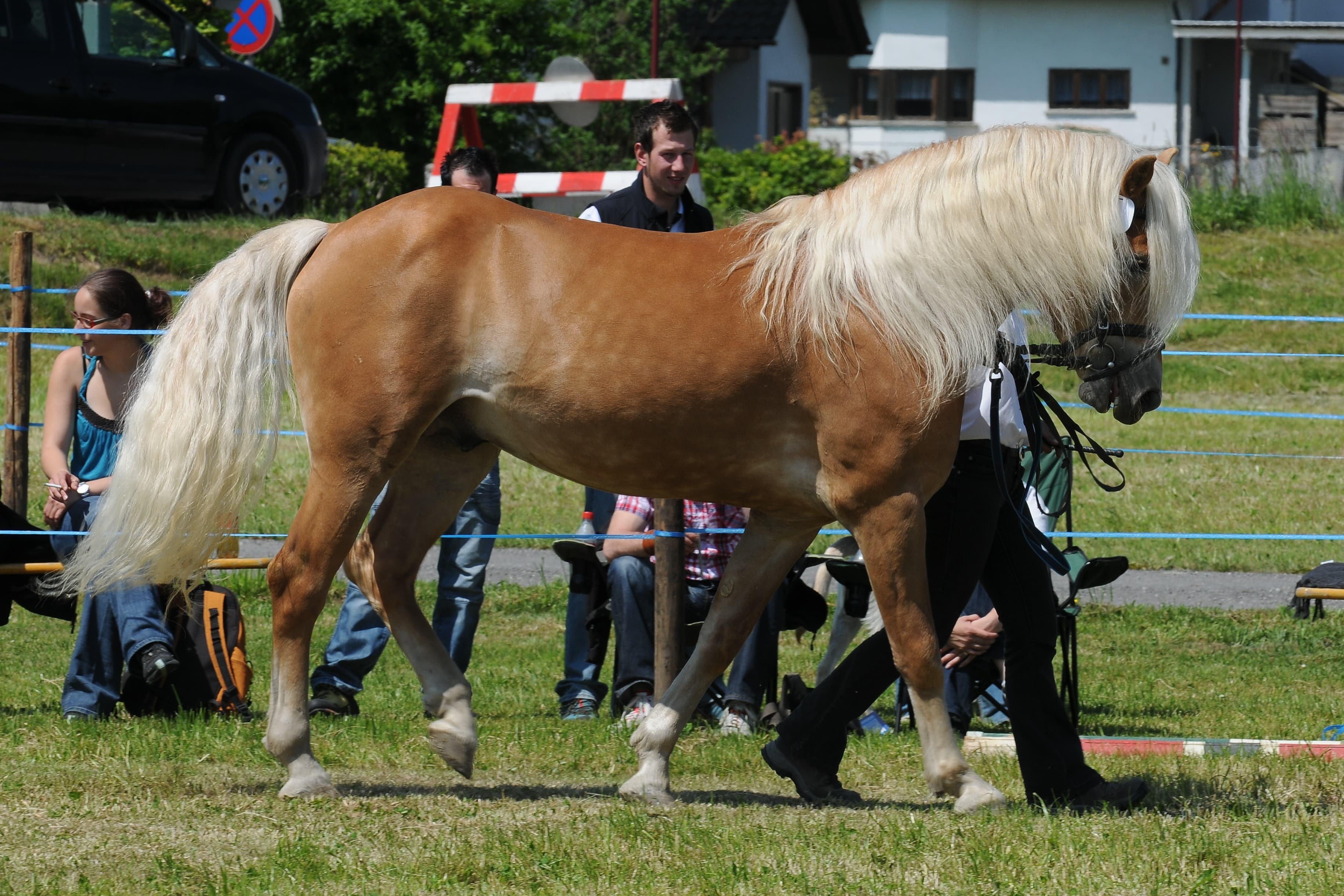
A Fohlenhof Ebbs stallion shown at Höchst, Austria, on 8 May 2011.

The Haflinger's Tyrolean origins and history
The Haflinger: Hafling, Avelengo and the Tyrolean valleys
The name Haflinger refers to Hafling, known in Italian as Avelengo, near Merano. The breed developed in the Tyrol of the Austro-Hungarian Empire, before the twentieth-century border division. Its early breeding areas included South Tyrol, now part of Italy. Historic Tyrol therefore locates the homeland without assigning the breed's whole history to one modern country.
The Haflinger: 249 Folie, born in 1874
The stallion 249 Folie was born in 1874 at Sluderno/Schluderns in the Val Venosta/Vinschgau. He was by the oriental stallion El Bedavi XXII, described as Arabian in homeland sources, out of a local mare. His male descendants established the sire lines maintained today. In 1898, the Empire's Ministry of Agriculture officially recognised the breed. Breeders gradually organised registration, shows and breeding-stock selection.
The Haflinger: Breeding divided by a new border
After the First World War, South Tyrol's transfer to Italy separated many mares from stallions held in Austrian depots. Breeding organisations developed on both sides of the border. In Austrian Tyrol, the association was reorganised in 1946 and Fohlenhof Ebbs became an important breeding and showing centre. In Italy, the national studbook and South Tyrolean organisations continued selecting local families.
The Haflinger: From mountain work to leisure horse
After the Second World War, machinery replaced some of the Haflinger’s agricultural and military work. Breeders increasingly selected horses for riding and driving, seeking manageable animals with movement suited to these activities. Compact horses and more sporting builds therefore coexist within the breed. Today, national studbook organisations coordinate their work internationally while retaining their own registers.
Sources for this section: ANACRHAI · history [1] · HPT · history and uses [2] · WHBSF · studbooks and breeding [5]
Haflinger conformation and height guidance
The Haflinger: a sound body with riding-horse qualities
Austrian and Italian breeding aims seek a harmonious, expressive and solid horse. The head should be relatively light, the neck sufficiently long and the shoulder sloping. A supported back, short muscular loin and broad, powerful quarters are desired. Limbs should have clean joints, correct alignment and strong feet. The Italian programme explicitly describes riding-horse qualities, beyond the breed's former draught role.
The Haflinger: Assessing movement and behaviour
Desired movement is regular, energetic and elastic, with a ground-covering walk and active hindquarters. Willing cooperation with people is also a breeding aim. Depending on the programme, conformation assessment is supplemented by ridden or driven performance testing. In France, prospective stallions undergo a testing competition, while mares are assessed in hand for conformation and movement before confirmation for breeding.
The Haflinger: Programme-specific ideals and minimums
The Tyrolean HPT describes an ideal height around 150 cm. Italian technical rules updated on 12 December 2024 set a minimum of 137 cm for both sexes at evaluation for entry into selected breeding-stock registers, from 30 months of age. A breeding ideal and an admission minimum are different measures. This directory places the Haflinger among small horses; eligibility for pony competition depends separately on measurement and sporting rules.
Sources for this section: ANACRHAI · 2024 rules [3] · HPT · current breeding aims [4]
The Haflinger's chestnut coat and markings
The Haflinger: Chestnut shades with a light mane and tail
The Italian Haflinger breed standard describes chestnut, preferably golden, with abundant mane and tail hair that should preferably be light. HPT accepts shades from light to dark chestnut with a light to white mane and tail. This combination is known as flaxen chestnut. A golden appearance alone does not make a horse palomino, a colour produced by a different mechanism.
The Haflinger: Markings contribute to breed assessment
Italian rules prefer legs without white markings. Excessively extensive white, unpigmented eyes and obvious black hairs in the mane or tail are described as undesirable. Decisions follow the rules and assessment of the relevant studbook. A marking visible in a photograph describes that animal's appearance; it does not reveal a coat-colour DNA test result.
Sources for this section: ANACRHAI · 2024 rules [3] · HPT · current breeding aims [4]
The Haflinger: From Alpine packing to riding and driving
The Haflinger: Mountain transport and draught work
Haflingers carried loads between valleys and high farms or mountain huts and worked on small Alpine holdings. They also served as military pack animals. Some packing and light timber extraction continue, but now represent a small part of the breed's work. These tasks helped shape selection for a sound, mobile horse able to travel over steep ground.
The Haflinger: Leisure and organised disciplines
Modern breeding serves trail riding, leisure riding and driving. European Haflinger Championships also include dressage, show jumping, eventing and Western disciplines. In combined driving, horse and driver bring together accurate figures, manoeuvrability through gates and the effort of outdoor courses. Breed competitions compare these abilities under defined conditions.
Sources for this section: HPT · history and uses [2] · WHBSF · sporting uses [8]
Haflinger organisations and studbooks
The Haflinger: Two reference organisations and national studbooks
The World Haflinger Breeding and Sports Federation (WHBSF) coordinates exchange and harmonisation. It identifies Austria's Haflinger Pferdezuchtverband Tirol (HPT) and Italy's national association ANACRHAI as the reference organisations holding original studbooks. The provincial South Tyrol breeders' federation contributes regional work. National studbooks then apply approved programmes with their own registration and assessment requirements.
The Haflinger: Seven sire lines do not describe all genetic diversity
A, B, M, N, S, ST and W denote seven stallion lines descending from Folie: Anselmo, Bolzano, Massimo, Nibbio, Stelvio, Student and Willi. A sire line follows father to father's father; it does not describe the maternal families or all of a horse's ancestors. International coordination allows at most 1.56% Arabian ancestry calculated from pedigrees and excludes other outside breeds. National requirements must be checked with the studbook that will register the foal.
The Haflinger: France: registration and breeding approval
The French rules effective from 1 January 2024, still linked by the IFCE when this page was reviewed, assign their application to the IFCE with the French Haflinger Association. Registration by descent requires an approved sire, a confirmed dam, identification and declarations. Stallions have a DNA genotype established for identity and parentage work. Artificial insemination and embryo transfer are allowed; cloned offspring cannot be registered. French breeding requirements remain separate from Austrian and Italian programmes.
Sources for this section: WHBSF · studbooks and breeding [5] · South Tyrol · federation [6] · ANACRHAI · 2024 rules [3] · IFCE · French rules 2024 [7]
Haflinger distribution and documented numbers
The Haflinger: an international breeding network
The Haflinger remains closely associated with Austria and Italy, with studbooks and associations elsewhere in Europe, the Americas and Australia. The WHBSF connects these bodies for breeding-stock exchanges, selection and sport. Membership numbers describe an organisational network rather than counting living horses. Figures from an individual national studbook therefore need to retain their geographical scope and category.
The Haflinger: France: 206 registered births for 2024
The IFCE's ÉCUS 2025 yearbook lists 206 Haflinger births registered in France for 2024. The SIRE extraction is dated 21 October 2025 and the figures are provisional because some files remain open. This counts a foal crop, rather than all living Haflingers, active breeding animals or registrations accumulated since the studbook began. The French figure is not a worldwide population estimate.
Sources for this section: WHBSF · studbooks and breeding [5] · IFCE · ÉCUS 2025 [9]
Haflinger genetic diversity and DNA testing
443 Haflingers studied in the Czech Republic
Kulišťáková and colleagues published a study in 2024 examining how imports contributed to diversity among Haflingers bred in the Czech Republic. They analysed 443 horses born between 1987 and 2021 using 16 microsatellites: short, variable stretches of DNA also used in parentage testing. Horses were grouped by country of origin to investigate similarities and differences associated with breeding-stock exchanges.
The Haflinger: What breeding-stock exchanges reveal
The analyses showed substantial mixing between Czech-, Austrian- and German-origin groups. Imports therefore contributed to diversity within the group studied. Small numbers from some other origins limited those comparisons. These markers describe population structure; they do not measure disease frequency or demonstrate that inbreeding is absent from every Haflinger population worldwide.
The Haflinger: Parentage and PSSM1 tests answer different questions
Parentage testing compares a foal's DNA with its declared parents to check the relationship. PSSM1 testing instead detects a GYS1 variant that disrupts muscle glycogen storage and can cause exercise-related pain and stiffness; one copy is enough to increase risk. In France, the result of the test called PSSM in the rules has been compulsory for stallion covering certificates since 2019 and is recommended for mares. The text requires results to be supplied without automatically excluding positive animals. These French obligations do not arise from Folie's Arabian ancestry.
Sources for this section: Kulišťáková · diversity 2024 [10] · IFCE · French rules 2024 [7] · UC Davis · PSSM1 [11]
Sources and updates
Profile updated on .
Breed organisations document the Haflinger’s history. The rulebooks explain registration requirements in each country. The French statistics describe breeding in France, while the genetic analyses cited concern horses studied in Czechia.
- ANACRHAI — Storia della razza
Folie, studbook development, recognition in 1898 and the consequences of Tyrol's division.
- HPT — History of the Haflinger Breed
Reorganisation in 1946, Fohlenhof Ebbs and the change from mountain work to leisure.
- ANACRHAI — Regolamenti, updated 12 December 2024
Italian standard, colour and evaluation from 30 months with a 137 cm minimum.
- HPT — Das Zuchtziel
Desired conformation, chestnut with light mane and tail, and ideal height around 150 cm.
- WHBSF — Breeding
Reference organisations, sire lines, pedigree limit on Arabian ancestry and national programmes.
- Provincial Federation of South Tyrol Haflinger Horse Breeders
Italian regional organisation and its link to international coordination.
- AFH / IFCE — French Haflinger studbook rules, 1 January 2024
Document linked by the current IFCE index: registration, testing, reproduction and PSSM requirements.
- WHBSF — Haflinger: history, characteristics and uses
Riding, driving and European breed championship disciplines.
- IFCE — ÉCUS 2025 yearbook, p. 22
206 French births for 2024; provisional SIRE data at 21 October 2025.
- Kulišťáková et al. — The genetic diversity and structure of the Haflinger horse population in the Czech Republic (2024)
443 horses born in 1987–2021 and 16 microsatellites; origin-related structure rather than disease frequency.
- UC Davis VGL — Polysaccharide Storage Myopathy (PSSM1)
Purpose of GYS1 testing and dominant inheritance with variable clinical expression.