
Breeds · breed profile
Grand Noir du Berry donkey
The Grand Noir du Berry donkey, a tall dark donkey with pale markings
The Grand Noir du Berry is a tall donkey with a black coat and pale areas on the muzzle, around the eyes and beneath the body. The breed standard, which describes the desired traits, excludes dark stripes along the back and across the shoulders. Breeders trace families through the studbook and develop uses for these donkeys in pack work, driving and riding.
- Category
- Donkey
- Country of origin
- France
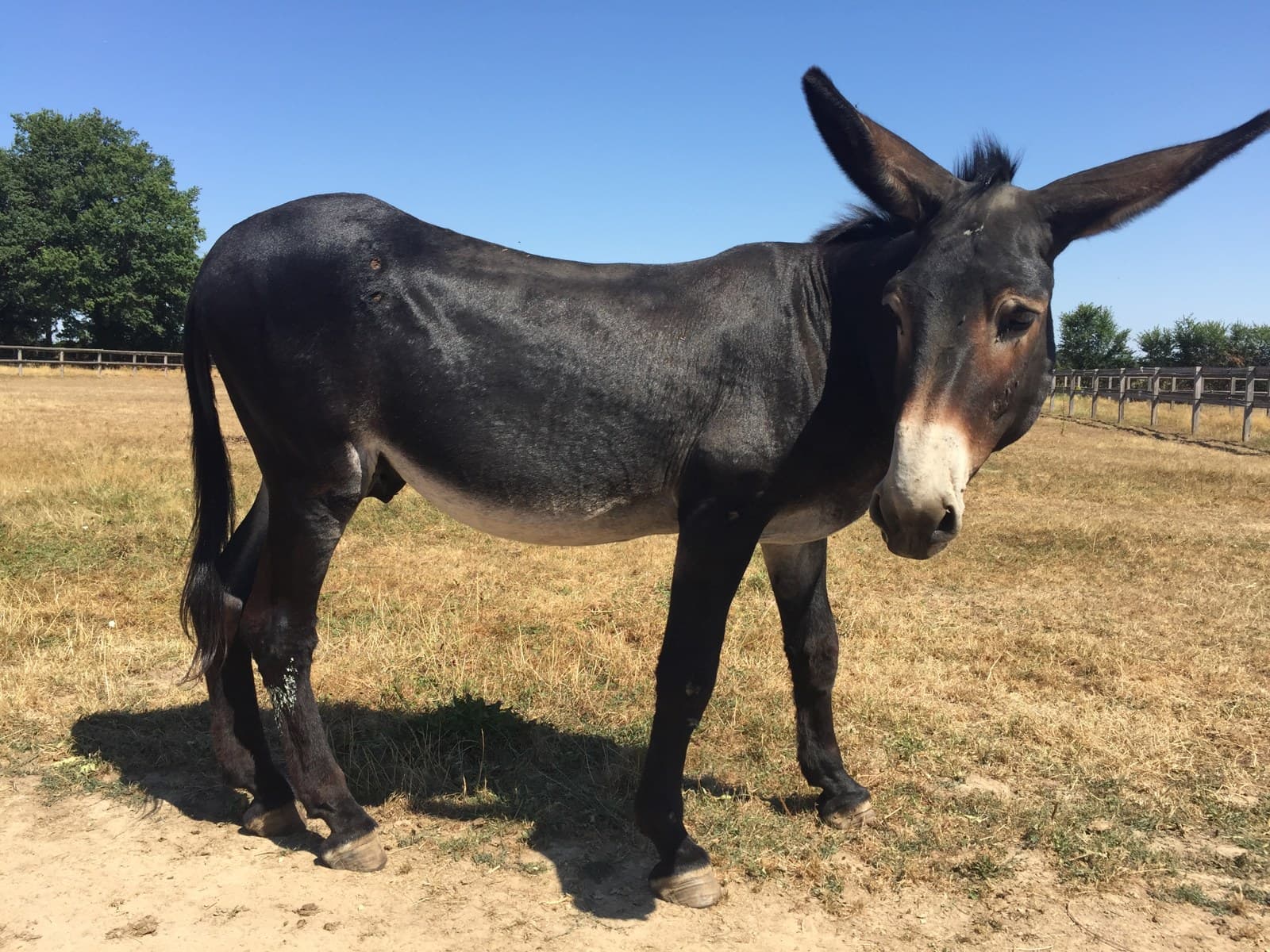
A Grand Noir du Berry donkey at the Pôle du Cheval et de l’Âne in La Celle-Condé.

The Grand Noir du Berry donkey: a working donkey preserved as regional heritage
The Grand Noir du Berry donkey: Organising conservation in Berry
The breed is associated with Berry and the use of strong donkeys for transport and rural work. The Association française de l’Âne grand noir du Berry, or AFAGNB, was established in 1994 to organise its management and promotion. Regional conservation programmes later supported pedigree recording, replacement breeding stock and activities that could help breeders continue keeping the population.
Sources for this section: Association française de l’âne Grand noir du Berry [1] · Région Centre-Val de Loire [2]
The Grand Noir du Berry donkey: a tall, balanced donkey
The Grand Noir du Berry donkey: Defined height ranges at age three
Association française de l’âne Grand noir du Berry describes the desired traits of the Grand Noir du Berry donkey in its studbook rules. This document guides the choice of breeding animals. The November 2025 rules specify 1.35–1.45 m for males and 1.30–1.40 m for females at three years. Two-centimetre tolerances are possible for exceptional animals under the stated conditions. The head has a straight profile, the neck is strong and long, the back straight and the loin short. Limbs should be strong and correctly aligned both standing and moving.
Sources for this section: Association française de l’âne Grand noir du Berry [1]
The Grand Noir du Berry donkey: Black colour without a shoulder cross
The Grand Noir du Berry donkey: Pale points are compatible with the breed’s name
The Grand Noir du Berry donkey breed standard accepts black to noir pangaré, with a grey-white belly, pale muzzle and light eye rings. Shoulder stripes, dorsal stripes and leg barring are excluded. “Black” therefore does not mean that every part of the donkey must be uniformly dark. These donkey colour requirements belong to the Berry standard and differ from the criteria used for other donkey breeds.
Sources for this section: Association française de l’âne Grand noir du Berry [1]
The Grand Noir du Berry donkey: Pack work, driving and recreational riding
The Grand Noir du Berry donkey: Assessing useful ability as well as appearance
The Grand Noir du Berry is promoted for pack walking, driving and some ridden activities. Approval includes tests of manageability and practical ability. The tests connect conformation selection with observation of the donkey in action, including its response to requests and acceptance of equipment.
Sources for this section: Association française de l’âne Grand noir du Berry [1]
The Grand Noir du Berry donkey: the November 2025 studbook rules
The Grand Noir du Berry donkey: Parentage, initial entry and breeding approval
The studbook is the register that records the identity and ancestry of animals admitted to the breed. The responsible organisation is Association française de l’âne Grand noir du Berry. Registration by descent requires an approved sire, an eligible dam and compatible parentage verification, among other conditions. Initial entry concerns animals at least four years old assessed through a defined procedure. Jack approval combines conformation with practical tests. Limited provisional approval may be granted to certain males of particular value for diversity; it is distinct from permanent approval.
Sources for this section: Association française de l’âne Grand noir du Berry [1]
The Grand Noir du Berry donkey: Keeping Berry breeders and bloodlines active
The Grand Noir du Berry donkey: a documented priority without a recent living total
The regional 2016–2020 programme already identified declining births and fewer breeding animals as conservation concerns. It supported pedigree management, young males and user training. The 2025 rules consulted do not provide a recent census of all living animals. Older population estimates are therefore not presented here as a current total.
Sources for this section: Association française de l’âne Grand noir du Berry [1] · Région Centre-Val de Loire [2]
The Grand Noir du Berry donkey: DNA parentage supports reliable pedigrees
The Grand Noir du Berry donkey: an origin check rather than a health certificate
Parentage testing compares a foal’s genetic markers with those of the declared parents. It helps establish reliable pedigrees for following family lines and planning matings. It does not automatically test for inherited diseases or every coat-colour variant. Conserving the Grand Noir du Berry requires several breeding backgrounds, alongside health care appropriate to donkeys and each individual’s history.
Sources for this section: Association française de l’âne Grand noir du Berry [1]
Sources and review date
Profile reviewed on .
The documents below were used to prepare this profile of the Grand Noir du Berry donkey. They explain which animals can enter the studbook and how breeding animals are selected.
- Association française de l’âne Grand noir du Berry — Studbook rules and breeding programme, November 2025
November 2025 rules: standard, parentage, initial entry and breeding approval.
- Centre-Val de Loire Region — CAP équin 2016–2020
Association history and regional conservation work; historical figures are not a present-day living population.