
Breeds · breed profile
The Friesian
Fries paard · Frysk hynder · Frison
The Friesian is a horse from Friesland in the northern Netherlands. Its black coat, abundant hair and high-set neck are associated with driving and dressage. The Koninklijke Vereniging Het Friesch Paarden-Stamboek, usually known as KFPS, maintains the studbook of origin and organises selection covering conformation, movement, working ability and health.
- Category
- Horse
- Country of origin
- Netherlands
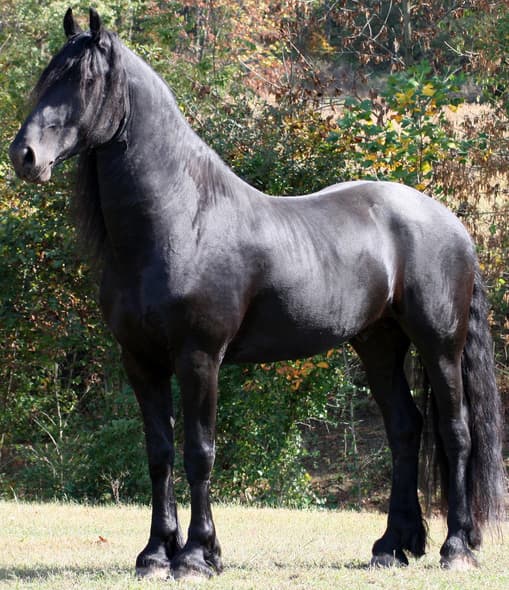
A male Friesian photographed in side view by Larissa Allen.

The Friesian, from Friesland to international breeding
The Friesian: a horse connected with Friesland’s transport and farms
The Friesian’s history belongs to Friesland, a northern Dutch region where horses supported travel and farm work. Elegant driving horses and trotting races also influenced breeding choices. Those uses changed over time: today’s horse reflects successive selection decisions, rather than the unchanged survival of a medieval horse.
The Friesian: the studbook was founded in 1879
Owners and breeders founded the studbook in 1879 to organise pedigrees and preserve Friesian horses. It connects animals with their parents and follows the contribution of families. KFPS’s official history records only three living purebred breeding stallions in 1913. That narrow point in the population’s history helps explain why many horses now share ancestors.
The Friesian: Farming and then leisure changed breeding goals
Early twentieth-century breeders sought a more compact agricultural horse. Mechanisation brought another decline. From the 1960s, promoting driving, riding and leisure helped breeding recover. The Friesian gradually regained a more elegant outline, with selection increasingly directed towards a riding and driving horse.
Sources for this section: KFPS · history [1]
The functional Friesian sought by KFPS
The Friesian: a breeding goal adopted in 2021
KFPS is the Dutch association responsible for the Friesian’s original studbook. Its breeding objective describes a horse with the breed’s physical characteristics, a willingness to work and sporting ability. Breeders also seek good health and the capacity for a long working life. These criteria guide assessment of breeding animals and mating decisions; they do not guarantee the qualities of each foal.
The Friesian: a high-set neck and a body built for movement
The expressive head has widely spaced eyes and small ears; the neck is long, slightly arched and set high from the chest. The shoulder is long and sloping, the back and loin strong, and the croup long and slightly inclined. Viewed from the side, the desired outline is longer than it is tall. Desired height is around 1.65 m at the withers, a conformation goal distinct from thresholds for individual registers and predicates.
The Friesian: Correct limbs and ground-covering movement
KFPS seeks clean joints, well-shaped feet and correct limb alignment. The walk should cover ground, while trot and canter combine balance, suppleness and power from behind. The mane, tail and feathering, the long hair around the lower legs, contribute to Friesian appearance. Assessing movement also helps evaluate function under saddle and in harness.
Sources for this section: KFPS · breeding goal [2]
The Friesian: Black coats and white markings under KFPS rules
The Friesian: Black is part of the breeding goal
KFPS seeks a jet-black coat, ideally without white markings. This colour selection explains the breed’s consistent appearance. Hair colour remains an observed characteristic; pedigree and the other selection criteria also inform registration and admission decisions.
The Friesian: Permitted markings depend on the register and selection stage
The 2024 registration rules restrict the stamboek and gelding register to black horses. They allow, among other exceptions, a head marking above eye level with a maximum diameter of 3 cm, and white areas on the soles. Body or leg markings fall outside these allowances. Stallion selection uses stricter conditions, so recording a birth and later admission must be distinguished.
Sources for this section: KFPS · breeding goal [2] · KFPS · 2024 registration rules [3] · KFPS · 2023 stallion rules [4]
From Friesian carriage traditions to modern dressage
The Friesian: the sjees and agricultural work
The sjees, a traditional two-wheeled Friesian carriage, recalls the place of driving in local travel and presentations. Friesians also performed light or medium agricultural work during different breeding periods. Their history therefore encompasses more than parade horses or heavy draught work alone.
The Friesian: Riding and driving horses assessed at work
KFPS now develops aptitude for dressage and several forms of driving. In dressage, figures and transitions demand precision and balance; in harness, the horse responds to the driver’s instructions. Aptitude tests observe horses doing this work and supplement examination of conformation and in-hand movement.
Sources for this section: KFPS · history [1] · KFPS · breeding goal [2]
The Friesian: Birth records, registers and KFPS breeding approval
The Friesian: Foal register registration is not stallion approval
KFPS distinguishes the main section and its classes from supplementary studbooks according to ancestry and parental status. The veulenboek records foals; a mare’s later entry into the stamboek involves inspection. Predicates such as Ster identify additional criteria. A male can have a KFPS pedigree without being an approved breeding stallion within the programme.
The Friesian: Stallions pass through several selection stages
The 2023 rules combine ancestry, relationship to the population, conformation, movement and aptitude tests with veterinary examinations and semen quality. Approval is followed by evaluation of offspring. Relatedness matters because giving a heavily represented stallion many more descendants can reduce the contribution of other families, even when he has strong individual qualities.
The Friesian: Parentage tests compare the foal’s and parents’ DNA
The laboratory compares markers from a foal with those of its declared parents to check compatibility. The 2024 rules require sire verification for foals in the main section, among other cases. Both parents are checked in specified circumstances, for example when a foal is not identified alongside its dam or follows embryo transfer. Parentage verification and disease testing therefore answer different questions.
Sources for this section: KFPS · 2024 registration rules [3] · KFPS · 2023 stallion rules [4]
The Friesian: Worldwide breeding and the interpretation of registry data
The Friesian: Associations connect breeders in different countries
KFPS’s historical overview reports more than 10,000 members in over 80 countries in 2023. This describes an organisation’s membership and reach, rather than the number of living horses. Births and inspections beyond the Netherlands contribute to the same pedigree recording, under arrangements with KFPS and the relevant national organisations.
The Friesian: Reported deaths affect counts of living horses
In its statement of 8 July 2026, KFPS explains that deaths are not always reported in its data. A horse can consequently remain recorded after death. Pedigrees remain valuable for studying families, but counting names without updating deaths does not provide a reliable census of horses alive today.
Sources for this section: KFPS · history [1] · KFPS · 8 July 2026 statement [5]
Family diversity and DNA testing in the Friesian
The Friesian: the rise in inbreeding is tracked per generation
KFPS’s statement of 8 July 2026 reports an inbreeding increase of about 0.7% per generation, calculated through the end of 2025. This measures change in relatedness within the recorded population, rather than the percentage of sick horses. Unequal stallion use increases some families’ contributions. Choosing less-related breeding animals and retaining several lines addresses a broader question than testing one variant.
The Friesian: the dwarfism test detects a B4GALT7 variant
The inherited form of dwarfism studied in Friesians causes shortened limbs and unusually loose joints. Testing looks for the B4GALT7 variant associated with the recessive condition: a horse with one copy can transmit it without having dwarfism, while two copies cause the disorder. In Leegwater and colleagues’ 2016 study, all 29 affected horses with available DNA had two copies, and eight parents of affected horses, already known to be carriers, had one. This group assembled to investigate the cause does not measure breed-wide frequency.
The Friesian: the hydrocephalus test detects a B3GALNT2 variant
Friesian hydrocephalus involves abnormal fluid accumulation in the brain, distending the skull and often resulting in a stillborn foal. Testing looks for the B3GALNT2 variant known for this recessive form. One copy indicates carrier status; two cause the disorder. For this variant, as for dwarfism, two carrier parents have a 25%, or one-in-four, chance of an affected foal at each conception.
The Friesian: KFPS rules address at-risk matings
Article 18 of the 2024 registration rules requires dwarfism and hydrocephalus testing for mares receiving Ster from 2017 and foal register or studbook mares whose foals are presented for registration from 2017. Mares whose parents have both tested non-carrier for both conditions are exempt. The aim is to avoid pairing carriers of the same variant, rather than automatically removing every family containing a carrier.
The Friesian: Distichiasis has a separate test and variable expression
UC Davis offers a test for a variant associated with distichiasis, in which misplaced eyelashes can irritate the cornea. Two copies increase the risk of expression, but some horses with two copies show no signs; this is incomplete penetrance. Results can guide eye examinations and mating decisions. Availability in a commercial panel should not be presented as a general requirement under KFPS Article 18, which concerns the two conditions above.
Sources for this section: KFPS · 8 July 2026 statement [5] · Leegwater et al. · 2016 [6] · UC Davis · dwarfism [7] · UC Davis · hydrocephalus [8] · KFPS · 2024 registration rules [3] · UC Davis · distichiasis [9]
Sources and review date
Profile reviewed on .
KFPS rules are read in their published Dutch versions: the breeding goal adopted in 2021, registration rules of 31 May 2024 and stallion selection rules of 2 June 2023. Scientific publications and laboratory information separately explain health testing.
- KFPS — Het Friese paard
Breed history, the 1879 studbook, stallions in 1913, changing uses and worldwide membership with an explicit 2023 reference.
- KFPS — Fokdoel
Goal adopted in autumn 2021: characteristics, desired height around 165 cm, movement, health and longevity.
- KFPS — Registratiereglement, 31 May 2024
Published authoritative Dutch version: registers, markings, DNA parentage and Article 18 on dwarfism and hydrocephalus, including exemptions.
- KFPS — Hengstenselectiereglement, 2 June 2023
Published reference rules for selection, examinations, approval and offspring evaluation; annual implementing provisions also apply to applications.
- KFPS — Inteelttoename… stabiel op 0,7%
Dated statement, calculations through the end of 2025, unequal stallion contributions and unreported deaths; no living population is inferred.
- Leegwater et al. — Dwarfism with joint laxity… (BMC Genomics, 2016)
Original B4GALT7 study published on 28 October 2016; verification in 29 affected horses and eight obligate carriers, not a breed-frequency survey.
- UC Davis VGL — Friesian Horse Dwarfism
Targeted variant, recessive inheritance and interpretation of copies for Friesian dwarfism.
- UC Davis VGL — Friesian Horse Hydrocephalus
B3GALNT2 variant, signs and inheritance of Friesian hydrocephalus; specific scope of the test.
- UC Davis VGL — Distichiasis
Available Friesian test, recessive inheritance with incomplete penetrance and eye monitoring; separate from the KFPS requirements described.