
Breeds · breed profile
The Fjord horse
Norsk fjordhest · Fjording
The Fjord is a small horse from western Norway, long used for farm work and transport. Its often upright, trimmed mane and dun colours give it a distinctive appearance. Breeders preserve a versatile horse for riding, driving and work through the Norwegian studbook of origin and coordinated national breeding programmes.
- Category
- Small horse
- Country or region of origin
- Norway
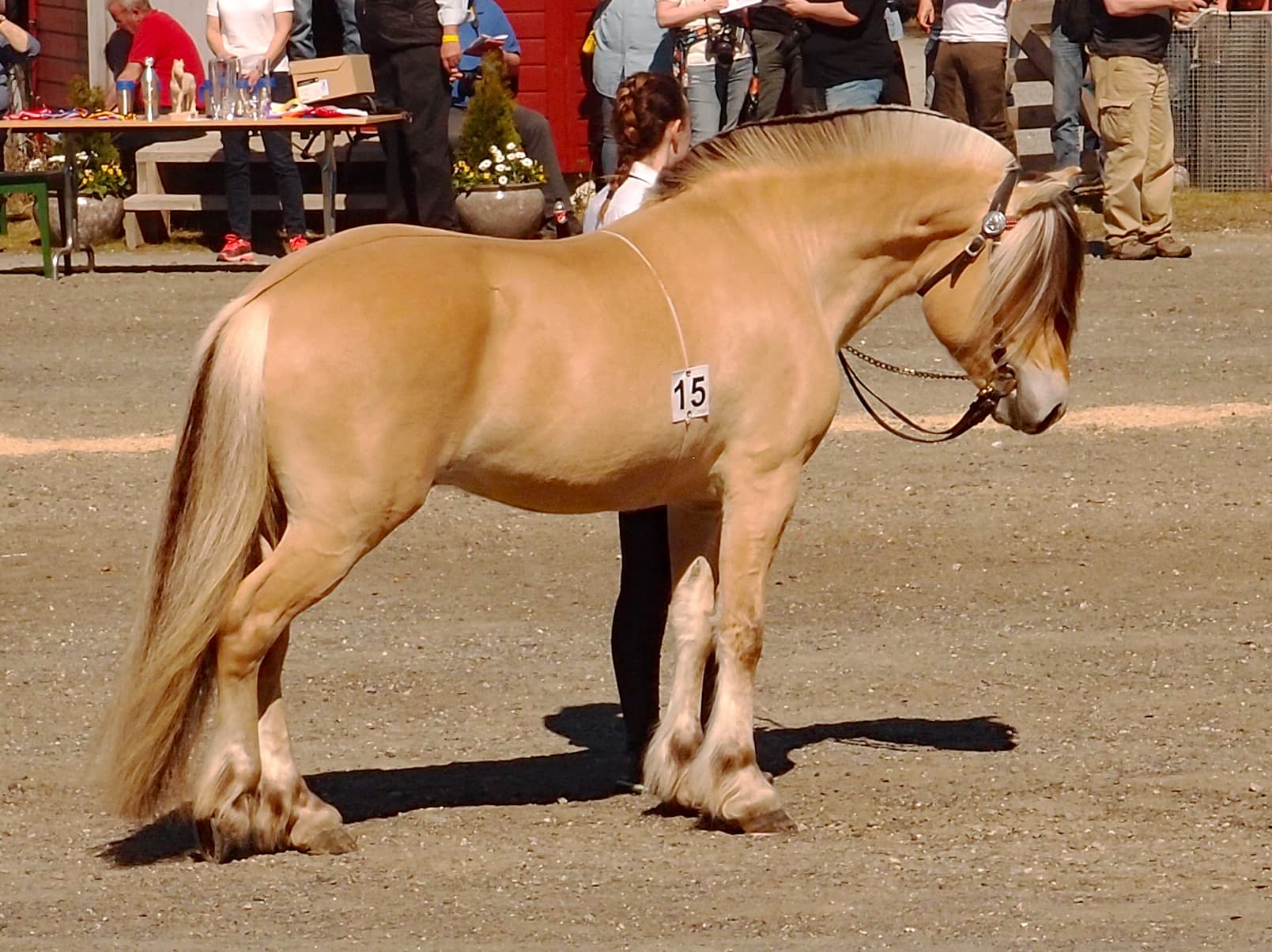
A Fjord stallion at the annual exhibition in Nordfjordeid, Norway, on 6 May 2017.

The Fjord horse’s Norwegian origins and history
The Fjord horse: the farms of western Norway
The Fjord developed in Vestlandet, western Norway, particularly around Nordfjord and Sunnmøre. Its older name, Vestlandshest, refers to this region. On small farms, one horse might help with harvesting, carry loads and pull vehicles. These tasks favoured a strong, manageable horse able to move across varied ground.
The Fjord horse: the nineteenth-century debate over crossbreeding
Organised breeding took shape in the mid-nineteenth century. The state stud at Hjerkinn was proposed in 1843, and shows developed, including an exhibition in Førde in 1864. Døle stallions were used to produce larger working horses. The resulting crosses sparked the Rimfakse dispute, named after the crossbred stallion Rimfakse. A meeting at Innvik in 1907 marked the decision to concentrate on pure breeding of the Fjord.
The Fjord horse: Pedigrees published in 1910
The first Fjord studbook was published in 1910 on the initiative of the Royal Norwegian Society for Development. It listed 308 stallions born between 1857 and 1904: a historical record of breeding animals, rather than a count of horses alive at one time. Njål 166, born in 1891, became particularly influential in the breed’s paternal families. The studbook makes it possible to follow those families across generations.
The Fjord horse: From farm traction to leisure activities
Mechanisation gradually reduced the demand for agricultural horses. Breeders continued selecting for riding, driving and family activities while preserving the breed’s type and colours. Nordfjordeid remains an important venue for stallion exhibitions. This change in use explains why mobility, as well as pulling strength, matters in the modern Fjord breeding goal.
Sources for this section: FjHI · history [1] · NFL · breed and uses [4]
The Fjord horse: Fjord conformation and height
The Fjord horse: Strength without excessive heaviness
Norges Fjordhestlag, the Norwegian Fjord breed association, uses its breeding plan to describe the horse breeders aim to produce: a small, expressive head with a broad forehead, a straight or slightly concave profile and a well-set neck. The shoulder should be long and sloping, the back and loin muscular, and the croup broad. Clean joints, correct limb alignment and sound feet should support lasting working ability. Muscular development must still allow free movement.
The Fjord horse: Regular movement and assessed cooperation
The Fjord breed standard seeks natural, energetic, balanced gaits. Judges assess rhythm, hindquarter activity and suppleness throughout the body. Behaviour is also observed during presentations and practical tests, with the aim of a willing horse that is easy to handle. Traditionally, the mane is trimmed into an arc to show the neck. The Norwegian 2026 plan states that a long mane should not, on its own, attract a deduction for breed type.
The Fjord horse: a desired 135–150 cm, with separate national rules
The Norwegian 2026 plan gives a desired height of 135–150 cm at the withers, with no absolute lower or upper limit for the breed. A departure can affect the assessment of breed type. However, the French programme dated 31 August 2024 requires candidates for national stallion approval to measure at least 140 cm on the day of presentation. That specific condition does not make 140 cm a worldwide registration minimum. The directory follows the breed’s description as a small horse.
Sources for this section: NFL · 2026 plan [2] · AFCF · French programme [5]
The Fjord horse: the Fjord’s five dun colours and markings
The Fjord horse: Norwegian colour names specific to the breed
Five colours are recognised: brunblakk, or brown dun; rødblakk, or red dun; grå, black-based dun, often called blue dun; ulsblakk, a very pale form of brown dun; and gulblakk, a pale form of red dun. In this terminology, grå describes black-based dun rather than progressive greying. Traditional colour labels used by a national registry therefore need to be read in the context of the Fjord breed.
The Fjord horse: Dun and Cream are separate mechanisms
Dun lightens the body while leaving more strongly pigmented areas. Ulsblakk and gulblakk combine this effect with Cream dilution, which may also be difficult to see on a grå Fjord. A colour test can identify the variants a horse can pass on when its appearance is ambiguous. If both parents carry one copy of Cream, each conception has a one-in-four chance of producing a double-Cream foal, very pale with blue eyes. That colour is not accepted by the Norwegian standard.
The Fjord horse: Dorsal stripes, leg barring and white markings
Primitive markings include the dark stripe along the back, the central stripe in the mane and tail, and sometimes leg barring or a stripe across the shoulders. They are features breeders seek to preserve. The Norwegian 2026 plan allows a star up to 5 cm across in mares and geldings; the published French programme allows a small star only in mares. Other white markings are excluded under these texts. Each national rule therefore needs its own attribution.
Sources for this section: FjHI · colours [3] · NFL · 2026 plan [2] · AFCF · French programme [5] · UC Davis · dun test [9]
Fjord horses at work, under saddle and in harness
The Fjord horse: Farm work and transport
Fjords helped with harvesting and hauled timber during winter logging. They carried loads and transported people, mail and goods between settlements and ferry landings. Those jobs combined pulling, packing and travelling along sometimes difficult paths. They explain the importance of strength and balance when breeders chose their horses.
The Fjord horse: Riding and driving activities
Today, Fjords are used for hacking, trekking, riding lessons, pleasure driving and driving competitions. Norwegian Fjord championships include dressage, show jumping and driving. Some organisations also use them in adapted riding and working activities. The breeding goal maintains this versatility, supported by practical tests of horses ridden or driven.
Sources for this section: FjHI · history [1] · NFL · breed and uses [4]
The Fjord horse: the Norwegian studbook of origin and French breeding
The Fjord horse: Norges Fjordhestlag, Norsk Hestesenter and FjHI
Norges Fjordhestlag runs the breed programme in Norway. Norsk Hestesenter, the Norwegian Horse Centre, registers horses and documents pedigrees on its behalf. Fjord Horse International brings together organisations from several countries and works to harmonise judging guidance around the Norwegian programme. The studbook links horses to their parents, while selection categories identify animals that have been assessed.
The Fjord horse: Stallion approval in Norway from 2026
A stallion’s first breeding approval lasts two years. To continue breeding after that period, he must complete the extended performance test and reassessment required by the programme. Conformation, health, behaviour and practical ability all form part of this process. Norwegian mares do not have the same approval requirement, although showing them is encouraged. Registration and breeding approval are therefore different stages.
The Fjord horse: the AFCF programme administered with IFCE
The Association française du cheval Fjord runs the French programme, with IFCE maintaining the studbook. Registration by descent depends on eligible parents, declarations, identification and compatible DNA parentage. Parentage testing compares a foal’s DNA with that of its declared parents to check the relationship. National stallion approval adds a veterinary examination, conformation judging and an official ridden or driven behaviour test. Those examinations do not amount to a compulsory genetic disease panel.
Sources for this section: NFL · 2026 plan [2] · AFCF · French programme [5]
The Fjord horse: Fjord distribution and French foal registrations
The Fjord horse: a Norwegian homeland and breeding abroad
Fjords continue to be bred in western Norway and in many other countries. Norges Fjordhestlag names Sweden, Denmark, Germany, the Netherlands, Belgium, the United States and Canada among them. National programmes and Fjord Horse International support exchanges between these breeding populations. Their geographical presence describes the breed’s spread without providing a dated worldwide census.
The Fjord horse: 124 French birth registrations for 2024
IFCE’s ÉCUS 2025 yearbook records 124 Fjord birth registrations in France for 2024. The SIRE figures were provisional on 21 October 2025 because some files still awaited completion. This measures one registered foal crop. It does not count all Fjords living in France across different generations, or horses registered in other countries.
Sources for this section: NFL · breed and uses [4] · IFCE · ÉCUS 2025 [6]
The Fjord horse: Fjord coat colour studies and genetic diversity
The Fjord horse: TBX3 and the dun test
Imsland and colleagues, in the 2016 volume of Nature Genetics, explain how TBX3 activity in the hair follicle affects pigment distribution within each hair. The dun test distinguishes the dun variant from non-dun variants, some of which allow primitive markings without body dilution. A dorsal stripe alone therefore does not establish a genotype. To identify the variants a breeding horse can transmit, a laboratory examines DNA rather than relying only on visible colour.
The Fjord horse: the initial 121 Fjords in the 2022 study
Avila and colleagues studied colour variants using samples submitted to the UC Davis Veterinary Genetics Laboratory. The Fjord group fell from 121 to 90 horses after close relatives were removed to reduce the influence of individual families; numbers then varied with the tests available. Owners had requested colour testing, a selection that can overrepresent particular colours. The results describe those tested horses rather than a random sample of the entire breed.
The Fjord horse: Sharing breeding across families
The Norwegian 2026 plan monitors relatedness and sets breeding quotas to reduce the concentration of descendants around a few stallions. A premium stallion’s basic lifetime quota is 70 coverings, with adjustments allowed by the programme. Using less-represented families helps retain genetic diversity, meaning differences in DNA between horses. Parentage testing documents those families, while a colour test answers the separate question of coat inheritance.
Sources for this section: Imsland et al. · TBX3 [8] · UC Davis · dun test [9] · Avila et al. · 2022 [7] · NFL · 2026 plan [2] · AFCF · French programme [5]
Sources and updates
Profile updated on .
The Norwegian Fjord breeding programme for 2026 sets out the characteristics breeders aim to preserve. The French programme dated 31 August 2024 explains registration and breeding approval in France. The coat-colour studies investigate how particular genetic variants affect hair colour.
- Fjord Horse International — Norwegian breeding history (2003 edition)
Nineteenth-century breeding, the 1907 dispute and the 1910 studbook. The file uploaded in 2025 retains its earlier edition date.
- Norges Fjordhestlag — Breeding plan for the Norwegian fjord horse, 2026
Standard, height, markings, the NHS role, stallion approval and preservation of families. English version of the plan valid from 2026.
- Fjord Horse International — Colours and primitive markings (2003 edition)
Five colour names, additional dilution, primitive markings and identification difficulties. Current marking rules come from the cited national programmes.
- Norges Fjordhestlag — Fjordhesten
Homeland, historical and present uses, shows and breeding countries. Undated worldwide estimates are not treated as a current census.
- AFCF / IFCE — Fjord breeding programme, 31 August 2024
19 pages; standard, parentage, registration and national approval, including 140 cm for candidate stallions. The internal date differs from the 2025 upload folder.
- IFCE — ÉCUS 2025 yearbook, page 22
124 Fjord birth registrations in France for 2024; SIRE data provisional on 21 October 2025.
- Avila et al. (2022) — Coat colour variants across 28 breeds
Genes, 13:1641. Fjord sample of 121, reduced to 90 after relatedness filtering; submitted colour-test samples, not a breed census.
- Imsland et al. (2016) — TBX3 and pigment distribution within hair
Nature Genetics, 48:152–158, published online in 2015. Dun mechanisms and non-dun variants, without worldwide Fjord frequencies.
- UC Davis VGL — Dun dilution
Purpose of testing, dun and non-dun variants, inheritance and primitive markings.