
Breeds · breed profile
Dutch Warmblood (KWPN)
The Dutch Warmblood is bred for riding sport and driving
The Dutch Warmblood is a sport horse developed in the Netherlands. KWPN is the Dutch abbreviation for its royal studbook, the registry that records horses and their ancestry. The organisation runs four breeding directions: dressage, jumping, harness horses and the versatile Gelder horse. These horses share a registration framework, but they are not all bred for the same job. The calculator uses the study’s label, “Dutch Warmblood”.
- Category
- Horse
- Country of origin
- Netherlands
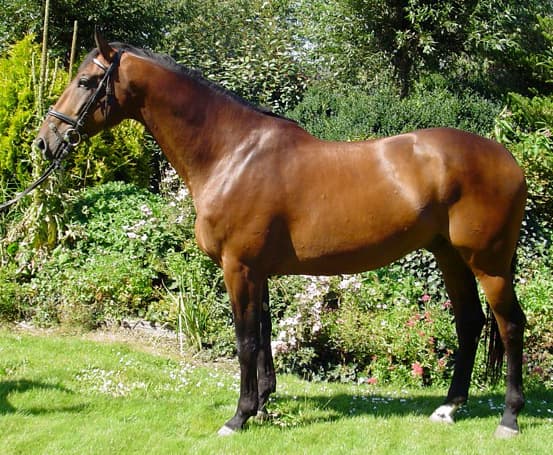
A KWPN horse photographed from the side outdoors.

Dutch Warmblood breeding grew out of Dutch farm work
Dutch breeders once needed horses that could work on farms and pull carriages. Groningen and Gelder horses met different regional needs. After the Second World War, machinery increasingly replaced horses in agriculture, while recreational riding and competition expanded. Thoroughbred stallions and horses from French and German breeding populations helped shape a more specialised riding horse. Royal recognition in 1988 gave the studbook its present KWPN name. Its modern sport horses reflect this change in purpose over successive generations.
Sources for this section: KWPN [1]
A Dutch Warmblood’s build depends partly on its breeding direction
Dressage breeders assess the walk, trot and canter, paying attention to balance and movement. Jumping breeders also examine how a horse approaches and clears fences. Harness horses are selected for more elevated movement in front of a vehicle. The Gelder direction retains a horse suited to both riding and driving. These differences help explain the range of outlines and movement within the KWPN. A single description of the ideal riding horse cannot fully describe all four directions.
Sources for this section: KWPN [2]
Coat colour does not identify a horse as a Dutch Warmblood
Bay, chestnut, black and grey occur in Dutch Warmbloods, as they do in many other sport horses. A grey horse may have been born dark and gradually developed white hairs, so its present appearance does not reveal every part of its colour genetics. Where available, DNA results can identify particular coat variants carried by an individual. Registration documents answer a different question: whether that horse is recorded in the KWPN and which ancestry has been recognised.
Sources for this section: Avila et al. (2022) [4]
Dutch Warmbloods compete in dressage, jumping and driving
KWPN horses take part in dressage and show jumping from amateur competition to international sport. Dressage asks the horse to perform accurate movements with balance and responsiveness. Jumping requires it to adjust its stride and negotiate a course of fences. Harness and Gelder breeding also supply horses for driving. Choosing a Dutch Warmblood therefore involves more than recognising the breed name: its breeding direction, training and experience should match the work its rider or driver intends to do.
Sources for this section: KWPN [2]
The KWPN studbook records different registration categories
KWPN registration rules distinguish the foal book, studbook and Registers A and B, among other categories. A horse’s placement depends partly on its parents and their standing in recognised registries. Approved outside ancestry can be admitted under specific conditions, so breeding is not restricted to two parents born within the same registry. Registering a foal is also different from approving a stallion for breeding. Stallion approval involves additional assessment; a registration certificate alone does not demonstrate that this assessment has been completed.
Sources for this section: KWPN [3]
Dutch Warmblood breeding extends beyond the Netherlands
KWPN horses are bred outside their country of origin. The registration rules recognise the North American organisation KWPN-NA, for example. A horse can therefore be born abroad and still hold KWPN papers. Avila and colleagues’ 2022 coat-colour study included 37 horses identified as Dutch Warmbloods, with 34 retained after close relatives were removed. Those figures describe a small laboratory sample. They are not the number of Dutch Warmbloods alive worldwide or the studbook’s annual foal registrations.
Sources for this section: KWPN [3] · Avila et al. (2022) [4]
Dutch Warmblood coat tests answer specific genetic questions
A coat-colour test looks for one or more DNA variants affecting pigment or white markings. The 2022 study used such results to describe variants among horses submitted to a laboratory. Its frequencies can support calculator estimates when a genotype is unknown, but they cannot establish the genotype of every Dutch Warmblood. A parentage test instead compares a foal’s DNA markers with those of its recorded parents. Neither kind of test, on its own, predicts how well the horse will perform in sport.
Sources for this section: Avila et al. (2022) [4] · KWPN [3]
Sources and review date
Profile reviewed on .
Breed organisations document history, registration rules and uses. The 2022 study examined horses submitted for coat-colour testing; its results describe that sample, rather than a census of the breed.
- KWPN — Historie
The breed’s history and the development of its breeding organisation.
- KWPN — Breeding directions
Uses of the horses and activities offered by breed organisations.
- KWPN — Registration regulations, 2021
Registration requirements, studbook categories and verification of ancestry.
- Avila et al. — Genes, 2022
Avila and colleagues (2022): coat variants, sample sizes before and after removing close relatives, and limitations of the laboratory sample.