
Breeds · breed profile
Demi-sang Arabe
The Demi-sang Arabe, a crossbred horse with recorded Arabian ancestry
The Demi-sang Arabe, or DSA, brings together crossbred horses with recorded Arabian ancestry. Their build and intended use vary with the other bloodlines in their pedigrees. The name does not mean that every DSA has exactly one Arabian parent and one parent of another breed.
- Category
- Horse
- Country of origin
- France
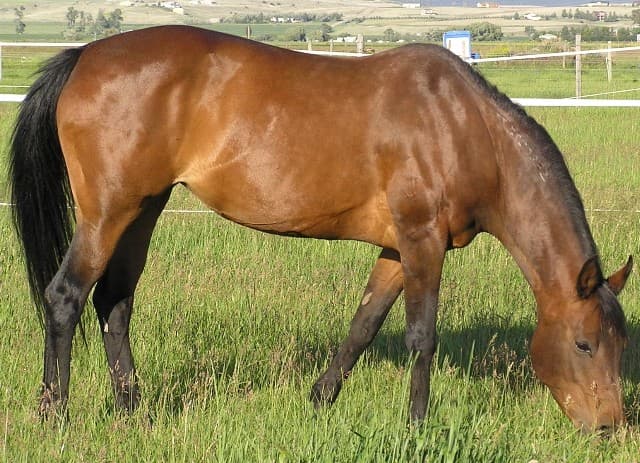
A bay three-quarter Arabian mare photographed in the United States, illustrating a cross; registration in the French DSA studbook is not established.

The Demi-sang Arabe: a registry shaped by endurance breeding
The Association du cheval arabe (ACA) dates the registry's creation to 2006, following an initiative by its Endurance Commission. Breeders were mating proven mares with Arabian stallions to produce long-distance horses. The registry gave these crosses a documented breeding framework while also accommodating horses intended for other equestrian activities.
Sources for this section: ACA [1] · ACA — 2024 [3]
The Demi-sang Arabe: the cross determines the individual build
Association française du cheval Arabe (ACA) describes the desired traits of the Demi-sang Arabe in its studbook rules. This document guides the choice of breeding animals. The 2026 DSA rules do not prescribe one height or body type for every registered horse. Neck shape, chest depth, muscle and bone depend on both parental lines. For endurance, breeders consider movement and the ability to sustain regular work; horses bred for other purposes need to be assessed against those activities. A uniform breed portrait would obscure this diversity.
Sources for this section: ACA [1]
The Demi-sang Arabe: Colour cannot establish the Arabian percentage
Colours and markings can come from either side of a cross. A DSA may therefore look different from a purebred Arabian. Its coat cannot establish its Arabian percentage or registration status. Those details come from identification documents and the recorded pedigree, including the ancestry of both parents.
Sources for this section: ACA [1]
The Demi-sang Arabe: Endurance is an important historical outlet
The Demi-sang Arabe is notably bred for endurance riding. Horse and rider cover long distances, with veterinary checks at several stages of the ride. These checks assess recovery and physical condition before the horse is allowed to continue. DSA horses are also used for leisure riding and other disciplines. Their abilities vary with their parentage, development and training.
Sources for this section: ACA [1] · ACA — 2024 [3]
The Demi-sang Arabe: the general rule is at least 50% Arabian ancestry
The French studbook generally requires at least 50% and less than 100% Arabian ancestry. It provides defined exceptions, including certain descendants of clones and some cases involving a parent from another studbook. ACA delegates registry administration to IFCE. Eligibility must be checked through the applicable registration route rather than inferred from the horse's appearance.
Sources for this section: ACA [1]
The Demi-sang Arabe: Production responds to the endurance market
In its history of the Demi-sang Arabe, published on 19 June 2024, the ACA describes a fall in births intended for endurance as demand for these horses changed. This concerns breeding activity, rather than the number of living DSA horses. The Écus 2025 yearbook also uses the category “Demi-sang (Anglo-arabe)”, whose label does not clearly isolate horses in the French DSA studbook. These sources therefore do not provide a reliable census of all living DSA horses.
Sources for this section: ACA [1] · IFCE — Écus 2025 [2] · ACA — 2024 [3]
The Demi-sang Arabe: SCID and CA tests address two inherited conditions
The SCID test detects the variant responsible for severe combined immunodeficiency. The CA test detects the variant associated with cerebellar abiotrophy, a neurological disorder affecting coordination. Since 2017, the rules have required published test results for the Arabian and DSA stallions concerned. Requiring a result does not mean that every stallion must be a non-carrier. DNA parentage testing separately checks the declared parents.
Sources for this section: ACA [1] · UC Davis VGL — SCID [4] · UC Davis VGL — CA [5]
Sources and review date
Profile reviewed on .
The documents below were used to prepare this profile of the Demi-sang Arabe. They explain which animals can enter the studbook and how breeding animals are selected.
- Demi-sang Arabe — Règlement du livre généalogique 2026
Studbook document covering selection, registration, breeding assessments and dated figures where available.
- IFCE — Annuaire Écus 2025
IFCE-SIRE statistics: French breeding activity in 2024, provisional at 21 October 2025, p. 11. The ambiguous Demi-sang (Anglo-arabe) row on pp. 11 and 22 is not used as a confirmed DSA count.
- ACA — Historique de la race DSA, 19 juin 2024
The breed organisation’s account of the population’s history, uses and development of the registry.
- UC Davis VGL — Severe Combined Immunodeficiency (SCID)
Purpose of the severe combined immunodeficiency (SCID) test and interpretation of carrier results.
- UC Davis VGL — Cerebellar Abiotrophy (CA)
Purpose of the cerebellar abiotrophy (CA) test and what the genetic result establishes.