
Breeds · breed profile
Dartmoor
The Dartmoor, a small pony from Devon’s moorland
The Dartmoor is a small, sturdy British pony used for riding and driving. The name refers to a registered breed, not every pony living on Dartmoor’s moorland. In France, the Association française du poney Dartmoor oversees breeding, with a separate register for eligible crossbred ponies.
- Category
- Pony
- Country or region of origin
- United Kingdom
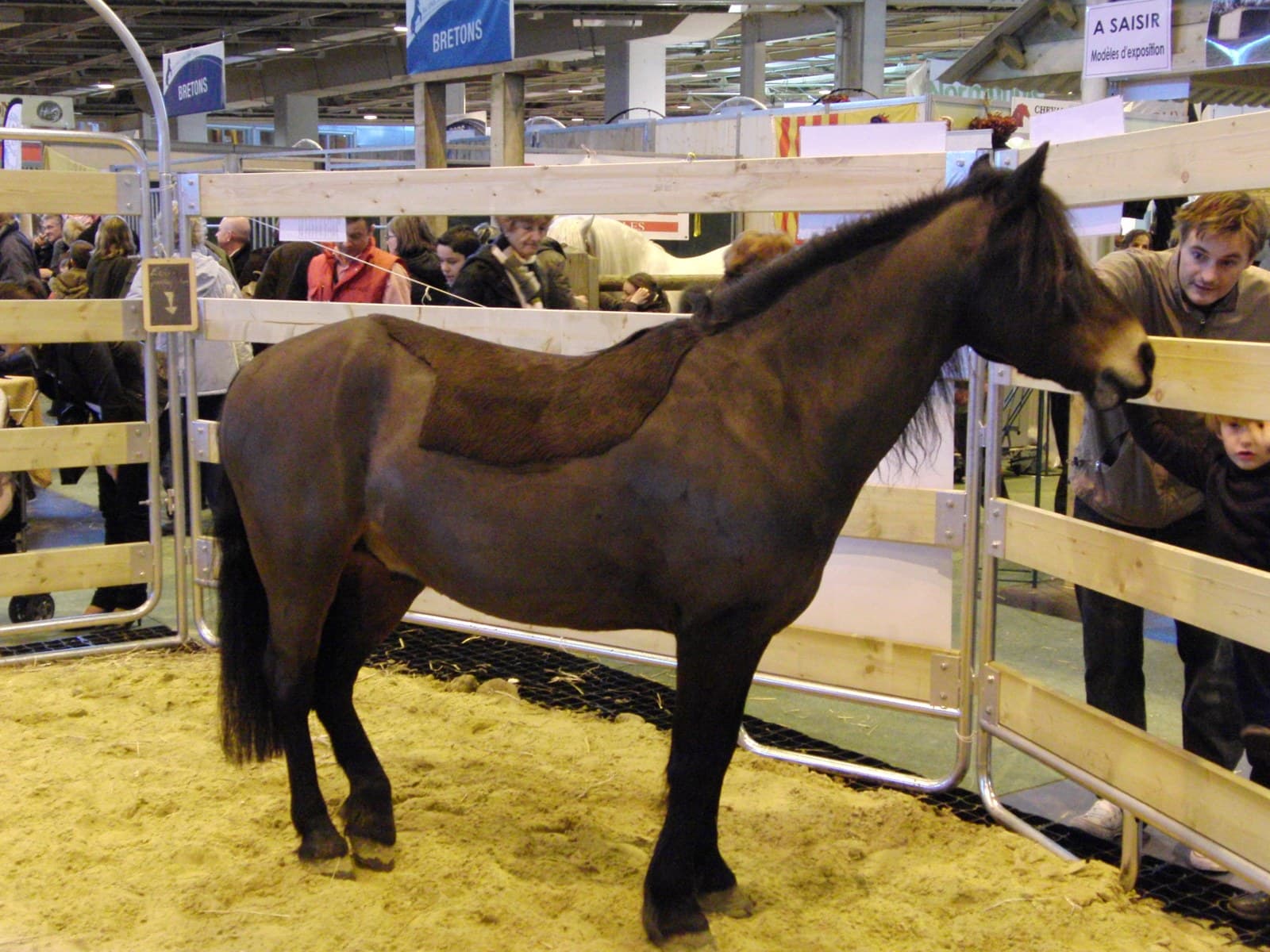
A Dartmoor pony at the 2010 Paris agricultural show.

The Dartmoor: a pony from the Devon moors
The Dartmoor: the landscape and the registered breed are different scopes
The Dartmoor Pony Society places the breed’s origins in Devon in south-west England. Ponies have lived on the moors for centuries, but many do not have ancestry recorded in the Dartmoor studbook. In France, imports organised notably by Sheila Corkery during the 1950s helped establish breeding. The registered pony subsequently found an important role in children’s riding and driving.
Sources for this section: Association française du poney Dartmoor [1] · Dartmoor Pony Society [2]
The Dartmoor: a small pony with a sturdy build
The Dartmoor: a maximum height of 1.27 m
Association française du poney Dartmoor describes the desired traits of the Dartmoor in its breeding programme. This document guides the choice of breeding animals. The Dartmoor breed standard sets a maximum height of 1.27 m. A small expressive head, medium-length neck and sloping shoulder lead into a deep body with ample bone. Cannon bones are short and feet hard. Movement should be straight and free, without exaggerated action. The aim is a well-made riding pony whose small size is supported by sound, substantial construction.
Sources for this section: Association française du poney Dartmoor [1] · Dartmoor Pony Society [2]
Colours accepted in the Dartmoor
The Dartmoor: Solid colours, grey and roan
The Dartmoor breed standard accepts bay, brown, black, grey, chestnut and roan. Piebald, skewbald and leopard-type spotted coats are not accepted. Some white markings are allowed, but excessive white is discouraged. These rules concern the registered breed: seeing a coloured pony on Dartmoor does not establish that its coat pattern belongs to the Dartmoor breed standard.
Sources for this section: Association française du poney Dartmoor [1] · Dartmoor Pony Society [2]
The Dartmoor: Children’s riding and driving
The Dartmoor: Versatility depends on appropriate preparation
Dartmoors are used as children’s riding ponies, in riding schools and in competitions suited to their size. They are also driven. The French programme seeks a willing temperament and functional ability. The preparation of young ponies and assessment of breeding stock connect these aims with the animals being produced.
Sources for this section: Association française du poney Dartmoor [1]
The Dartmoor: Purebred and Part-Bred registration
The Dartmoor: Two records serving different purposes
The studbook is the register that records the identity and ancestry of animals admitted to the breed. The responsible organisation is Association française du poney Dartmoor. The French studbook records the breed’s ancestry and recognises official overseas studbooks. A separate Part-Bred register admits eligible crosses. For births from 2024, it requires at least 12.5% Dartmoor ancestry and an appropriate recorded ancestor under the rules. Part-Bred registration does not make a crossbred pony purebred. Stallions also have approval and annual breeding-authorisation procedures.
Sources for this section: Association française du poney Dartmoor [1] · Dartmoor Pony Society [2]
The Dartmoor: Replacement breeding in France
The Dartmoor: 48 purebred births in 2022
The French breeding programme for the Dartmoor records 48 purebred Dartmoor births in 2022 and, separately, 11 Part-Bred births. Keeping those categories separate is essential when assessing purebred conservation. French breeding is dispersed, with a stronger presence in the north-western quarter. The association has assembled a group of stallions to provide access to different bloodlines and encourage breeding within the purebred population.
Sources for this section: Association française du poney Dartmoor [1]
The Dartmoor: Pedigrees support conservation
The Dartmoor: Maintaining origins without inventing a health status
The Dartmoor breeding programme stresses family diversity and keeping mares in purebred breeding. Genetic identification and pedigree records help establish reliable parentage; they do not screen for every inherited disease. The sources used here do not justify assigning another breed’s disease panel to Dartmoors. Individual history and clinical assessment should guide health investigations, alongside the population’s pedigree-based conservation work.
Sources for this section: Association française du poney Dartmoor [1]
Sources and updates
Profile updated on .
The documents below were used to prepare this profile of the Dartmoor. They explain which animals can enter the studbook and how breeding animals are selected.
- Association française du poney Dartmoor — Studbook rules and breeding programme, 2024
French programme: history, 48 purebred births in 2022 and the Part-Bred threshold for births from 2024.
- Dartmoor Pony Society — The breed and its standard
Original studbook standard and the distinction between registered Dartmoors and other moorland ponies.