
Breeds · breed profile
Crème horse
The Crème horse, bred for a pale coat and riding qualities
The Crème horse is bred for riding qualities and a pale coat associated with cream dilution. The Association française du cheval Crème defines the ancestry, physical traits and test results required for registration. Similar colours occur in other breeds, so a horse’s documents establish whether it belongs to the Crème studbook.
- Category
- Horse
- Country of origin
- France
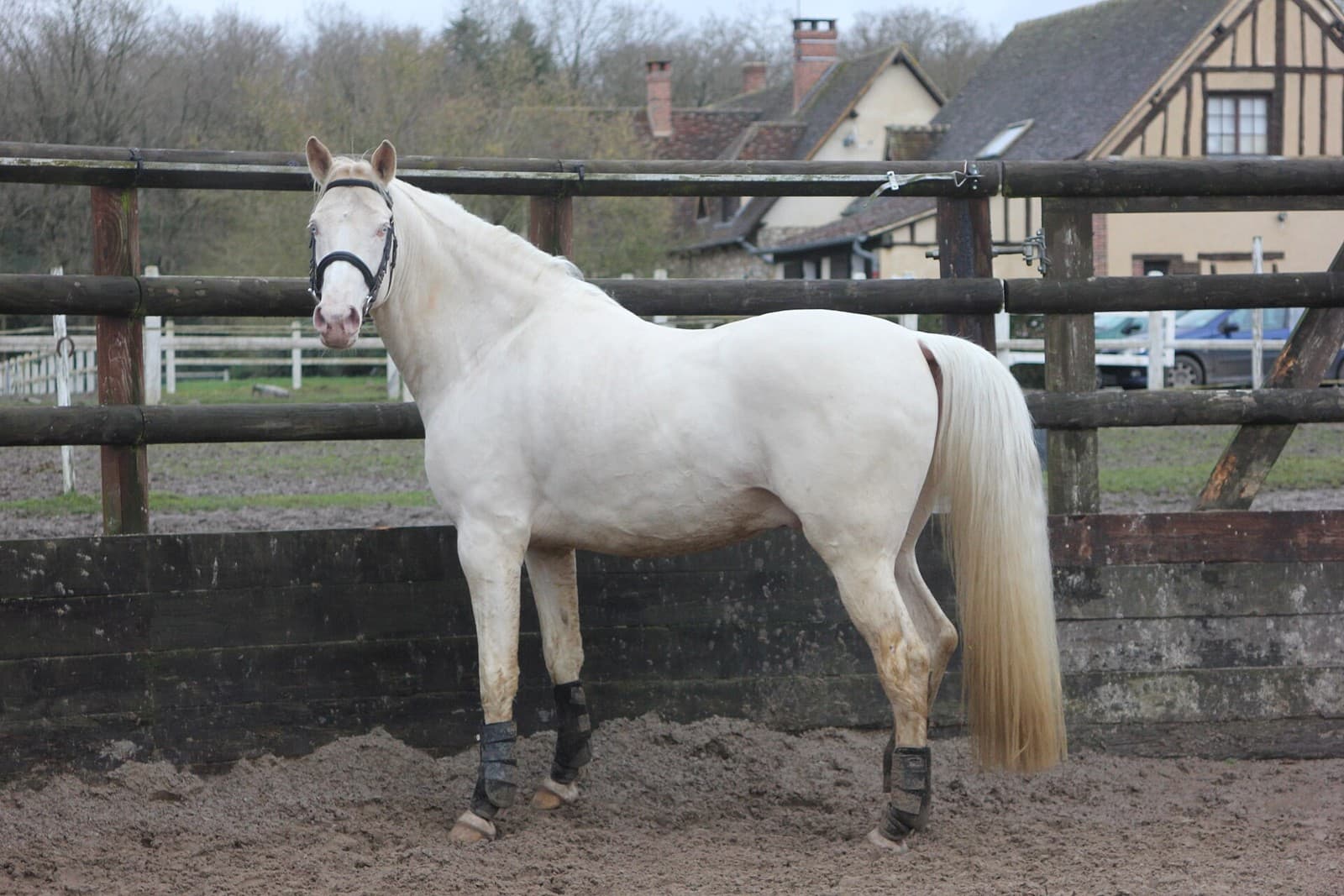
A stallion identified as a Crème horse, shown in profile.

The Crème horse: Establishing the French studbook
Breeding very pale horses has led to several different selection initiatives. In France, the Association française du cheval Crème (AFCC) received official recognition in 2005. The 2023 rules organise a studbook with cream horses and a separate Breeding Stock section. This administrative history is distinct from the history of the cream variant itself, which occurs in many horse populations.
Sources for this section: AFCC [1] · Légifrance — 2005 [3]
The Crème horse: a riding horse at least 1.48 m tall
Association française du cheval Crème (AFCC) describes the desired traits of the Crème horse in its studbook rules. This document guides the choice of breeding animals. The Crème horse breed standard sets a minimum height of 1.48 m. It seeks an expressive head, large eyes, a fairly long well-set neck, a long sloping shoulder, deep chest and relatively short back. The loin should be broad, the croup rounded and muscular, and the limbs correctly aligned. Overall proportions should support ridden work.
Sources for this section: AFCC [1]
The Crème horse: Cream colour and the Breeding Stock section
The cream type has pink skin, blue eyes and very pale hair ranging from off-white to cream. The studbook also provides for Breeding Stock horses, including eligible colours with one cream variant copy. Initial-registration rules exclude certain other dilutions and white patterns, including pearl, champagne and overo. Similar-looking coats can therefore have different genetic causes and registration eligibility.
Sources for this section: AFCC [1]
The Crème horse: Uses depend on build and education
The Crème horse breeding programme selects a riding-horse type. Schooling, hacking and presentations demonstrate movement and responsiveness beyond coat colour. Choosing a horse for a particular rider also involves age, education and experience. Colour requirements do not describe the level of training already achieved by an individual.
Sources for this section: AFCC [1]
The Crème horse: Admission involves more than colour
AFCC defines the divisions, ancestry requirements, inspection and breeding approval. Conditions vary with a horse's ancestry and route into the studbook. Identification documents and the required results must therefore be considered together. The colour term “cremello” is not, by itself, evidence of registration in the French Crème studbook.
Sources for this section: AFCC [1]
The Crème horse: Limited declared French activity in 2024
The 2025 Écus yearbook lists five mares covered in 2024 for anticipated Crème production in France, using provisional data dated 21 October 2025. This figure concerns declarations included in that table. It counts neither every cream-coloured horse in France nor every living animal registered in the studbook.
Sources for this section: IFCE — Écus 2025 [2]
The Crème horse: Cream dilution, SCID and CA: different tests
The cream test detects a variant in SLC45A2; two copies strongly dilute the base coat. For the breeding animals concerned, the rules also check absence of the greying variant. SCID and CA tests detect variants associated with severe combined immunodeficiency and cerebellar abiotrophy, a neurological condition affecting coordination. Negative results are required with an Arabian or DSA parent, or in the Mayghib line; a five-disease panel is required with a Quarter Horse parent. The rules provide exemptions where both parents already have compatible results. Requirements therefore need to be read by ancestry and section, rather than treated as one identical panel for every horse.
Sources for this section: AFCC [1] · UC Davis VGL [4] · UC Davis VGL — SCID [5] · UC Davis VGL — CA [6]
Sources and review date
Profile reviewed on .
The documents below were used to prepare this profile of the Crème horse. They explain which animals can enter the studbook and how breeding animals are selected.
- Crème — Règlement du stud-book 2023
Studbook document covering selection, registration, breeding assessments and dated figures where available.
- IFCE — Annuaire Écus 2025
IFCE-SIRE statistics: French breeding activity in 2024, provisional at 21 October 2025, p. 11.
- Arrêté du 20 juin 2005 — Agrément de l’Association française du cheval Crème
Recognition of the French association in 2005; this document does not establish the historical origin of the colour variant.
- UC Davis VGL — Cream
Testing the SLC45A2 cream variant and the effects of one or two copies on base colour.
- UC Davis VGL — Severe Combined Immunodeficiency (SCID)
Purpose of the severe combined immunodeficiency (SCID) test and interpretation of carrier results.
- UC Davis VGL — Cerebellar Abiotrophy (CA)
Purpose of the cerebellar abiotrophy (CA) test and what the genetic result establishes.