
Breeds · breed profile
Corsican horse
The Corsican horse, known locally as U Cavallu Corsu
The Corsican horse is a small riding horse associated with the island’s terrain and rural life. A compact build, strong feet and suitability for outdoor work are central to its selection. Recognised in 2012, it has its own studbook, separate from the Corsican donkey registry.
- Category
- Horse
- Country of origin
- France
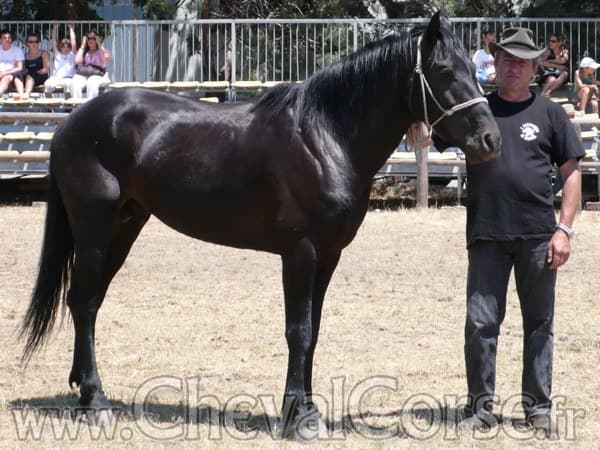
Caprice, a Corsican stallion shown in hand.

The Corsican horse: an island breed recognised in 2012
The Corsican horse: From local population to organised studbook
Horses supported travel and farming in Corsica long before the present registry existed. U Cavallu Corsu, the association established in 2009, organised the identification and recognition of local animals. National recognition followed in January 2012. That date marks an administrative milestone in conservation, rather than the arrival of horses on the island.
Sources for this section: U Cavallu Corsu [1] · U Cavallu Corsu [2]
The Corsican horse: a small horse for varied terrain
The Corsican horse: the Corsican standard’s proportions
U Cavallu Corsu describes the desired traits of the Corsican horse in its breeding programme. This document guides the choice of breeding animals. The Corsican horse breed standard gives a height of 1.30–1.52 m and an indicative weight of 300–400 kg. It describes a fairly short head, broad neck, short back and lean, strong limbs. The feet are small with hard horn. Active movement and balance should support ridden work; small stature should not be confused with an inability to perform useful work.
Sources for this section: U Cavallu Corsu [1]
The Corsican horse: Dark coats and controlled white markings
The Corsican horse: Black, seal brown and bay
The rules of the French Corsican horse studbook accept black, noir pangaré, a dark coat with lighter areas, and bay. A small forehead marking may be tolerated, but a blaze is outside the standard. White leg markings are prohibited in stallions and limited in mares and geldings. Assessment therefore depends on the precise conditions for the animal concerned, not simply its overall body colour.
Sources for this section: U Cavallu Corsu [1]
The Corsican horse: Outdoor riding in Corsica
The Corsican horse: Trail riding and rural activities
Trail riding is an important outlet for a horse whose history is closely connected with island routes. Equestrian tourism, leisure riding and rural activities help sustain the breed. Local breeding also supports pastoral practices. These uses connect breeders with the island’s routes and with activities that give horses a continuing role in the rural economy.
Sources for this section: U Cavallu Corsu [1]
The Corsican horse: the registry and breeding approval
The Corsican horse: Recorded ancestry within a defined system
The studbook is the register that records the identity and ancestry of animals admitted to the breed. The responsible organisation is U Cavallu Corsu. The rules effective from January 2023 distinguish births within the Corsican home region from those outside it. Registration by descent requires eligible breeding parents and, for births since 2014, a parentage check. Initial registration and certain contributions from Barb stallions are possible through specific procedures. These are controlled routes, not automatic admission for every crossbred horse.
Sources for this section: U Cavallu Corsu [1]
The Corsican horse: Conserving an island population
The Corsican horse: Keeping families and breeding activity viable
The association documents identification, selection and promotion centred on Corsica. The sources used here do not supply a recent, consistent census of all living animals. Conservation therefore needs to follow births and breeding stock while also considering the survival of breeding farms and different families. Suitable uses help maintain an active breeding population rather than merely a collection of registered names.
Sources for this section: U Cavallu Corsu [1] · U Cavallu Corsu [2]
The Corsican horse: Chestnut testing in Corsican breeding stock
The Corsican horse: a coat-colour requirement is not a health result
Extension testing can detect the recessive chestnut variant, which a dark-coated horse may carry without appearing chestnut. Stallion candidates must have a result showing that they do not carry it. Requirements for females vary with the registration or breeding procedure. This is a colour-selection rule. Parentage checks and infectious-disease requirements serve other purposes and should not be presented as a single inherited-disease panel.
Sources for this section: U Cavallu Corsu [1]
Sources and review date
Profile reviewed on .
The documents below were used to prepare this profile of the Corsican horse. They explain which animals can enter the studbook and how breeding animals are selected.
- U Cavallu Corsu — Studbook rules and breeding programme, 2023
Rules effective from January 2023: standard, home region, breeding contributions and eligibility.
- U Cavallu Corsu — The association
The association’s foundation in 2009, recognition in 2012 and conservation work.