
Breeds · breed profile
The Connemara pony
Connemara pony
The Connemara is a pony from western Ireland, where the same animals once worked the land, transported produce and carried family members. Its compact build and jumping ability supported its development as a riding and sport pony. The Connemara Pony Breeders’ Society holds the studbook of origin in Clifden, County Galway.
- Category
- Pony
- Country of origin
- Ireland
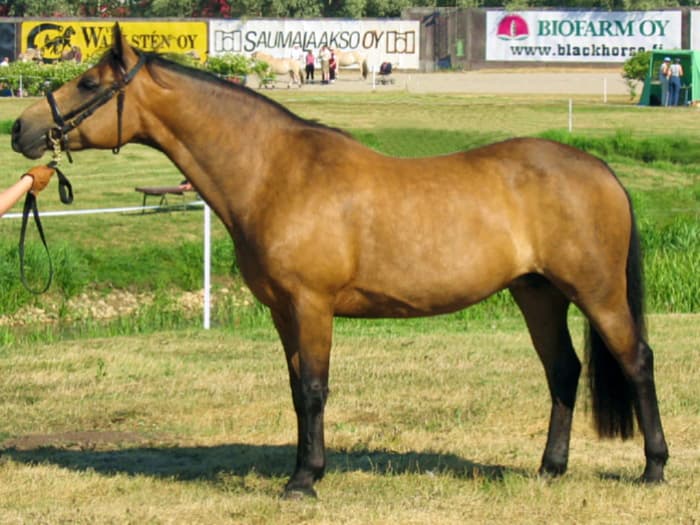
A Connemara mare standing in profile in a field.

The Connemara pony: the origins and development of the Connemara breed
The Connemara pony: a pony from western County Galway
Connemara lies west of Lough Corrib in County Galway, on Ireland’s Atlantic coast. Ponies took part in farm life, cultivating land, carrying peat and transporting the family. The need for a manageable animal with stamina arose from this variety of tasks, before the development of sport breeding.
The Connemara pony: a society founded in 1923
The Connemara Pony Breeders’ Society, or CPBS, was founded in 1923 to preserve and improve the breed. Its first studbook volume, published in 1926, recorded 93 breeding mares and 9 stallions. These figures describe that first register, rather than every pony living in the region at the time. Registration made it possible to follow families and breeding decisions across generations.
The Connemara pony: Documented sire lines and outside influences
The programme traces sire lines to ponies including Cannon Ball, Connemara Boy and Mountain Lad. Before the studbook closed, Irish Draught, Thoroughbred and Arabian stallions also contributed. The Thoroughbred Little Heaven, through his son Carna Dun, and Clonkeehan Auratum, by the Arabian Naseel, influenced recognised lines. A sire line follows successive fathers; it does not describe all of a pony’s ancestors.
The Connemara pony: Closing the studbook in 1964
The studbook of origin closed to outside blood in 1964. Subsequent generations have been recorded within the registered population and recognised studbooks. Overseas organisation developed alongside this: the British society was founded in 1947 and has kept its own studbook since 1979. It has supported the transition from regional working pony to a riding breed raised in many countries.
Sources for this section: CPBS · 2025 programme [1] · BCPS · history and uses [2]
The Connemara pony: Connemara conformation and height requirements
The Connemara pony: a riding pony with depth and substance
The CPBS standard describes a medium-length head, broad between the eyes, with a defined jaw that is not coarse. The neck should not be set too low and joins a sloping shoulder and defined withers. The body has a deep chest, strong back and strong loins. Muscular quarters support propulsion and the ability to cover ground.
The Connemara pony: Limbs and movement suited to work
The Connemara breed standard seeks long, strong forearms, short cannons and strong, low-set hocks. Feet should be regular, hard and medium-sized. Movement should be free, active and straight, without excessive knee action. A cooperative temperament, stamina and jumping ability are among the qualities that inspections and performance records aim to preserve.
The Connemara pony: 128–148 cm: a breed aim and classification rules
The 128–148 cm range at the withers describes the desired height at maturity, not an average. The 2025 CPBS programme uses age-specific classification thresholds and official measurements without shoes: the upper limits for young ponies are therefore below 148 cm. At three and four years old, the upper limits for Classes 1 and 2 are 143 and 145 cm respectively. It also provides OH and E classes for ponies meeting other criteria but not the height requirements. Exceeding a limit does not erase a registered pedigree.
Sources for this section: CPBS · 2025 programme [1] · BCPS · standard [3]
The Connemara pony: Connemara colours and traditional colour names
The Connemara pony: Grey and a range of diluted colours
The Connemara breeding programme recognises grey, black, bay, chestnut, roan, buckskin, palomino and very pale double-cream dilutions, among other colours. A foal that will become grey can be born dark and gradually develop white hairs. The adult appearance therefore needs to be distinguished from its birth colour and the variants the pony can pass on.
The Connemara pony: Understanding the traditional word “dun”
Traditional Connemara descriptions use “dun” for colours including buckskin. The 2025 programme puts the two names together in its colour list. This wording alone does not establish the presence of the genetic Dun dilution. A colour test identifies the variant carried; a colour name in a register cannot establish that genotype on its own.
Sources for this section: CPBS · 2025 programme [1] · BCPS · standard [3]
The Connemara pony: From farm work to equestrian sport
The Connemara pony: One pony for several jobs
On Connemara farms, ponies worked the land, carried peat and pulled a carriage for family journeys. Breeding needed to retain an animal strong enough for those loads but manageable in local conditions. These tasks help explain the importance of hardiness and versatility in today’s programme, even though the market for the breed has changed.
The Connemara pony: Jumping, eventing and dressage
Children and adults ride Connemaras for leisure and competition. The breed takes part in showjumping, dressage and eventing, which combines a dressage test with cross-country and showjumping courses. The British society also documents TREC and endurance. Competition results and conformation classes give breeders different information about trained performance and physical structure.
Sources for this section: CPBS · 2025 programme [1] · BCPS · history and uses [2]
The Connemara pony: the Connemara studbook of origin and its classes
The Connemara pony: Recording identity and parentage
The CPBS programme covers the island of Ireland, including the Republic of Ireland and Northern Ireland. Registration requires parents from recognised studbooks and DNA verification of the foal’s parentage. The laboratory compares the youngster’s DNA markers with those of the declared sire and dam. A microchip and identification document connect those results to the correct animal.
The Connemara pony: Five classes in the 2025 programme
Foals initially enter Class 3. Inspection can subsequently place them in Class 1, 2, OH or E according to ancestry, age, conformation, movement, height and health requirements. Colts can be presented from three years old and fillies from two. Class 1 requires a higher assessment than Class 2. OH addresses excess height; E provides, among other things, for a later remeasurement. Geldings follow a procedure based on height.
The Connemara pony: HWSD results and inspection
The Connemara breeding programme requires HWSD testing before registration, with exemptions for offspring of two officially recorded non-carrier parents and for geldings. Status is recorded in the identification document and database. A healthy carrier can enter Class 1 or 2 if the other criteria are met; a pony with two copies of the HWSD variant remains in Class 3. Birth registration and classification after inspection are therefore separate stages.
Sources for this section: CPBS · 2025 programme [1]
The Connemara pony: Distribution and documented breeding animals
The Connemara pony: an Irish studbook and overseas organisations
Western Ireland remains the breed’s home, but Connemaras are bred in Great Britain, continental Europe, North America, Australia and New Zealand, among other places. The 2025 programme describes cooperation between the CPBS and overseas organisations through the International Committee for Connemara Pony Societies. Each studbook records its own registrations; the existence of these studbooks does not itself provide a worldwide count of living animals.
The Connemara pony: the CPBS programme’s breeding figures for 2024
The Connemara breeding programme approved on 7 March 2025 reports 3,741 breeding mares and 463 stallions for 2024 in the society’s breeding population. Its geographical scope is the island of Ireland. These are figures for breeding animals, not all living Connemaras: they do not include geldings or all youngstock and should not be extended to overseas studbooks.
Sources for this section: CPBS · 2025 programme [1] · BCPS · history and uses [2]
The Connemara pony: HWSD research, testing and mating choices
The Connemara pony: an inherited weakness of the hoof wall
HWSD stands for Hoof Wall Separation Disease. It causes the hoof wall to split and crumble from an early age, with variable severity. More weight can then fall on the sole, causing substantial pain. The identified variant is an insertion in SERPINB11 that disrupts production of the protein. Inheritance is recessive: carriers with one copy are clinically unaffected by this disease.
The Connemara pony: How the variant was identified in 2015
Finno and colleagues initially compared 15 affected Connemaras with 24 controls, then removed 7 genetically different controls to improve the comparison. They next sequenced two cases and two controls and checked candidate variants in 369 Connemaras. These stages linked the SERPINB11 insertion to the disorder. Recruiting cases, relatives and controls to find a cause is not a representative survey of current breeding populations.
The Connemara pony: Avoiding two disease-associated copies in a foal
The DNA test distinguishes non-carriers, healthy carriers and ponies with two copies of the variant. Two healthy carriers have a 25% chance at each conception of producing a foal with two disease-associated copies. Choosing a tested non-carrier partner for a carrier avoids that combination. The test does not predict the exact severity of lesions in a pony with two copies, and hoof cracks can have causes other than HWSD.
The Connemara pony: Keeping families while controlling risk
The Connemara breeding programme asks breeders to consider HWSD results alongside ancestry, conformation and performance. A healthy carrier can be paired with a non-carrier, retaining useful families rather than automatically removing every carrier from breeding. Parentage verification supports reliable pedigrees; HWSD testing answers a question about one specific variant. They use DNA for different purposes.
Sources for this section: Finno et al. · 2015 [4] · UC Davis · HWSD [5] · CPBS · 2025 programme [1]
Sources and updates
Profile updated on .
The CPBS programme approved on 7 March 2025 defines the Irish system described here, including OH and E classes. British sources document the breed’s spread and uses. The original paper and UC Davis explain discovery of the HWSD variant and its test.
- Connemara Pony Breeders’ Society — Breeding programme (PDF, 7 March 2025)
History, standard, studbook closure, classes, testing and 2024 breeding animals on the island of Ireland.
- British Connemara Pony Society — About the society
British society founded in 1947, its studbook from 1979 and equestrian disciplines.
- British Connemara Pony Society — About the breed
Conformation, mature height range and coat-colour terminology.
- Finno et al. (2015) — SERPINB11 variant associated with HWSD
PLOS Genetics, 11, e1005122. Case-control study, sequencing and candidate variant testing.
- UC Davis Center for Equine Health — Hoof Wall Separation Disease (2020)
Clinical signs, variation in severity, inheritance and using tests to plan matings.