
Breeds · breed profile
The Comtois
Cheval de Trait Comtois · Franche-Comté
The Comtois is a draught horse from the Jura plateaux in Franche-Comté. Organised breeding developed around Maîche in the Doubs before spreading to other French regions and abroad. Its compact body and often light mane and tail are familiar features, but a studbook colour description and a dilution-test result do not always describe the same thing.
- Category
- Horse
- Country of origin
- France
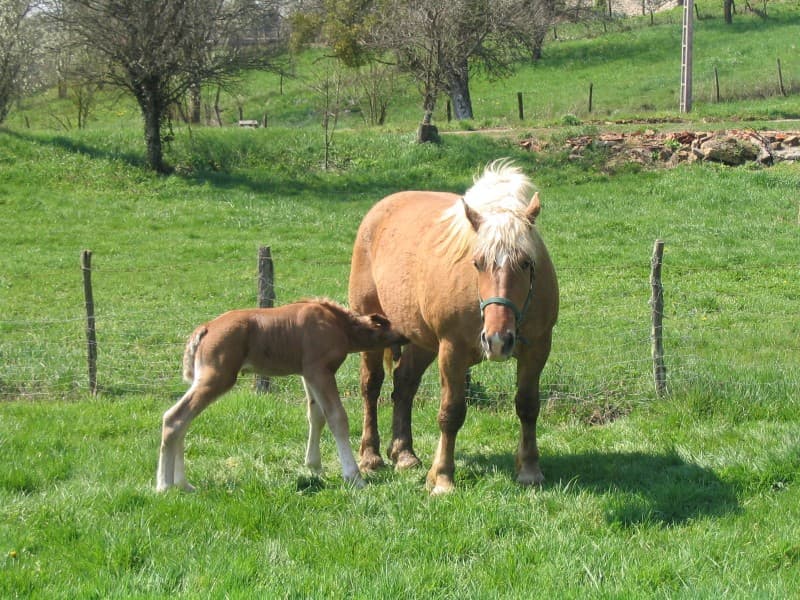
A Comtois mare with her foal, photographed in May 2007 by Jean-René Gousset.

The Comtois: From the Maîche plateau to organised breeding
The Comtois: a homeland in the hills of Franche-Comté
The Association nationale du cheval de trait comtois (ANCTC) places the Comtois homeland on the Maîche plateau in the Doubs, among Jura pastures and forests. Horses worked in farming and transport across this hilly region. That setting helps explain the emphasis on a medium-sized horse able to pull and move through places where manoeuvrability matters.
The Comtois: a show in 1910 and a studbook in 1919
In the early twentieth century, breeders organised more systematic selection, including the use of small bay Ardennais stallions. Maîche’s first breeding show took place in 1910; the union and studbook were founded in 1919. The register then recorded identities and family relationships, giving the breed a definition beyond appearance alone.
The Comtois: Selection continued after motorisation
Motorisation reduced the demand for agricultural draught horses while other markets gained importance. The union became the Association nationale du cheval de trait comtois (ANCTC) in 2003 and was approved as the breed’s breeding organisation in 2018. Its 2026 programme combines preservation with versatility, improved breeding practices and market development.
Sources for this section: ANCTC, history [1] · ANCTC / IFCE, July 2026 [5]
The Comtois build and movement sought by breeders
The Comtois: a compact body without excessive bulk
The Comtois breed standard describes the traits breeders seek: a square, expressive head, small mobile ears and a muscular neck. The shoulder is long and sloping, with a broad breast and deep chest. A relatively short back and firmly connected loin link the forehand to broad hindquarters and a well-developed thigh.
The Comtois: Strong limbs and active movement
The Comtois breeding programme seeks strong joints, clearly defined tendons, correct limb alignment and well-shaped hooves. Movement should remain supple and active. In a conformation and movement show, judges assess these proportions and the horse’s way of going. Body weight alone cannot describe the structure being evaluated.
The Comtois: the 2026 programme sets a 1.50 m minimum
The Comtois breeding programme gives a minimum height of 1.50 m and a descriptive weight of approximately 600–800 kg. The association’s introductory page instead gives 1.50–1.65 m and about 650–800 kg. For regulatory conditions, the July 2026 programme is the reference; the introductory range does not create a 1.65 m admission ceiling.
Sources for this section: ANCTC, breed outline [2] · ANCTC / IFCE, July 2026 [5]
The Comtois: Light manes, registry descriptions and silver dilution
The Comtois: Colour categories in the programme
The 2026 programme accepts bay or chestnut, preferably dark or copper-coloured, with flaxen or mixed mane and tail. It also specifies white markings excluded by the standard. These names describe and register horses; they do not directly report colour-gene tests. A blonde mane therefore does not, on its own, establish that a horse is genetically chestnut.
The Comtois: Why a silver bay can have a light mane
The Silver variant of PMEL primarily dilutes black pigment. A horse with a bay base may retain a reddish body while its mane, tail and dark points are lightened. On a chestnut base, the dilution is not visible in the coat. DNA testing can clarify the variant’s presence when appearance is ambiguous, while studbook eligibility still follows the registry’s criteria. The same variant is also associated with congenital eye abnormalities, discussed in the genetic-testing section.
Sources for this section: ANCTC / IFCE, July 2026 [5] · UC Davis, Silver [6]
The Comtois: Work, leisure and breeding markets
The Comtois: From farming to horse logging
The Association nationale du cheval de trait comtois (ANCTC) documents Comtois work in farming, vineyards and forestry. In logging, the horse draws timber to a place where it can be collected. The handler asks for changes of direction, adjustments in pulling effort and precise stops. The task combines strength with suitable training and equipment.
The Comtois: Driving, services and meat production
The association also describes driving, leisure and horse-powered services. The 2026 programme aims to develop versatility and explicitly includes horsemeat production and marketing. These outlets coexist and help explain breeding priorities, foal sales and the economic organisation of farms.
Sources for this section: ANCTC, working uses [4] · ANCTC / IFCE, July 2026 [5]
The Comtois studbook and selection of parents
The Comtois: ANCTC and IFCE registration
ANCTC runs the breeding programme, with delegated tasks including record administration carried out by IFCE. The studbook distinguishes registered foals, confirmed breeding animals, imports and initial entries. Its haute valeur génétique confirmation is a qualification under this programme, involving assessment of build and ancestry. It does not mean that the horse’s whole genome has been sequenced.
The Comtois: Foal registration and stallion approval
Entry by descent links a declared mating, parents meeting the studbook’s conditions and identification of the foal. Prospective breeding males undergo national approval at Maîche, with pedigree and conformation requirements. The 2026 text also creates an elite stallion section for horses scoring at least 17 during approval.
The Comtois: a parentage requirement scheduled from 2028
The July 2026 programme requires prospective stallions to have their pedigrees confirmed by parentage testing from the 2028 approval onwards. That future date must be distinguished from conditions already applicable in 2026. The test compares the candidate’s DNA with that of its declared parents to assess compatibility, rather than screening every health-related variant.
Sources for this section: ANCTC / IFCE, July 2026 [5]
The Comtois: Distribution and annual production
The Comtois: From the Jura to other breeding regions
The Association nationale du cheval de trait comtois (ANCTC) describes breeding in Franche-Comté, Alsace, Burgundy, the Massif Central, Pyrenees and Alps, as well as exports to several European countries. The breed’s place of origin and an individual horse’s birthplace may therefore differ. Registration of a foreign-born animal follows the relevant studbook’s rules and recognised extensions of the programme.
The Comtois: 3,539 births in France in 2022
The 2026 programme uses 3,539 Comtois births in France in 2022 as the starting point for a development target for 2027. The 2022 figure describes one year’s production; the 2027 target is not an observed result. Neither directly counts Comtois horses alive worldwide in 2026.
Sources for this section: ANCTC, breeding regions [3] · ANCTC / IFCE, July 2026 [5]
The Comtois: Silver, eye abnormalities and junctional epidermolysis bullosa
The Comtois: Silver testing also provides health information
Silver testing detects the PMEL variant associated with dilution and multiple congenital ocular anomalies, or MCOA. Horses carrying two copies generally have more severe abnormalities than those with one, and chestnuts can carry the variant without visible dilution. The Comtois programme includes screening of male breeding stock and eye research. Genetic results and an ophthalmic examination provide complementary information.
The Comtois: the 2003 LAMC2 study examined cases and families
Milenkovic and colleagues investigated the cause of severe skin fragility in foals. Their study included 19 Comtois, with 5 affected foals, parents and controls, alongside 47 Bretons. It linked the disease to the LAMC2 variant already known in Belgian draught horses. Families recruited around affected cases are not a sample from which to estimate current frequency throughout the breed.
The Comtois: JEB testing identifies healthy carriers
Junctional epidermolysis bullosa causes severe separation of skin and mucous membranes in newborn foals. The test detects the causal LAMC2 variant. One copy may be carried without disease; two cause the form described. Two carriers have a 25% risk of an affected foal at each birth. A carrier mated to a tested non-carrier cannot produce that combination for this variant, allowing the family to remain in breeding without bringing together two copies.
Sources for this section: ANCTC / IFCE, July 2026 [5] · UC Davis, Silver [6] · Milenkovic et al., 2003 [7] · UC Davis, JEB1 [8]
Sources and review date
Profile reviewed on .
The ANCTC programme published by IFCE in September 2026 carries an internal last-amended date of 24 July 2026. It sets out selection rules and some future measures. Association pages describe the homeland and working uses, while research publications and laboratories explain Silver and LAMC2 testing.
- ANCTC — Histoire du cheval Comtois
Twentieth-century organisation, the 1910 show and 1919 studbook. Ancient-ancestry stories are not treated as demonstrated pedigrees.
- ANCTC — Standards de la race
Public description and introductory size range. The July 2026 programme governs regulatory thresholds and selection.
- ANCTC — Zones d’élevage
Maîche plateau homeland and geographical spread; not a dated worldwide census.
- ANCTC — Métiers
Farming, draught work and present-day uses, distinguished from the programme’s production objectives.
- Comtois draught horse breeding programme — last amended 24 July 2026
Version listed as current by IFCE, hosted in its September 2026 folder. Height minimum, rules, Silver, 3,539 births in 2022 and parentage from 2028 approvals. Future targets are not results.
- UC Davis Veterinary Genetics Laboratory — Silver
PMEL variant, effects on different base colours and association with MCOA. General test interpretation, not representative Comtois frequency data.
- Milenkovic et al. — A mutation in the LAMC2 gene causes H-JEB in two French draft horse breeds
19 Comtois including 5 affected foals and 47 Bretons including 10 affected foals, with parents and controls. A causal study of selected families.
- UC Davis Veterinary Genetics Laboratory — Junctional Epidermolysis Bullosa (JEB1) in Belgians
LAMC2 testing also indicated for Comtois and Breton horses, healthy carriers and recessive inheritance. A laboratory offering does not establish a registry requirement.