
Breeds · breed profile
Norman Cob
The Norman Cob, a light draught horse descended from Normandy’s carriage horses
The Norman Cob combines a substantial build with the active movement of its carriage-horse ancestors. It belongs to France’s draught breeds while retaining a lighter type than the largest heavy horses. Breeding is strongly associated with Normandy, with another important concentration in western France.
- Category
- Horse
- Country of origin
- France
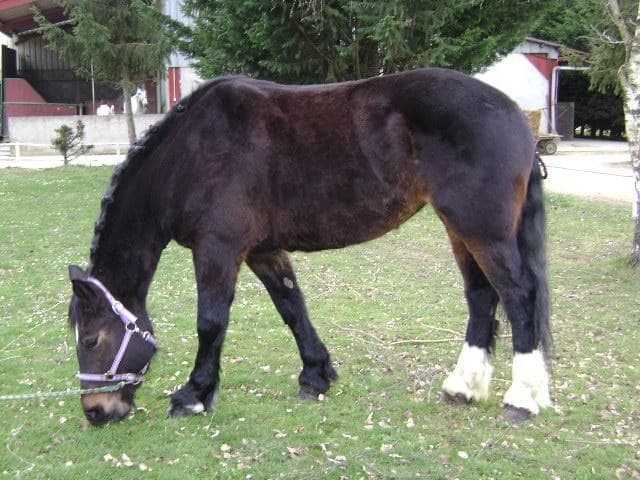
Olympe de Fontaine, a Norman Cob mare grazing.

The Norman Cob: From Norman carriage horse to modern Cob
The Norman Cob: Transport, farming and changing breeding aims
The Norman Cob descends from carriage horses developed in Normandy. Local selection and contributions from lighter horse populations produced a powerful but mobile type. Changing demand later directed part of this population towards agricultural work. The Cob’s own studbook dates from 1950 and should not be confused with older records for the related Norman horse populations from which several breeds developed.
Sources for this section: SNEUCCN [1]
The Norman Cob: a mobile, lighter draught horse
The Norman Cob: a broad range of heights and builds
Syndicat national des éleveurs et utilisateurs de chevaux Cob normand (SNEUCCN) describes the desired traits of the Norman Cob in its breeding programme. This document guides the choice of breeding animals. The programme dated 26 June 2023 describes a height of 1.55–1.72 m and a weight of 550–900 kg. An expressive head, well-set neck, relatively short back and deep chest characterise the breed. Limbs should be strong and clean without excessive heaviness. Energetic, supple movement supports the versatility sought for riding, driving and work.
Sources for this section: SNEUCCN [1]
The Norman Cob’s accepted colours
The Norman Cob: Bay, chestnut and noir pangaré
The Norman Cob breed standard accepts the various shades of bay and chestnut, together with noir pangaré, a very dark coat with lighter areas. White facial and leg markings may occur. Coat conformity is part of studbook entry requirements. Appearance alone cannot establish a horse’s full ancestry or reveal all the colour variants it may carry and pass to its offspring.
Sources for this section: SNEUCCN [1]
The Norman Cob: Driving remains a central use
The Norman Cob: From recreation to professional work
Norman Cobs are used for recreational and competitive driving, work and riding. The programme also mentions municipal services and mounted units. Practical use forms part of selection: young stallion candidates take a driving test during approval. The test connects assessment of conformation with observation of the horse at work.
Sources for this section: SNEUCCN [1]
The Norman Cob studbook
The Norman Cob: Recorded origins and verified parentage
The studbook is the register that records the identity and ancestry of animals admitted to the breed. The responsible organisation is Syndicat national des éleveurs et utilisateurs de chevaux Cob normand (SNEUCCN). Registration by descent requires an approved sire before mating, a registered or eligible contributing dam, and compatible DNA parentage. Certain females with three Norman Cob grandparents may qualify as contributing mares under the rules. From 2024 births, payment of the registration fee also enrols the foal in the breeding programme. Resemblance to the breed is not a general route to admission.
Sources for this section: SNEUCCN [1]
The Norman Cob: Replacing breeding stock while retaining diversity
The Norman Cob: 206 births in France in 2021
The Norman Cob breeding programme reports 206 French births in 2021. Breeding is particularly established in Manche, Calvados and Orne, as well as Vendée and Loire-Atlantique. The breed organisation maintains a group of stallions from different backgrounds to widen mating choices. Its targets for births by 2030 are conservation ambitions, not figures already achieved or a census of living horses.
Sources for this section: SNEUCCN [1]
PSSM1 documented in the Norman Cob
The Norman Cob: a test for a specific GYS1 variant
PSSM1 testing detects a GYS1 variant associated with abnormal storage of glycogen, the stored form of sugar in muscle. Research on this association in Norman Cobs was published in 2009. One copy can be associated with muscle signs, but the result does not predict their severity in an individual. A negative result concerns that variant and does not exclude every muscle disorder. A study sample cannot by itself establish a current frequency for the whole breed.
Sources for this section: SNEUCCN [1] · UC Davis VGL [2] · Herszberg et al., 2009 [3]
Sources and review date
Profile reviewed on .
The documents below were used to prepare this profile of the Norman Cob. They explain which animals can enter the studbook and how breeding animals are selected.
- SNEUCCN — Studbook rules and breeding programme, 26 June 2023
Programme dated 26 June 2023: history, standard, parentage, 206 births in 2021 and stallion management.
- UC Davis VGL — PSSM1 testing
The GYS1 variant, dominant inheritance and result interpretation; this source is not used to infer a current breed frequency.
- Herszberg et al. (2009) — GYS1 and myopathy in the Norman Cob
Original study associating the variant with myopathy in the studied group, referenced by VGL; not a current breed census.