
Breeds · breed profile
French Miniature Horse
The French Miniature Horse, a small horse with balanced proportions
The French Miniature Horse, or CMF, is a small horse bred for balanced proportions and easy movement. The Association française du cheval miniature maintains its studbook, a register of horses and their parents. Registration depends on specific height, ancestry and physical assessment requirements. Activities with these horses mainly involve handling them from the ground or driving.
- Category
- Horse
- Country of origin
- France
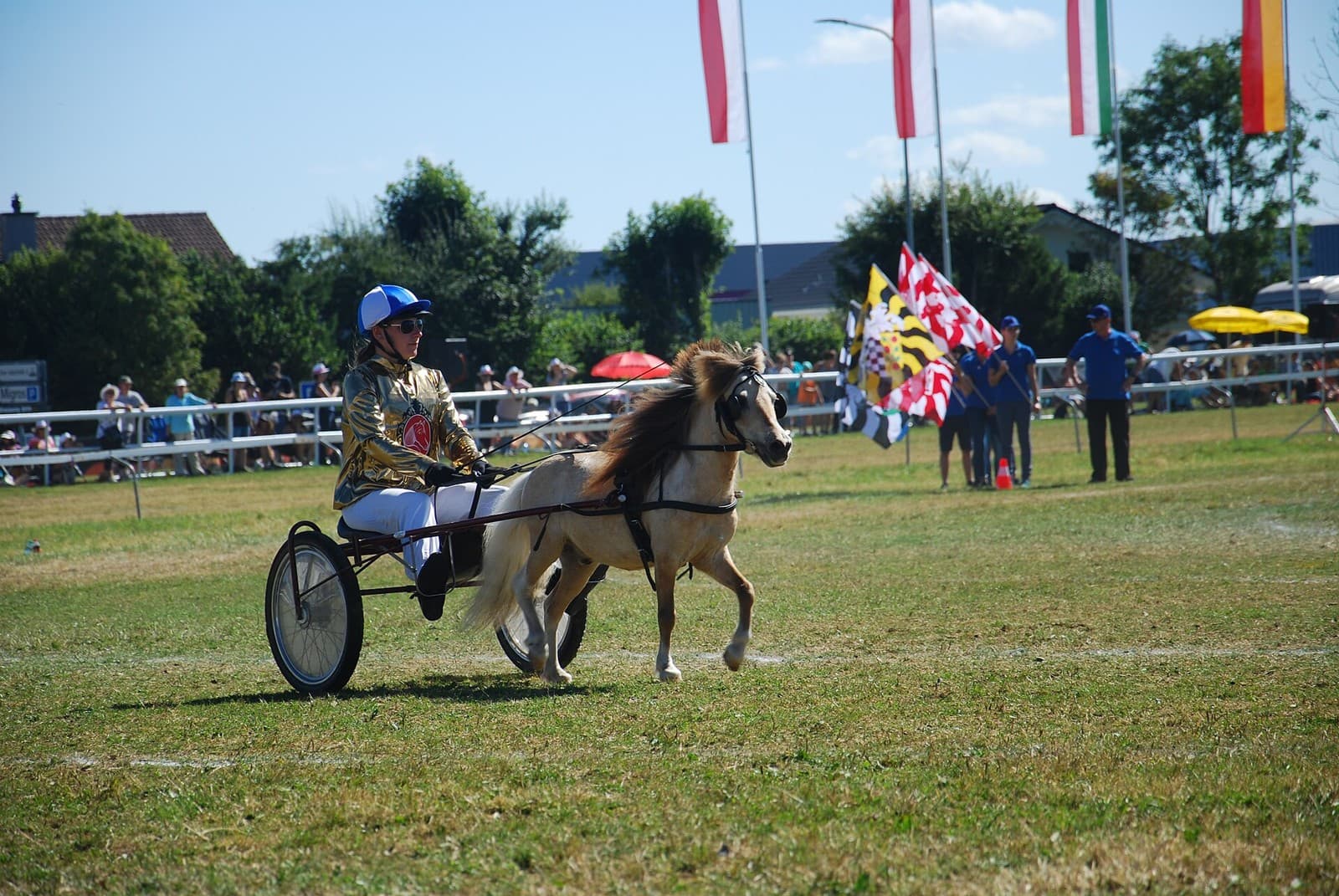
A miniature horse driven at the 2016 Marché-Concours in Switzerland, illustrating an activity; registration in the French CMF studbook is not established.

The French Miniature Horse: From miniature breeding to French recognition
The Association française du cheval miniature (AFCM), founded in 1995, supported breeding that included American origins. The French Miniature Horse was recognised in 2017. The programme aims to develop a documented population whose pedigrees, size and functional qualities can be assessed over successive generations.
Sources for this section: AFCM [1]
The French Miniature Horse: Adult height and balanced proportions
Association française du cheval miniature (AFCM) describes the desired traits of the French Miniature Horse in its breeding programme. This document guides the choice of breeding animals. The adult limit is 89.5 cm at the bony top of the withers from five years of age; younger horses are assessed under age-specific provisions. The head should be proportionate, with a straight or slightly concave profile, broad forehead and elegant neck. A short back, muscular hindquarters and compact feet complete the type. Relative leg length also matters: smaller size should preserve balance and free movement.
Sources for this section: AFCM [1]
The French Miniature Horse: All coat and eye colours are accepted
The French Miniature Horse breeding programme accepts every coat and eye colour. Colour therefore does not distinguish a CMF from every other small equid. Markings also help identify an individual in its description. An unusual coat cannot compensate for structural faults when a prospective breeding animal is assessed.
Sources for this section: AFCM [1]
The French Miniature Horse: Groundwork and driving activities
The French Miniature Horse can take part in in-hand showing, obstacle courses led from the ground, liberty work and driving. In groundwork, a person accompanies or directs the horse without riding it. Some miniatures also participate in professionally supervised animal-assisted activities. Their small size does not automatically make them children’s riding ponies: activities must respect how much weight they can carry or pull.
Sources for this section: AFCM [1]
The French Miniature Horse: the AFCM studbook and approval process
AFCM runs the selection programme and French studbook rules. Eligible ancestry, identification, measurements and inspection distinguish a breed registration from the commercial description “miniature”. Breeding animals must meet the provisions for their age and admission route. An early measurement cannot replace the adult height check.
The calculator’s Miniature Horse choice follows the group in the 2022 coat study. That broad name does not establish that the animals belonged to the French registry. Other organisations, such as the American Miniature Horse Association, maintain their own registries and height and ancestry requirements. This profile describes only the French Miniature Horse. The study group’s numbers must therefore not be presented as population counts or genetic frequencies specific to that French studbook.
Sources for this section: AFCM [1] · American Miniature Horse Association [2] · Avila et al. (2022) [3]
The French Miniature Horse: Mares covered in 2022
The French Miniature Horse breeding programme reports 54 mares covered in 2022, using a SIRE extract dated 13 February 2023. This measures breeding activity during that year. It is neither the number of foals subsequently born nor the total number of miniature horses in France, which may belong to several different studbooks.
Sources for this section: AFCM [1]
The French Miniature Horse: Selection for size must preserve function
French Miniature Horse breeders assess both height and body structure. They examine proportions, teeth, limb alignment and movement. Choosing only the smallest animals would overlook these other traits. Pedigrees help breeders follow characteristics within families. A DNA test answers the particular question it was designed for: the CMF programme does not describe a single test that detects every cause of small stature and every inherited defect.
Sources for this section: AFCM [1]
Sources and review date
Profile reviewed on .
The documents below were used to prepare this profile of the French Miniature Horse. They explain which animals can enter the studbook and how breeding animals are selected.
- Cheval miniature français — Programme de sélection 2024
Studbook document covering selection, registration, breeding assessments and dated figures where available.
- American Miniature Horse Association
Names, registry scope and membership requirements.
- Avila et al. — Genes, 2022
Avila and colleagues (2022): coat variants, sample sizes before and after removing close relatives, and limitations of the laboratory sample.