
Breeds · breed profile
The Castillonnais horse
Cheval de Castillon · cheval du Biros
The Castillonnais is a mountain horse from the valleys around Castillon-en-Couserans in western Ariège. Its conservation relies on a small network of breeders and several practical uses: riding, driving, packing and draught work. The breeding programme aims to rebuild numbers while preserving the families and physical character of this Pyrenean horse.
- Category
- Horse
- Country of origin
- France
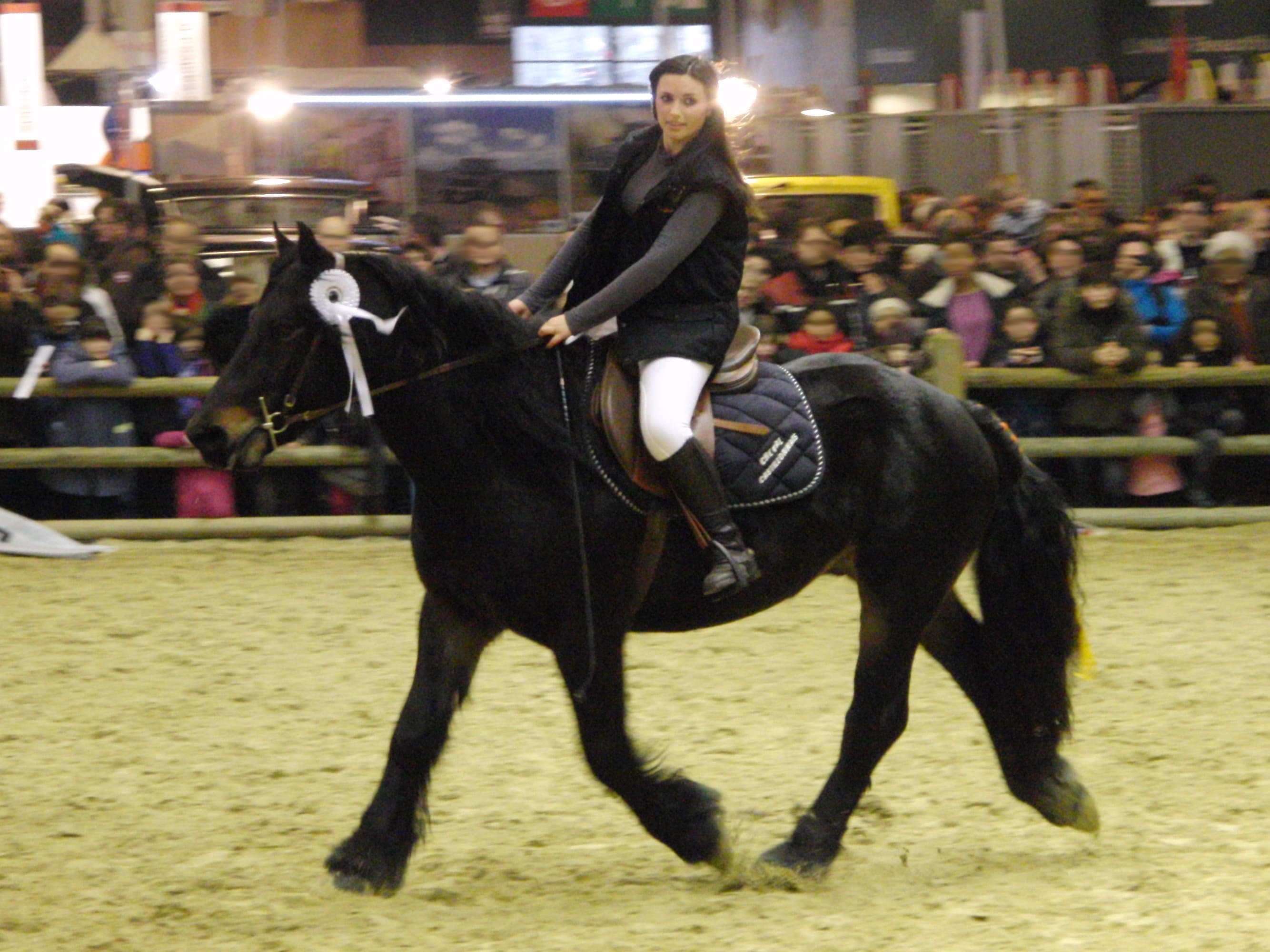
A ridden Castillonnais at the Paris International Agricultural Show in 2013.

The Castillonnais horse: the Castillonnais: conserving a horse from Couserans
The Castillonnais horse: the valleys of Castillon and the Biros
The breed takes its name from Castillon-en-Couserans in Ariège. Cheval du Biros and Saint-Gironnais are other names recalling its valleys and markets. These horses served mountain communities by carrying loads, pulling equipment and travelling along difficult tracks.
The Castillonnais horse: the loss of work threatened the population
Motorisation, the disappearance of traditional uses and crosses with heavier horses reduced the local population. During the 1980s, breeders began finding and preserving animals of the desired type. Rebuilding the breed therefore combined the choice of breeding stock with efforts to secure uses for their offspring.
The Castillonnais horse: an association in 1992 and recognition in 1996
The Association nationale du cheval Castillonnais d’Ariège-Pyrénées, or ANCCAP, was founded in 1992. Official breed recognition followed in 1996. The studbook subsequently provided a way to track ancestry and admissions, including special routes intended to widen the population under controlled conditions.
Sources for this section: ANCCAP · breed [2] · ANCCAP · association [3] · ANCCAP · V5-2026 [1]
The Castillonnais horse: the Castillonnais standard in the 2026 programme
The Castillonnais horse: a compact build for several kinds of work
Association nationale du cheval Castillonnais d’Ariège-Pyrénées (ANCCAP) describes the desired traits of the Castillonnais in its breeding programme. This document guides the choice of breeding animals. The Castillonnais breed standard seeks an expressive head, broad forehead, straight or slightly concave profile and a neck of medium length. The back should be broad and supported, the loin muscular and the croup rounded. Strong limbs, broad feet with hard black horn and ground-covering movement complete the desired build.
The Castillonnais horse: a height range of 1.40–1.55 m
The Castillonnais breeding programme, published by the ANCCAP as version V5-2026, sets a minimum height of 1.40 m and a maximum of 1.55 m. It also gives a desired average adult height of 1.50 m for males and 1.45 m for females. The permitted range and the breeding targets serve different purposes; neither is a statistical survey of the population’s actual heights.
Sources for this section: ANCCAP · V5-2026 [1]
The Castillonnais horse: Understanding the Castillonnais’ dark coat
The Castillonnais horse: a dark body with reddish areas
The French Castillonnais breed standard uses noir pangaré for a dark coat with reddish shading, especially around the flanks and muzzle, the latter often called a fox nose. It also uses the older description bai châtain foncé. These are terms for visible appearance and identification, not genetic test results that can be converted directly into a genotype.
The Castillonnais horse: Bay is accepted according to the entry route
The Castillonnais breeding programme allows uniform bay except for foundation entry, which requires the stipulated pangaré features. White markings are restricted, with different provisions for males and females. Uniform black must not be confused with noir pangaré: the descent-registration article excludes colours other than noir pangaré or bay.
Sources for this section: ANCCAP · V5-2026 [1]
The Castillonnais horse: Riding, driving and packing with the Castillonnais
The Castillonnais horse: Carrying and pulling are different tasks
The Castillonnais breeding programme describes a horse intended for riding, driving and packing. A pack saddle secures and balances a load on the horse’s back, for example when transporting equipment. Draught work uses a harness to move an implement or load. These uses require different equipment and training.
The Castillonnais horse: Working tests assess practical behaviour
Trekking, riding instruction and rural activities are among the intended uses. Stallion approval includes a ridden test and a draught test, with an optional driving presentation. These situations reveal movement, balance and responses to the handler’s requests, complementing the physical assessment.
Sources for this section: ANCCAP · V5-2026 [1]
The Castillonnais horse: Several routes into the Castillonnais studbook
The Castillonnais horse: Recorded parents and verified ancestry
ANCCAP directs the programme, working with IFCE on records and identification documents. Registration by descent requires an approved sire, an eligible coat colour, declarations, identification and compatible parentage verification. Broodmares must be confirmed and stallions approved to breed under the programme’s conditions.
The Castillonnais horse: Foundation entry is a selection procedure
The studbook allows certain previously unregistered animals to apply for foundation entry after assessment by the commission. Conditions differ by sex, age, coat and presentation. Candidate mares, from four years old, must be shown with a conforming foal by an approved Castillonnais stallion. Looking like the breed is therefore insufficient for registration.
The Castillonnais horse: Pedigree and physical type are considered together
For mares and entire males applying for foundation entry, the rules provide for checking possible ancestry against major ancestors of the breed. An in-hand assessment also examines breed type, conformation and limbs. Together these checks document admissions while supporting the rebuilding of the population.
Sources for this section: ANCCAP · V5-2026 [1]
The Castillonnais horse: the Castillonnais population in the 2026 programme
The Castillonnais horse: an Ariège centre with breeders farther afield
Couserans remains the historical home, but the programme covers all of France, including overseas territories. ANCCAP’s map shows horses kept beyond Ariège. Maintaining breeding establishments and moving breeding animals between them supports the breed outside its original region.
The Castillonnais horse: 13 active stallions and 60 members in 2026
Programme V5-2026 reports 13 stallions active at stud and 60 ANCCAP members in 2026. A member may own several horses, while active stallions are only part of the breeding stock. These figures describe activity and the breeder network; they are not a count of every living Castillonnais.
Sources for this section: ANCCAP · V5-2026 [1]
The Castillonnais horse: Family diversity and Castillonnais DNA checks
The Castillonnais horse: Balancing bloodlines when planning matings
ANCCAP’s 2026 mating recommendations consider physical type, inbreeding and the balance of family lines. Inbreeding rises when the parents share ancestors; reviewing several generations helps avoid repeatedly combining the same families. Advice applies to particular breeding animals and that season, rather than simply recommending the most decorated stallion.
The Castillonnais horse: Parentage testing does not assess every quality
A parentage test compares DNA markers from a horse with those of its proposed parents to check compatibility. It supports reliable pedigrees and decisions based on them. It does not measure trekking ability or every health risk; those questions require other observations or targeted tests suited to the trait being examined.
Sources for this section: ANCCAP · 2026 breeding season [4] · ANCCAP · V5-2026 [1]
Sources and review date
Profile reviewed on .
The current programme offered by IFCE when consulted is labelled V5-2026 internally. ANCCAP’s pages document conservation history and explain mating recommendations for the 2026 breeding season.
- ANCCAP — Castillonnais breeding programme, V5-2026
Version offered by IFCE in November 2026: standard, 13 active stallions, 60 members, registration and approval tests.
- ANCCAP — Le cheval Castillonnais
Couserans origins, conservation history and uses; ancient ancestry narratives are not treated as genetic evidence.
- ANCCAP — L’association
Formation in 1992 and official breed recognition in 1996.
- ANCCAP — Stallion-use recommendations, 16 April 2026
Seasonal advice based on conformation, inbreeding and balanced bloodlines; not disease-frequency data.