
Breeds · breed profile
The Camargue horse
Cheval de race Camargue
The Camargue is a small riding horse from the Rhône delta, where breeding remains closely linked to wetlands and cattle work. Its coat turns grey with age. Behind this familiar appearance lies a studbook, selection through working tests and several registration names that describe where and how a horse was bred.
- Category
- Horse
- Country of origin
- France
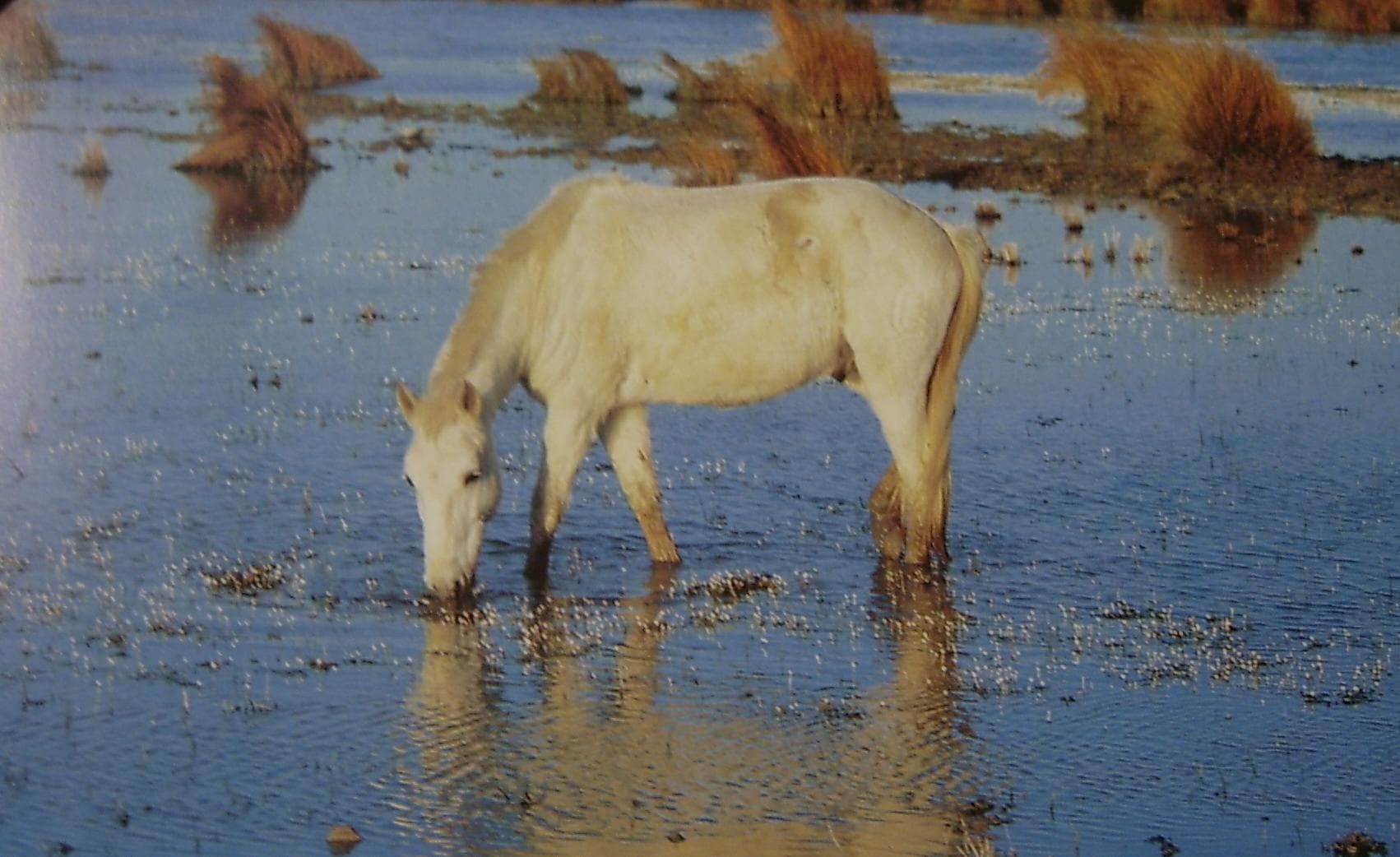
A Camargue horse photographed in a wetland in 2008.

The Camargue horse: the Camargue as a working horse of the Rhône delta
The Camargue horse: Wetlands and cattle shaped its role
Camargue breeding developed around Arles, across the Rhône delta and neighbouring districts. The mounted cattle herders, known as gardians, need horses that can cross wet ground, turn quickly and remain responsive while cattle are sorted. These tasks explain why agility and stamina matter so much in the breed’s selection.
The Camargue horse: Breeders organised conservation in 1964
Mechanisation and the growth of riding tourism in the 1950s and 1960s changed demand for horses. Pale crossbred horses were increasingly used for tourist rides. Breeders founded the Association des éleveurs de chevaux de race Camargue, or AECRC, in 1964 to preserve their working horse and the outdoor breeding system associated with it.
The Camargue horse: Recognition in 1978 established the breed’s framework
Surveys of breeding stock, shows and support from the Camargue regional nature park helped establish a studbook recording horses and their parents. Official recognition followed in 1978. This date marks the organisation of the register, rather than the arrival of horses in the delta.
Sources for this section: AECRC · history [2] · AECRC · programme [1]
The Camargue horse: the Camargue standard favours strength and agility
The Camargue horse: a supported back and substantial limbs
Association des éleveurs de chevaux de race Camargue (AECRC) describes the desired traits of the Camargue in its breeding programme. This document guides the choice of breeding animals. The Camargue breed standard describes a head with a flat forehead, straight profile and short ears, carried on a neck of medium length. A deep chest, muscular shoulder and short, broad loin support the rider. Strong joints and feet with a broad bearing surface complete a compact horse intended for practical work.
The Camargue horse: an adult height of 1.35–1.50 m
The Camargue breed standard specifies 1.35–1.50 m at the withers for an adult measured without shoes. This is a breed criterion, not a measured population average. The desired temperament combines calmness at rest with a quick response when the rider asks for action; working assessments also examine this responsiveness.
Sources for this section: AECRC · programme [1]
The Camargue horse: Why the Camargue’s coat turns grey
The Camargue horse: Foals are born with coloured hair
Camargue foals are born pigmented, then develop increasing numbers of white hairs over the years. A very pale adult may therefore have been a dark foal. The standard requires grey in adulthood, while the registration rules accept grey or presumed grey at birth. Age is essential when interpreting the coat.
The Camargue horse: Grey does not reveal every inherited coat variant
Grey involves the progressive loss of pigment from the hair and is associated with variants of STX17. It can develop over different base colours. A photograph of a pale adult cannot identify every coat variant it may pass on, or establish whether it inherited one or two copies of a grey-causing variant.
Sources for this section: AECRC · programme [1] · UC Davis · grey presence [4]
The Camargue horse: Cattle work and today’s uses of the Camargue
The Camargue horse: Sorting and moving cattle
In traditional work, the rider separates an animal from the herd, directs it or helps move cattle between grazing areas. The horse must follow the animal’s changes of direction while responding to its rider. Cattle-sorting tests draw on this role and assess working ability alongside physical conformation.
The Camargue horse: Trail riding and Camargue equitation
Leisure rides, longer treks and Camargue riding competitions provide further uses today. Outdoor courses ask the horse to negotiate difficulties and remain easy to direct. Outdoor herd management remains central to Camargue breeding: these horses are owned and supervised, rather than forming a population without human management.
Sources for this section: AECRC · uses [3] · AECRC · programme [1]
The Camargue horse: the studbook and the Camargue registration names
The Camargue horse: AECRC oversees selection; IFCE maintains the records
AECRC defines the breeding programme, while IFCE carries out delegated identification, registration and pedigree certification. Registration by descent requires eligible parents, a declared mating, identification and compatible parentage verification, among other conditions. Parentage testing compares the foal’s DNA with that of its declared parents.
The Camargue horse: Manade, hors manade and hors berceau
A recognised manade is a herd raised at liberty within the breed’s home area under the programme’s conditions. Camargue applies to horses born and identified there within a recognised manade; Camargue hors manade covers other qualifying breeders within that area. Camargue hors berceau identifies horses born outside it. All three names concern horses entered in the same studbook.
The Camargue horse: Stallion approval includes working assessments
New stallion candidates are presented from three years of age. Classification covers conformation, gaits, cattle sorting and an outdoor course. Qualifié and Elite are categories awarded under defined criteria. Being born into the breed therefore does not automatically authorise a male to sire registered offspring.
Sources for this section: AECRC · programme [1]
The Camargue horse: Where Camargues are bred and what the figures count
The Camargue horse: a defined home area with breeding beyond it
The Camargue breeding programme places the breed’s home area between Montpellier, Tarascon and Fos-sur-Mer, extending through Salon-de-Provence. Breeding remains particularly concentrated in Gard, Bouches-du-Rhône and Hérault. The hors berceau designation also allows registered Camargues born elsewhere to be identified clearly.
The Camargue horse: 613 births reported in France for 2022
The Camargue breeding programme reports 613 births, 927 mares covered and 202 male breeding animals in France in 2022. These figures describe different parts of breeding activity. Adding them would not produce a count of living horses, and mares covered in one year do not all correspond to foals born in that same year.
Sources for this section: AECRC · programme [1]
The Camargue horse: DNA, grey and the conservation of Camargue families
The Camargue horse: Match the grey test to the question
A grey-presence test looks for the variants responsible for greying. UC Davis’s presence/absence test reports whether a variant is detected, without identifying its type or the number of inherited copies. The laboratory offers a separate copy-number test, although some results remain ambiguous. These tests describe coat genetics; they establish neither breed membership nor parentage.
The Camargue horse: Preserving families as well as visible traits
The Camargue breeding programme includes the conservation of bloodlines and genetic diversity among its objectives. Pedigrees help identify ancestors used very widely and families with fewer descendants. This work concerns the whole breeding population: selecting only for a colour or repeatedly using a few popular stallions cannot preserve that range of ancestry.
Sources for this section: UC Davis · grey presence [4] · UC Davis · copy number [5] · AECRC · programme [1]
Sources and review date
Profile reviewed on .
The AECRC programme is dated April 2024 internally, although IFCE distributes the file in its 2025 folder. The association’s pages add historical and practical context; UC Davis explains the scope of the grey tests.
- AECRC — Camargue horse breeding programme, April 2024
History, standard, French breeding figures for 2022 and studbook rules; version offered by IFCE when consulted.
- AECRC — Origine de l’association
Breeder organisation from 1964 and official breed recognition in 1978.
- AECRC — Mode de vie et utilisation
Outdoor management, gardians, cattle work and Camargue equitation.
- UC Davis VGL — Gray Presence/Absence
Detection of grey variants; this test does not identify their type or number of copies.
- UC Davis VGL — Gray Copy Number
Separate analysis of STX17 variants and interpretation limits; no Camargue-specific frequency inferred.