
Breeds · breed profile
The Breton
Cheval de Trait Breton · draught and postier types
The Breton is a draught horse from Brittany, with a homeland that also includes Loire-Atlantique. Farming, transport and military needs shaped several builds. Today, the more compact draught type and the postier, with its more extended proportions and movement, belong to one breed and one studbook.
- Category
- Horse
- Country of origin
- France
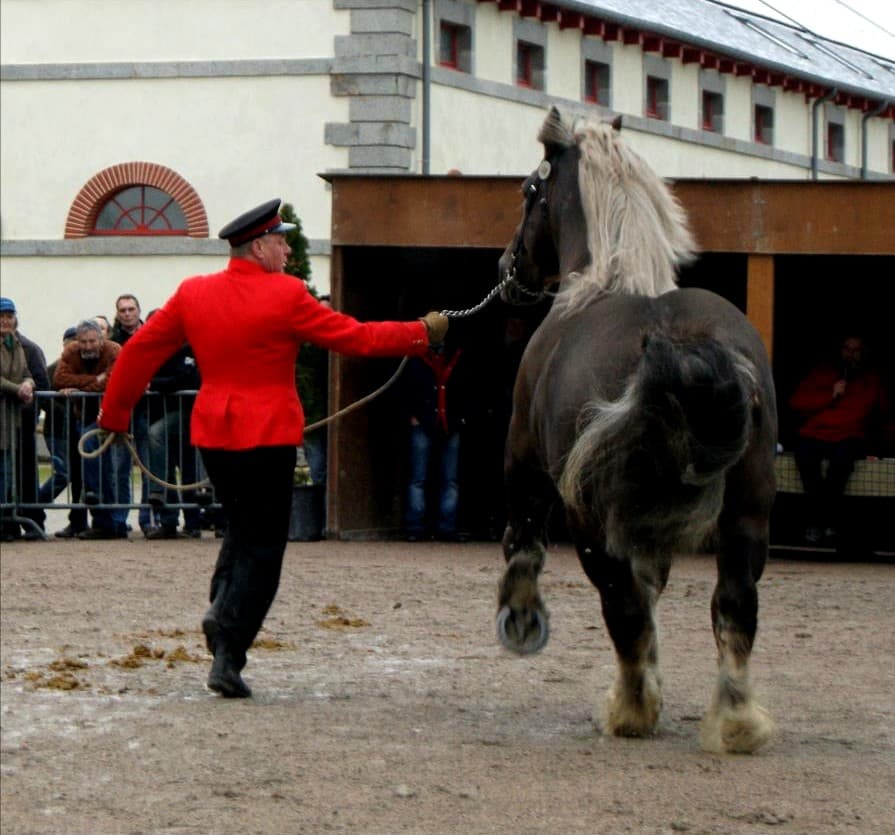
Rigolo de Feins, a Breton stallion presented at the Haras de Lamballe on 9 February 2013.

The Breton: Selection shaped by Brittany’s needs
The Breton: Regional breeding for several markets
Horses bred in Brittany supplied riding animals, artillery teams and horses for farms and transport. The Léon area of northern Finistère played an important part in breeding and trading them. The Breton name consequently covered horses of different sizes and builds, gradually selected according to the work they were expected to do.
The Breton: How Norfolk crosses helped shape the postier
Breeders used several crosses during the eighteenth and nineteenth centuries. The breeding programme highlights imported British Norfolk stallions crossed with mares from the Léon to produce the postier breton. Horse-drawn transport required strength and a sustained trot. That purpose helps explain the postier’s more extended build compared with the compact draught type.
The Breton: From exports to a changing breeding economy
The Association nationale du cheval de trait breton (ANCTB) describes particularly active exports between 1900 and 1940, including horses leaving from Landivisiau. Mechanisation later reduced agricultural demand, and meat production became an important market. The current programme retains both meat production and horses for work or leisure. It dates the breeders’ union to 1920, before its responsibilities were transferred to ANCTB.
Sources for this section: ANCTB, the breed [1] · ANCTB / IFCE, programme [2]
The Breton: Understanding the draught and postier types
The Breton: Two types within one studbook
The Breton includes a powerful, compact draught type and a lighter postier type with a more elongated outline. In the postier, breeders pay particular attention to the trot, which is useful for pulling a carriage. The Association nationale du cheval de trait breton keeps both types in the same studbook while distinguishing them in some show classes. Breeders can mate the two types, so the resulting horses do not always fit two sharply separated outlines.
The Breton: Build and movement are assessed together
For the draught type, the standard describes a deep chest, broad muscular back, ample hindquarters and short cannon bones (the long bones above the fetlocks). The postier has a finer head, long neck and sloping shoulder. Both should have correct limb alignment and active movement. Judges therefore assess the horse standing and moving, rather than judging body mass alone.
The Breton: an indicative average of 1.59 m
The Breton breeding programme gives an average height of 1.59 m at the withers and a range of 1.55–1.65 m. These are reference points for the intended build, rather than a recent census of every Breton or separate limits for the two types. Proportions and locomotion also matter when comparing horses.
Sources for this section: ANCTB, the breed [1] · ANCTB / IFCE, programme [2]
The Breton: Accepted colours and white markings
The Breton: More than chestnut alone
The French Breton breeding programme accepts chestnut, chestnut roan, bay, roan, black, noir pangaré and chocolat. The last two are French registry descriptions for a black coat with lighter areas and a chocolate appearance. These categories do not give colour frequencies or DNA results. Roan descriptions refer to white hairs mixed with a pigmented coat, a different process from progressive greying.
The Breton: Colour and excessive white are assessed separately
The Breton breed standard seeks horses without excessive white markings and excludes piebald or skewbald coats. The programme also provides penalties for particular markings during stallion approval. A facial marking or white sock must therefore be assessed within that specific framework. A single photograph cannot replace the approval panel’s examination and decision.
Sources for this section: ANCTB / IFCE, programme [2]
The Breton: Draught work, driving and farm production
The Breton: Tasks requiring strength and manoeuvrability
Bretons have worked in ploughing, transport and general farm duties. The current programme describes market gardening, vineyards, urban services and logging, in which a horse pulls timber to a collection point. These tasks also require accurate stopping, turning and restarting, with an appropriately trained handler and suitable equipment.
The Breton: Leisure, working trials and horsemeat production
Recreational and competitive driving and trail riding provide other outlets. Working trials assess practical responses to the handler’s aids and the horse’s manoeuvrability. Meat production also remains an explicit breeding-programme objective for French and overseas markets. Including it helps explain some decisions about build and the economic organisation of breeding farms.
Sources for this section: ANCTB, the breed [1] · ANCTB / IFCE, programme [2]
The Breton: Who maintains the studbook and how registration works
The Breton: ANCTB and IFCE have different responsibilities
The Association nationale du cheval de trait breton (ANCTB) defines and runs the breeding programme. It delegates the studbook’s administrative management and certification of breed identity to IFCE. The studbook links horses to their parents and offspring; identification connects those family records to an individual animal through its markings and electronic transponder.
The Breton: Registering a foal by descent
The Breton breeding programme requires, among other conditions, a declared mating to an approved stallion, notification of the birth to IFCE, regulatory identification and an accepted coat colour. It also describes initial entry and importation routes with their own conditions. Looking like the breed standard is therefore not enough, by itself, to create a pedigree registration.
The Breton: Stallion approval and certified parentage
A national panel examines prospective stallions and either approves them or defers admission. IFCE also certifies parentage under the applicable procedures. When a DNA parentage check is performed, the laboratory compares the offspring’s DNA with that of its declared parents. It checks compatibility of the relationship, answering a different question from an inherited-disease test.
Sources for this section: ANCTB / IFCE, programme [2] · ANCTB, association [3]
The Breton: Breeding beyond Brittany
The Breton: From the homeland to other French regions
The Breton breeding programme records breeding throughout France, particularly in Brittany, Pays de la Loire, Auvergne-Rhône-Alpes, Occitanie and Nouvelle-Aquitaine. It also mentions Spain. The homeland identifies the breed’s historical origins; it does not restrict where a Breton may be bred or registered under recognised rules.
The Breton: 2,443 registered births in France in 2022
The programme published in 2025 reports 2,443 registered births and 4,119 mares put to breeding for Breton production in France in 2022. These figures count different animals: the first follows that year’s registered foals, the second the mares covered. Neither is a living population count for 2026 or a worldwide total.
Sources for this section: ANCTB / IFCE, programme [2]
The Breton: Junctional epidermolysis bullosa: research and testing
The Breton: Why the 2003 JEB study examined affected families
Milenkovic and colleagues investigated whether a LAMC2 variant already identified in Belgian draught horses also explained French cases of junctional epidermolysis bullosa. Their study included 47 Bretons, with 10 affected foals, parents and controls, alongside 19 Comtois horses. Recruiting around cases and their families helps identify the disease’s cause, but does not measure its current frequency in the breed.
The Breton: the LAMC2 test detects a variant that weakens skin attachment
Junctional epidermolysis bullosa causes severe fragility of the skin and mucous membranes from birth, with tissue separation and sometimes loss of the hooves. DNA testing detects the causal LAMC2 variant to identify carriers before breeding. This form is recessive: a horse with one copy can remain healthy while passing it on; two copies cause the disease.
The Breton: JEB: the risk when both parents are carriers
If both parents carry one copy of this variant, each foal has a 25% chance of inheriting two copies and being affected. Mating a carrier to a tested non-carrier avoids that combination for this variant while retaining the family in breeding. The result concerns the mutation tested; it does not turn the test into an examination for every skin disease.
Sources for this section: Milenkovic et al., 2003 [4] · UC Davis, JEB1 [5]
Sources and review date
Profile reviewed on .
The Association nationale du cheval de trait breton describes the breed’s origins and two types. The programme published by IFCE in June 2025 sets out French rules and statistics from 2022. The original 2003 study and UC Davis laboratory guidance document the variant responsible for junctional epidermolysis bullosa.
- ANCTB — Le Cheval Breton
History, descriptions of the two types, colours and uses. Ancient-origin narratives and undated figures are not turned into demonstrated pedigrees or current statistics.
- Breton draught horse breeding programme, published by IFCE in June 2025
Standard, organisation, registration and French statistics from 2022. The hosting folder dates publication; the document contains data and examples from earlier years.
- ANCTB — L’Association
Responsibilities and available working-trial documents, including rules from 2026; registration conditions are taken from the breeding programme.
- Milenkovic et al. — A mutation in the LAMC2 gene causes H-JEB in two French draft horse breeds
Original study: 47 Bretons including 10 affected foals, and 19 Comtois including 5 affected foals, with parents and controls. Family recruitment rather than a current prevalence survey.
- UC Davis Veterinary Genetics Laboratory — Junctional Epidermolysis Bullosa (JEB1) in Belgians
LAMC2 testing relevant to Breton and Comtois horses, recessive inheritance and mating choices. The Saddlebred test concerns a different genetic cause.