
Breeds · breed profile
Barb
The Barb, a North African riding and working horse
The Barb is a horse from the Maghreb, associated with travel, work and North African riding traditions. Its standard describes a medium-sized, compact and solid horse. The French studbook distinguishes the Barb from the Arab-Barb, which has a different combination of ancestry.
- Category
- Horse
- Country of origin
- Maghreb
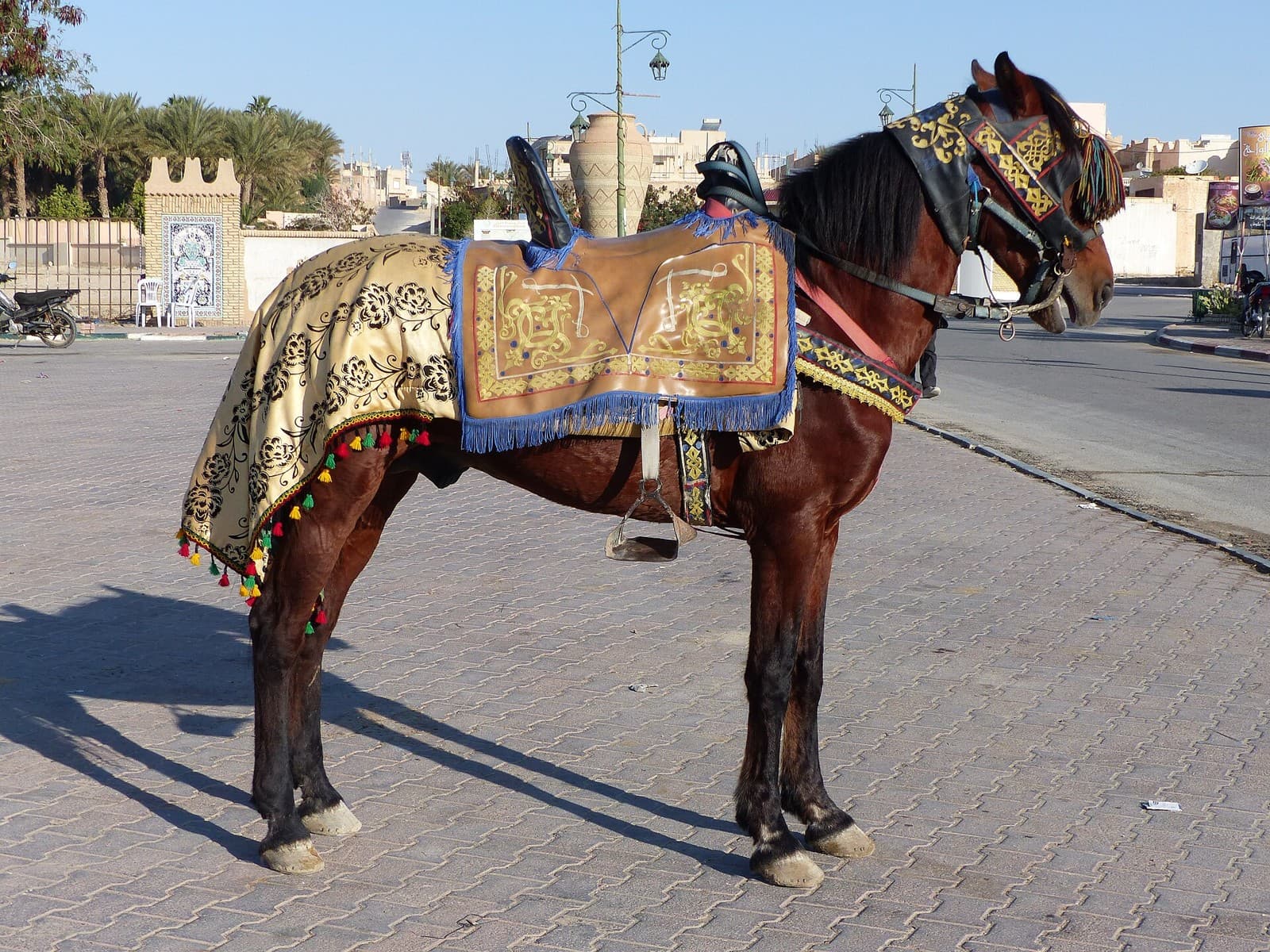
A bay Barb dressed for a fantasia in Tozeur, Tunisia.

The Barb: Maghreb origins and longstanding exchanges
North African horses travelled between the Maghreb and Europe through trade, warfare and population movements. Barbs served as military mounts and travelling horses. Their history cannot be assigned to a single present-day country. Modern breed organisations established pedigree records and selection criteria for this regional population.
Sources for this section: AFCB / OMCB [1] · AFCB [3]
The Barb: a relatively square frame and sloping croup
Association française du cheval barbe (AFCB) describes the desired traits of the Barb in its studbook rules. This document guides the choice of breeding animals. The World Barb Horse Organisation standard gives an average height of 1.55 m. This describes the type rather than functioning on its own as an admission threshold. The head often has a slightly convex profile, with a strong neck, marked withers and deep chest. A supported back, short loin, sloping croup and low-set tail complete the outline. Joints should be clearly defined and feet sound.
Sources for this section: AFCB / OMCB [1]
The Barb: Grey, bay and chestnut in the standard
The Barb studbook rules list grey, bay and chestnut. A grey Barb may have been darker when young because greying develops with age. Colour cannot reliably distinguish a Barb from an Arab-Barb or another breed. Identification and recorded ancestry establish its place in the studbook.
Sources for this section: AFCB / OMCB [1]
The Barb: Trail riding and traditional displays
Barbs are used for outdoor riding, travel over varied ground and traditional events such as fantasia, a coordinated group display by riders. The preparation needed for that activity differs from the education of a leisure trail horse. The individual animal's training and experience need to match its intended work.
Sources for this section: AFCB / OMCB [1] · AFCB [3]
Barb and Arab-Barb sections in France
The Association française du cheval barbe (AFCB) oversees French selection within the World Barb Horse Organisation's framework. Its rules distinguish Barb and Arab-Barb sections. Ancestry and breeding approval determine registration. Reading the precise section named in the papers is useful even when “Barb” is used more broadly in conversation.
Sources for this section: AFCB / OMCB [1]
The French Barb production category in 2024
The 2025 Écus yearbook records 146 mares covered in France in 2024 under its “Barbe” production category. These provisional data, dated 21 October 2025, classify mares by the anticipated breed of their foal. The table does not separate Barb and Arab-Barb sections here, so this is not a count of living purebred Barb mares in France.
Sources for this section: IFCE — Écus 2025 [2]
The Barb: Parentage checks document ancestry
To check a Barb foal’s parentage, the laboratory compares selected DNA markers with those of its declared dam and sire. If the markers are incompatible, the declared parentage needs to be reconsidered. This helps record families correctly in the Barb and Arab-Barb sections. Pedigrees can then be used to identify shared ancestors and plan matings that maintain several families within the population.
Sources for this section: AFCB / OMCB [1]
Sources and review date
Profile reviewed on .
The documents below were used to prepare this profile of the Barb. They explain which animals can enter the studbook and how breeding animals are selected.
- Barbe — Règlement du stud-book, approbation 2021
Studbook document covering selection, registration, breeding assessments and dated figures where available.
- IFCE — Annuaire Écus 2025
IFCE-SIRE statistics: French breeding activity in 2024, provisional at 21 October 2025, p. 11.
- AFCB — Histoire du cheval Barbe
The breed organisation’s account of the population’s history, uses and development of the registry.