
Breeds · breed profile
Auxois
The Auxois, a draught horse from Burgundy
The Auxois is a large Burgundian draught horse selected for traction and long associated with farming. Its historical links with the Ardennes and Trait du Nord are reflected in rules allowing certain approved breeding contributions. It nevertheless has its own studbook and breeding organisation.
- Category
- Horse
- Country of origin
- France
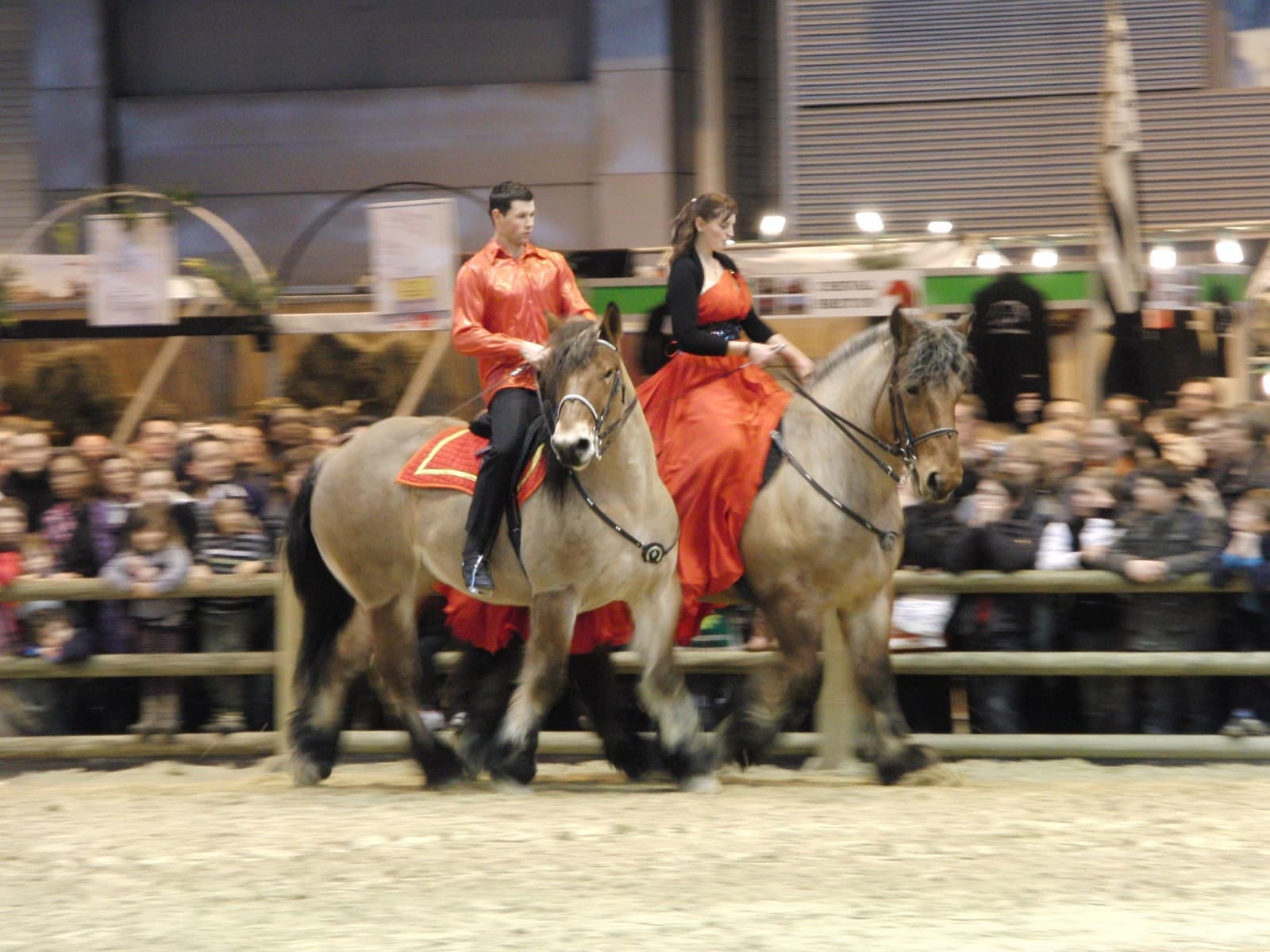
Two ridden Auxois horses during a presentation at the 2011 Paris agricultural show.

The Auxois: a draught horse developed in Burgundy
The Auxois: Agriculture and contributions from related heavy horses
The Auxois originated in Burgundy, where agricultural work favoured a powerful horse. Ardennes and Trait du Nord breeding contributed to the development of the regional type. Organised selection dates from the early twentieth century, with breed recognition in 1913. Mechanisation later reduced traditional demand and made conservation increasingly important to the breeders who retained the horses.
Sources for this section: Union nationale du cheval de trait Auxois [1] · Races de France [2]
The Auxois: Large size and substantial bone
The Auxois: Power must be supported by sound movement
Union nationale du cheval de trait Auxois describes the desired traits of the Auxois in its breeding programme. This document guides the choice of breeding animals. Races de France describes a usual height of 1.63–1.72 m and a weight of approximately 700–1,000 kg. The body is substantial, the neck powerful and the limbs strong. These figures describe the general type rather than replacing an individual assessment. A working draught horse also needs functional limb alignment and regular movement: body mass alone does not establish its ability to pull.
Sources for this section: Union nationale du cheval de trait Auxois [1] · Races de France [2]
Coats seen in the Auxois
The Auxois: Bay and roan in the breed description
Breed presentations particularly mention bay and roan. Roaning mixes white and coloured hairs through the body and should not automatically be equated with progressive greying. For registration or approval, assessment under the studbook’s criteria is what matters. Colour alone cannot reliably distinguish an Auxois from the related draught populations that have contributed to its history.
Sources for this section: Union nationale du cheval de trait Auxois [1] · SFET [3]
The Auxois: Agricultural traction, driving and public services
The Auxois: Developing contemporary work for the breed
Vineyard work, timber extraction and some municipal services provide employment for trained draught horses. Recreational driving and public demonstrations also help make the Auxois visible. These activities require both an educated horse and a skilled handler, using equipment suited to the task. They offer outlets for breeders and can support the continued maintenance of the population.
Sources for this section: Union nationale du cheval de trait Auxois [1] · Races de France [2]
The Auxois studbook rules
The Auxois: Recorded descent and approved outside contributions
The studbook is the register that records the identity and ancestry of animals admitted to the breed. The responsible organisation is Union nationale du cheval de trait Auxois. The rules approved on 29 April 2023 cover registration by descent and initial registration of certain animals conforming to the breed type. Ardennes or Trait du Nord stallions may be approved as contributing sires, without losing the record of their own origin. Stallion candidates can be assessed from age two for breeding at three and must have genetic identification.
Sources for this section: Union nationale du cheval de trait Auxois [1]
The Auxois: Conserving a small breeding population
The Auxois: 99 births reported for 2022
Races de France reports 99 births in 2022. This annual figure indicates the scale of replacement breeding, not the total living population. Conservation requires active breeders and a sufficiently varied choice of breeding animals. Contributions from related draught populations are controlled by the registry so that useful diversity can be introduced while retaining the Auxois type and breeding aims.
Sources for this section: Union nationale du cheval de trait Auxois [1] · Races de France [2]
The Auxois: Monitoring chronic progressive lymphoedema
The Auxois: Clinical assessment within stallion approval
Chronic progressive lymphoedema affects lymph drainage in the limbs and can cause thickened skin, folds and lesions. The Auxois rules state that a stallion assessed at grade 4 will not be approved for the following season. This is a clinical assessment of the horse, not the interpretation of a simple DNA test. Veterinary research describes a complex condition with a suspected inherited component.
Sources for this section: Union nationale du cheval de trait Auxois [1] · UC Davis [4]
Sources and review date
Profile reviewed on .
The documents below were used to prepare this profile of the Auxois. They explain which animals can enter the studbook and how breeding animals are selected.
- Union nationale du cheval de trait Auxois — Studbook rules and breeding programme, 29 April 2023
Rules approved on 29 April 2023: registration, contributing breeds, approval and lymphoedema assessment.
- Races de France — Auxois draught horse
Origins, size, uses and 99 births reported for 2022.
- SFET — Auxois standard and uses
Breed presentation drawing on IFCE and breed-organisation information, including coat descriptions.
- UC Davis — Chronic progressive lymphoedema
Clinical features and complex causation; suspected inherited susceptibility is not equivalent to a simple DNA test.