
Breeds · breed profile
Auvergne horse
The Auvergne horse, a riding and working horse from the Massif Central
The Auvergne is a compact, versatile bay horse descended from the rural horse populations of the Massif Central. Breeders combine conservation of a regional type with the development of horses for trail riding and driving. Membership of the breed depends on its studbook: a bay coat or a home in Auvergne is not enough.
- Category
- Horse
- Country of origin
- France
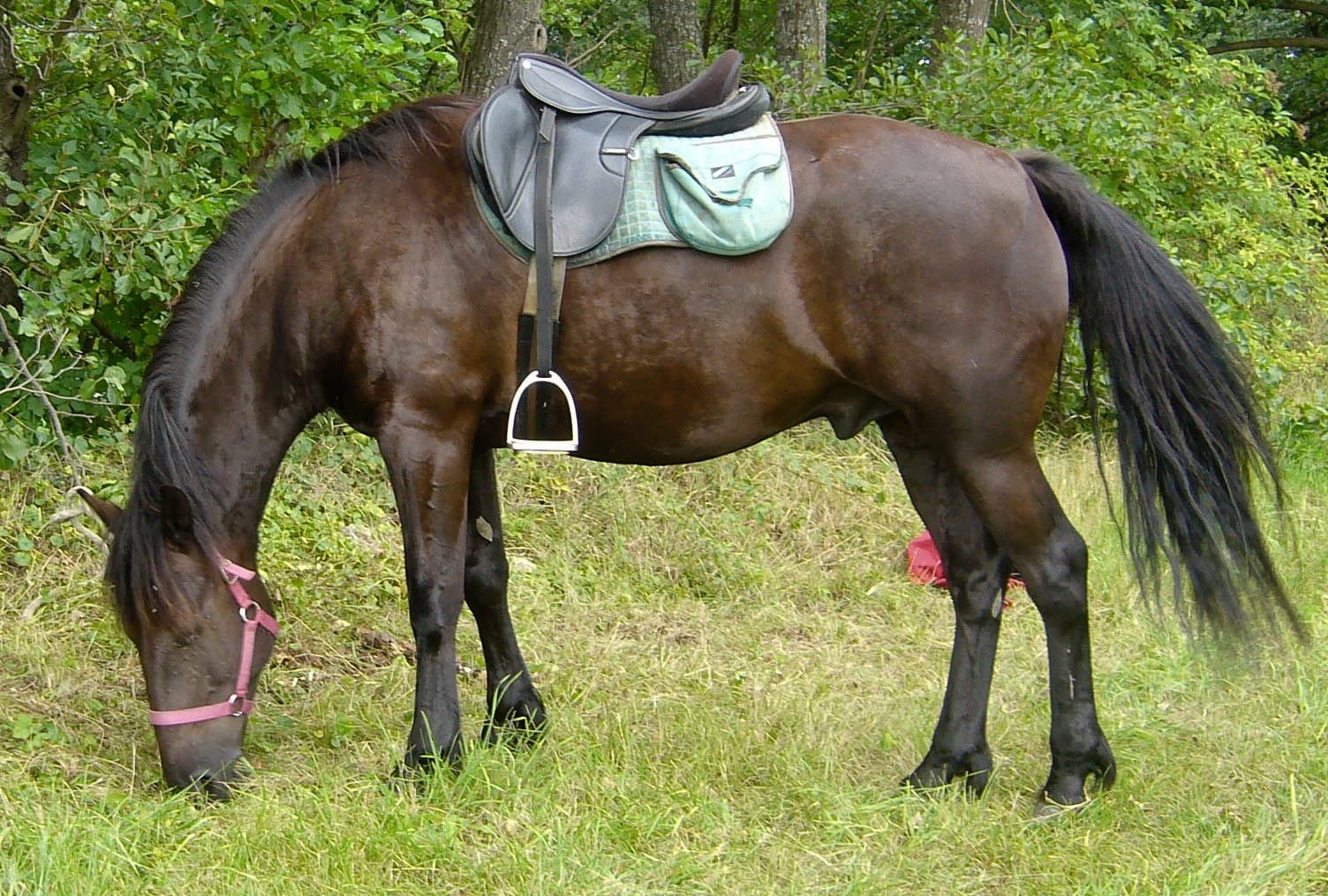
A saddled Auvergne horse grazing.

The Auvergne horse: From farm horse to conservation breed
The Auvergne horse: Preserving a mountain horse population
Local horses once carried people and worked on farms throughout Auvergne. Their history includes both crosses intended for cavalry use and the survival of more compact rural horses. Mechanisation reduced the need for these animals. Breeders formed a conservation association in 1996; the Association nationale du cheval de race Auvergne, known as ANCRA, now coordinates the breed’s development.
The Auvergne horse: Compact build and supple movement
The Auvergne horse: the proportions described by the standard
Association nationale du cheval de race Auvergne (ANCRA) describes the desired traits of the Auvergne horse in its breeding programme. This document guides the choice of breeding animals. The Auvergne horse studbook rules effective from January 2024 describe a height of 1.43–1.57 m and a weight of 450–650 kg. The neck is short and broad, the back and loin short, and the body rounded. Short cannon bones (the long bones above the fetlocks) and fairly round feet complete a sturdy outline. Movement should be energetic, supple and ground-covering, so sound construction is assessed in motion as well as at a standstill.
Sources for this section: ANCRA [1]
The Auvergne horse: the Auvergne’s bay coat
The Auvergne horse: Colour is one part of breed selection
The Auvergne horse breed standard accepts all shades of bay, with black mane, tail and lower legs. White markings are restricted, and the muzzle is described as lighter. An abundant, sometimes slightly wavy mane and tail are also characteristic. These features help describe the selected type, but a bay horse of another origin does not become an Auvergne simply by looking similar.
Sources for this section: ANCRA [1]
The Auvergne horse: Trail riding, driving and leisure use
The Auvergne horse: Putting versatility to work
Outdoor riding and recreational driving are important uses for the breed. Trail riding and TREC, a sport testing skills used on trail rides, draw on balance, responsiveness and sustained effort across varied ground. TREC combines navigation, control of the gaits and obstacles resembling challenges on a trail. These outlets connect conservation breeding with practical activities for the horses produced.
Sources for this section: ANCRA [1]
The Auvergne horse: Entry in the Auvergne studbook
The Auvergne horse: Parentage and assessment both matter
The studbook is the register that records the identity and ancestry of animals admitted to the breed. The responsible organisation is Association nationale du cheval de race Auvergne (ANCRA). Registration at birth requires, among other conditions, an approved sire, a registered dam, a bay coat and DNA parentage compatible with the declared parents. Some horses aged at least two may enter through an initial registration procedure, subject to the rules and a commission assessment. This route supports conservation without treating an outward resemblance as proof of ancestry.
Sources for this section: ANCRA [1]
The Auvergne horse: Breeding remains rooted in its home region
The Auvergne horse: 81 births reported for 2024
The Divagri conservation profile reports 81 Auvergne horse births in 2024. It counts one year’s foals, rather than all living horses of the breed. Auvergne remains central to breeding. Continuing this work requires younger mares to replace older breeding mares, stallions from several families and people willing to use the horses produced. Together, these factors help breeders keep producing foals while retaining varied ancestry.
Sources for this section: ANCRA [1] · Divagri [3]
The Auvergne horse: What the genetic analyses establish
The Auvergne horse: Parentage and coat tests answer different questions
Parentage analysis compares DNA markers to check whether a foal is compatible with its declared parents. The Extension and Agouti tests required for stallion candidates instead examine variants involved in basic coat colours. They are not a general inherited-disease screen. Breeding decisions should consider those results alongside pedigree and the contribution of a family to the population’s diversity.
Sources for this section: ANCRA [1]
Sources and review date
Profile reviewed on .
The documents below were used to prepare this profile of the Auvergne horse. They explain which animals can enter the studbook and how breeding animals are selected.
- ANCRA — Studbook rules and breeding programme, 2024
2024 rules: standard, registration, parentage and coat-colour testing.
- ANCRA — History of the Auvergne horse
Regional population history and the establishment of its conservation association.
- Divagri — Auvergne horse, 2024 figures
Conservation profile reporting 81 births in 2024; this annual figure is not a census of living animals.